
TL;DR
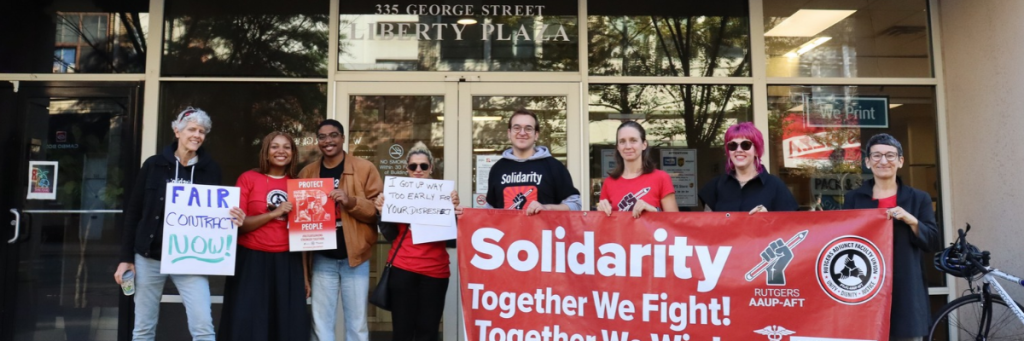
The Unified Bargaining Committee met with management at Liberty Plaza on October 13, greeted by a small welcome committee of members. Management completely struck another proposal today: the Side Letter on Rutgers Immigrant Community Assistance Project (RICAP) while claiming they share our commitment to this essential program. Management also countered on the Side Letter on Accommodations, refusing to include timelines for resolving claims, and continuing their resistance to making university policy enforceable by adding it to our contracts. They also gave us counters on Fringe Benefits (Article 28B), and the Side Letter on Title IX Appeal of Discipline. The unions presented counters on Dues Deduction (Article 5), Union Rights (Article 7), NTT Promotion and Reappointment (Article 11), and Conditions of Employment (Article 22A).
Highlights from the Session
Management Rejects the Side Letter on RICAP
The Side Letter on the Rutgers Immigrant Community Assistance Project (RICAP) is of great importance to our members and international students. RICAP is a Rutgers Law School program that provides incredible immigration and visa support services for members of our community, including undergraduate and graduate students. The goal of this proposal is to enshrine RICAP in our contract so that it remains in place. After all, one of the overarching goals of our contract campaign is to unite for our future. RICAP is an organization that is supported by both sides of the table, and yet management struck the entire article.
Management’s rejection of this side letter indicates their resistance to putting existing university policy and programs into the union contract. They clearly do not want to negotiate around these issues. Management claims that RICAP isn’t going anywhere and that the program is strongly supported by the university administration, but they aren’t interested in showing us that it isn’t going anywhere by enshrining it in the contract. We pointed out that the chancellors and deans who helped create RICAP are no longer here. We need this program institutionalized so that we are not relying on the goodwill of individuals in management, but instead on contract language that can be enforced.
This side letter should have been an easy win, but management has decided that they want to offer us assurances at the table but refuse to put them in the contract. If management wants to progress and help us reach achievable goals that will materially improve international workers’ security, then they should be willing to put RICAP’s ongoing existence in our contract.
The Unified Bargaining Committee will meet and plan a response to this rejection.
Management Counters on Accommodations
Management provided another counter on the Side Letter on Accommodations. The Unified Bargaining Team once again pointed out that the issue with their counter is the lack of timelines, as well as the fact that the university does not feel like they need to align policy with contract language. This issue has now come up across several articles and side letters during the negotiations process. We want an enforceable contract with a clear grievance process, whereas management does not. Although the university has claimed that they couldn’t have timelines for the accommodations process in the contract because that would make it difficult to comply with the ADA, we showed them examples of other collective bargaining agreements that include timelines. This is a key priority for members of our Disability Justice Working Group, and our bargaining committee will continue to push.
There was some discussion about whether to include a clause stipulating that determining how to pay for an accommodation is a management prerogative. We simply want to ensure that stretched department and program budgets are not an acceptable excuse for denying an accommodation; budgets should not factor into whether or not accommodations are covered.
Union Counters on the NTT Grievance Procedure, Union Rights, Dues Deductions, and More
The Unified Bargaining Team shared a counter on the NTT Grievance Procedure. The main goal of this counter was to ensure that the article included a timeline for promotion decisions. Management maintained that they have a difference of opinion regarding how to approach this article.
Additionally, we provided counters on articles pertaining to dues deduction, particularly focused on ensuring there is a good process for transferring membership across unit transition, as well as union rights, especially the rights of union staff to access buildings and maintain accurate lists of bargaining unit member data so that the union can function more efficiently.
Next Steps
The next bargaining session is scheduled for Tuesday, Oct. 20, at 10 a.m., at Liberty Plaza in New Brunswick.