
July 1, 2022 – June 30, 2026
AGREEMENT
This Agreement between Rutgers, The State University (hereinafter called the “University”) and the Rutgers Faculty, represented by the Rutgers Council of AAUP Chapters, American Association of University Professors-American Federation of Teachers (hereinafter called the “AAUP-AFT”) is made and entered into on this 8th day of May, 2023.
Note: Articles denominated by the letter “A” after the article number do not apply to legacy BHSNJ unit members. Articles denominated by the letter “B” after the article number only apply to legacy BHSNJ unit members.
Article 1 – Purpose
(Applies to all Unit Members, including Legacy BHSNJ Unit Members)
The parties recognize and declare that it is their mutual goal to maintain a harmonious relationship in determining conditions of employment. To this end they mutually enter into this agreement intended to state the employment relations between the University and the AAUP-AFT.
Article 1.B2 – Purpose & Definitions
(Applies to Legacy BHSNJ Unit Members Only)
The New Jersey Medical and Health Sciences Education Restructuring Act incorporated certain schools, centers and institutes of the former University of Medicine and Dentistry of New Jersey (UMDNJ) into Rutgers, the State University of New Jersey (hereinafter called the “University”). This Agreement is effective July 1, 2022, by and between the University and the Council of Chapters of the American Association of University Professors Biomedical and Health Sciences of New Jersey (hereinafter “AAUP-BHSNJ”), now the AAUP-AFT. The parties recognize that it is their responsibility to provide a high quality educational program, to encourage the development of new knowledge through research, and to provide service to the larger community and that this Agreement is intended to contribute to the fulfillment of those responsibilities. The parties recognize and declare that it is their mutual goal to maintain a harmonious relationship in determining mandatorily negotiable terms and conditions of employment. To this end they mutually enter into this Agreement intended to state the relationship between the University and the AAUP-AFT under applicable State and Federal law.
- A “Legacy UMDNJ” position is a position, which historically was associated with the University of Medicine and Dentistry of New Jersey before July 1, 2013.
- For purposes of this Agreement, the Legacy UMDNJ positions are found in the following entities:
- New Jersey Medical School
- Robert Wood Johnson Medical School
- Rutgers School of Dental Medicine
- School of Health Professions (excluding Program Directors represented by NJEA)
- School of Nursing (Newark)
- School of Public Health
- University Libraries
- “Legacy BHSNJ Unit Members” or “Legacy AAUP-BHSNJ Unit Members” refers to AAUP-AFT unit members formerly represented by the AAUP-BHSNJ in Legacy UMDNJ positions as described in Article 3, Recognition.
- Librarian unit members refers to AAUP-AFT librarian unit members formerly represented by the AAUP-BHSNJ in Legacy UMDNJ positions as described in Article 3, Recognition.
- Grievant is a member of the AAUP-AFT who has filed a grievance under Article 9, Articles 10.B and/or Article 11.B.
______
2. Articles denominated by the letter “A” after the article number do not apply to legacy BHSNJ unit members. Articles denominated by the letter “B” after the article number only apply to legacy BHSNJ unit members.
Article 2 – Academic Freedom
(Applies to all Unit Members, including Legacy BHSNJ Unit Members)
The AAUP-AFT and the University recognize and incorporate by reference in this Agreement the principles of academic freedom as adopted by the University’s Board of Governors on January 13, 1967 and as set forth in University Policy 60.5.1, last revised July 13, 2015 (as may be revised from time to time). All members of the negotiations unit are entitled to academic freedom, regardless of the media, and are covered by this Article and by University Policy 60.5.1, with the exception that paragraphs C through J do not apply to Legacy BHSNJ unit members, unless those unit members are covered by Article 26.B, footnote 52.
The AAUP-AFT and the University also incorporate by reference in this Agreement the principles and protections of academic freedom articulated by President Jonathan Holloway on the web site of the Office of the President at https://www.rutgers.edu/president/academic-freedom-free-speech and attached as Appendix S to this Agreement.
The parties recognize that PERC previously has ruled in at least one matter involving the University (PERC No.91-81 (1991)) that a negotiations proposal of the Union involving academic freedom was not mandatorily negotiable. Accordingly, before the AAUP-AFT may submit a grievance to binding arbitration alleging a violation of this Article, it must first obtain a final decision on a Petition for Scope of Negotiations Determination that the alleged violation involves a mandatory subject of negotiations.
Article 3 – Recognition
The following paragraphs (par. 1 through 6) do not apply to Legacy BHSNJ Unit Members:
1. The University recognizes AAUP-AFT as the sole and exclusive bargaining representative of all Rutgers University faculty members, teaching assistants and graduate assistants as hereinafter defined. Groups of employees may be added or deleted by mutual consent of the parties.
2. Except as set forth in Paragraph 4 below, the terms “faculty member” and “faculty members” shall include all of the following academic personnel currently employed or to be employed by Rutgers:
- All faculty members with the rank of distinguished professor, professor, associate professor, assistant professor, instructor, lecturer, research associate and adjunct faculty who are engaged in instruction, research, or other academic service;
- Members of the research, library, general extension, and cooperative extension staffs and those others, who, by virtue of University regulations hold equivalent rank (see Appendix A) to the faculty categories enumerated in (a) above;
- Faculty members who are engaged in instruction and/or research for fifty percent or more of their time during the academic year and who hold the title of associate dean, assistant dean, assistant to dean or academic director.
3. The terms “graduate assistant” and “graduate assistants”, and “GA” and “GAs”, and “teaching assistant” and “teaching assistants”, and “TA” and “TAs”, shall include all University personnel holding the titles of graduate assistant and teaching assistant.
4. Excluded are all officers of administration who are deemed to be confidential employees or managerial executives, including but not limited to deans, associate deans, assistant deans, assistants to deans, and academic directors who are not engaged in instruction or research for fifty percent or more of their time during the academic year; visiting professors unless they have served more than three consecutive years; honorary professors; fellows; members of the coadjutant staff who are not required by law to be negotiations unit members; all those persons who administer or help to administer a major academic unit or program of the University; all employees who are included in any other existing University collective negotiations unit3; and all other employees of the University.
Visiting professors who hold an appointment at the effective date of this agreement and who have served more than three consecutive years shall continue to be excluded. By October 30 of each year, the University shall provide the AAUP-AFT a list of visiting professors.
5. Teaching assistants and graduate assistants shall be covered by this Agreement except to the extent specifically provided for herein.
6. PRESERVATION OF WORK
The University and the AAUP-AFT agree that the educational, research and service missions of Rutgers University are generally best served by the appointment of full-time tenured and tenure-track faculty.
By annual notice to chancellors, deans and center directors, the University shall encourage the appointment of full-time tenured and tenure-track faculty, while recognizing there are legitimate reasons for also employing a variety of non-tenure-track and other faculty. The University shall annually provide a copy of this notice to the AAUP-AFT.
The University and the AAUP-AFT agree to work cooperatively to secure funding to increase both the number and the overall percentage of tenured and tenure-track appointments.
This section 6 shall not be grievable.
The following paragraphs (par. 7 through 8) apply to Legacy BHSNJ Unit Members only:
7. Faculty members and staff librarians in Legacy UMDNJ positions: The University recognizes the AAUP-AFT as the exclusive negotiating agent for all teaching and/or research faculty and staff librarians by the University in legacy UMDNJ positions, but specifically excluding all faculty members and staff librarians who, in addition to their professorial or librarian titles, hold any title which carries managerial, administrative, or supervisory responsibility (among titles so excluded are President, Vice President, Chancellor, Senior Vice Chancellor, Vice Chancellor, Provost, Dean, Vice Dean, Associate Dean, Associate Vice President, Assistant Dean, Assistant to the Dean, Director, Department Chairperson, Section Chief, Division Chief, Division Director, University Librarian, Assistant University Librarian, Campus Library Director, Personnel Administration Librarian, Supervising Librarian), all faculty members or staff librarians who work on average of fewer than four hours per week over a period of 90 days, persons otherwise employed by the University who are presently represented for purposes of collective negotiations by another employee organization and all other employees not employed as faculty or staff librarians, for the purpose of negotiations regarding the terms and conditions of employment and in the settlement of grievances.
8. Process for Removal of Legacy BHSNJ Unit Members from the Negotiations Unit:
The following procedure shall be followed in the event the University seeks to remove Legacy BHSNJ Unit Members from the negotiations unit:
- If the University determines that an employee in a position currently represented by the Union is performing confidential, supervisory, managerial executive, or other duties justifying exclusion from a negotiations unit as defined by Section 3 of the New Jersey Employer-Employee Relations Act (EERA), at least thirty(30) days in advance of the employee’s removal, the University will notify the Union and provide the Union with the basis upon which it maintains that the employee should be excluded from the negotiations unit, including a description of the duties that the employee will be assigned that justify their removal from the unit, including the employee’s job description and a table of organization, if available.
- If the Union objects to the designation of an employee as appropriate for exclusion from the negotiations unit prior to the removal of the employee from the negotiations unit, the University and the Union will meet to review the basis for the exclusion. If after such review the Union continues to object, the employee may be removed from the unit. The Union may pursue its objection in an appropriate forum.
_____
3. This reference is with the exception of AAUP-AFT negotiations unit members who also are included in the Winter and Summer Instructors Unit.
Article 4 – Prohibited Discrimination and Prohibited Harassment
(Applies to all Unit Members, including Legacy BHSNJ Unit Members)
All negotiations unit members are protected by and subject to University policies prohibiting discrimination, harassment, retaliation, workplace violence, sexual violence, relationship violence, stalking and related misconduct (as amended from time to time).
A negotiations unit member alleging a violation of the above-referenced policies is encouraged to contact the Office of Employment Equity (“OEE”).
- There shall be no discrimination or harassment by the University or the AAUP-AFT against any member of the negotiations unit because of race, creed, color, sex, religion, national origin, ancestry, marital status, civil union status, domestic partnership status, familial status, age, autism spectrum disorder, disability or atypical hereditary cellular or blood trait, genetic information, refusal to submit to a genetic test or make available the results of a genetic test, veteran status, affectional or sexual orientation, gender identity or expression, membership or non-membership in or activity on behalf of or in opposition to the AAUP-AFT, or any other legally protected status.
Article 5 – Deduction of Professional Dues
(Applies to all Unit Members, including Legacy BHSNJ Unit Members, except as provided herein)
- DUES DEDUCTION
- The University agrees to deduct on a pro-rata basis from each biweekly paycheck the annual AAUP-AFT professional dues of each member of the negotiations unit as defined herein, for whom the AAUP-AFT furnishes to the University a voluntary written authorization for such deduction, on a form acceptable to the University. Once the AAUP-AFT furnishes to the University such voluntary written authorization for such deductions from any negotiations unit member, that negotiations unit member shall retain that status each semester, academic year, or calendar year that they are employed as a member of the negotiations unit, unless that member submits a written withdrawal of their authorization.
- Withdrawals of unit member authorizations for the deduction of dues shall be effective the July 1 following receipt of a request by University payroll to withdraw authorization for the deduction of dues, except for unit members who authorized dues deduction prior to May 22, 2018 (the effective date of the Workplace Democracy Enhancement Act), the withdrawal of dues deduction shall be effective the January 1 or July 1 following receipt of the request by University payroll, whichever date is sooner.
- The University shall reinstate the dues deduction of any negotiations unit member who has temporarily left the negotiations unit (but retained a title in the negotiations unit) because of a University assignment to a position not covered by the recognition clause of this agreement and who has previously given voluntary written authorization. The original authorization forms, or copies of them, will be supplied by the AAUP-AFT to the University for verification, if requested. The resumption of dues deduction shall be made as soon as practical after receipt by the University of written notice from the AAUP-AFT that a negotiations unit member has returned to a position covered by the recognition clause of this agreement. Negotiations unit members must submit written withdrawals of their authorization to the AAUP-AFT. It is the AAUP-AFT’s responsibility to transmit such withdrawals of authorization to the University. The University will continue to deduct dues until it receives the withdrawal of authorization.
- The amount of AAUP-AFT professional dues shall be such amount as may be certified to the University by the AAUP-AFT at least 30 days prior to the date on which deduction of AAUP-AFT professional dues is to be made. The University shall remit to the AAUP-AFT all professional dues deducted pursuant hereto every two weeks in which such deductions are made, together with a list of names of members of the negotiations unit from whose pay such deductions have been made.
POLITICAL CHECK-OFF
To the extent permitted by law and as described more particularly in Appendix C and Appendix D to this Agreement, as soon as practical after the effective date of this Agreement, the University shall upon presentation of a proper and duly signed authorization form, deduct from the salary of each employee in the collective negotiations unit the sum authorized by the employee, not to exceed the limits prescribed by law, for the purpose of contributing to the AFT Committee on Political Education (COPE). This provision applies to present and future members and non-member employees in the collective negotiations unit.
The deductions referred to above shall be forwarded to AAUP-AFT in accordance with the provisions of applicable law and as described more particularly in Appendix C and Appendix D to this Agreement.
- In the event a claim is filed by a member or former member of the negotiations unit for a return of dues deducted from the member’s paycheck pursuant to this Article, the AAUP-AFT shall be solely responsible for the return of such dues, provided the University transmitted the dues to the AAUP-AFT and provided the AAUP-AFT or a court determines that the AAUP-AFT or the University is obligated to return the dues.
Article 6 – Diversity, Equity and Inclusion
(Applies to all Unit Members, including Legacy BHSNJ Unit Members)
The AAUP-AFT and the University recognize the value of diversity, equity and inclusion (“DEI”) among all negotiations unit members. They mutually agree, therefore, to the following during the term of this Agreement:
- The University will provide data to the AAUP-AFT, which includes the available race and gender of all negotiations unit members and rank and type of appointment.
- The University Committee on Diversity, Equity and Inclusion4 (UCD) shall address DEI issues pertaining to all negotiations unit members. The UCD will be co-chaired by the Executive Vice President for Academic Affairs (EVPAA) or designee, and shall be comprised of six members of the negotiations unit selected by the AAUP-AFT, and up to six members, including the EVPAA or designee, who may or may not be members of the negotiations unit, selected by the EVPAA, with representation from the three geographic areas of the University (New Brunswick, Newark, Camden) and from Rutgers Biomedical and Health Sciences (RBHS). The AAUP-AFT shall select a member of the Committee to serve as co-chair. The ten members of the UCD other than the co-chairs of the UCD shall make recommendations to the co-chairs by simple majority vote regarding decisions on how to carry out its charge pursuant to paragraphs 3 through 7 below and decisions with respect to expenditures on diversity initiatives pursuant to paragraph 10 below. Those recommendations receiving a majority vote shall be made to the co-chairs, who must jointly authorize the implementation of such decisions and/or the expenditure of such funds. Any action by the UCD must be in compliance with University policy and applicable law. Up to two attorneys from the Office of Senior Vice President and General Counsel shall serve in an advisory and non-voting role to the UCD. The UCD shall meet at least three times per year.
- Consistent with the University’s prior efforts regarding comprehensive strategic planning in DEI, the University is actively committed to the strategic planning and implementation for continuous improvement in DEI of its academic communities. The charge to the UCD shall be to review progress in the relevant DEI programs at the University, illuminate best practices and effective outcomes, as well as identify gaps pertaining to diversity, equity and inclusion which meet the needs of all negotiations unit members including diversity training, recruitment, retention, mentoring and professional development.
- Annual Diversity Conference: The UCD shall decide whether to plan an annual joint AAUP-AFT/University conference on DEI issues confronting faculty, including, but not limited to, historically underrepresented faculty, and graduate students in public research institutions across the United States.
- Annual Report: The UCD will produce an annual report of its activities along with plans and goals for the following year.
- The UCD, may propose recommendations to the University for determining why faculty, including, but not limited to, historically underrepresented faculty, leave the University, with the goal of understanding the factors related to faculty retention. The UCD may also form a retention sub-committee comprised of UCD members that will provide recommendations to the University to support the development of an inclusive University culture and faculty retention.
- The UCD may make recommendations to the EVPAA for the creation of new award programs, including exceptional service awards to recognize faculty who have a demonstrated commitment to working on DEI issues faced by the University’s student population. UCD’s recommendations to the EVPAA may include eligibility requirements and the frequency of awards.
- The University shall support mentorship programs for negotiations unit members recommended by the UCD in collaboration with chancellor led units.
- A University designee(s) shall meet with the UCD twice each fiscal year of the Agreement to discuss the hiring and retention of a diverse faculty in support of the President’s diversity initiatives pertaining to faculty, teaching assistants and graduate assistants. The University shall provide to the UCD a report on or about January 1 and July 1 of each year regarding the expenditure of funds from the President’s Faculty Diversity Hiring Initiative established by the University for the recruitment and retention of a diverse faculty. The report shall identify in the aggregate and non-personally identifiable format the faculty hired and retained with the assistance or support of the President’s Faculty Diversity Hiring Initiative as it relates to new programs developed during the course of this contract pertaining to faculty, teaching assistants and graduate assistants. This information will be available to the union as part of the yearly UCD information. Specific information, including the names, departments and schools of those hired as part of the presidential faculty diversity hiring initiative shall be provided to the co-chairs of the UCD in accordance with current practice.
- The University shall make available up to a maximum of $125,000 for each academic year of this Agreement (“Annual UCD Fund Amount”) to be utilized during the term of this Agreement, to support the diversity, equity and inclusion initiatives set forth in Paragraphs 3 through 9 above. If any funds remain from the $125,000 allocated for any given academic year of this Agreement, those remaining funds shall be applied to the remaining academic years of this Agreement, but no funds shall rollover at the expiration of the term of this Agreement. This Annual Fund Amount shall be in addition to the allocations for initiatives recommended by the UCD during the term of the preceding collective negotiations agreement between the University and the AAUP-AFT which the University committed to implementing (“Prior UCD Contract Amount”), but which have not yet been expended, up to an amount no greater than that provided for in the Prior UCD Contract Amount. This Prior UCD Contract Amount of $500,000 is a one-time rollover amount which shall be in addition to the Annual UCD Fund Amount of $125,000 and neither amount, including any funds that remain from either amount, shall rollover at the expiration of the term of this Agreement unless otherwise agreed to in writing by the parties.
- All faculty, including, but not limited to, historically underrepresented faculty, are strongly encouraged to consult with their chairs, deans/directors, and other senior members of the faculty as they prepare to seek reappointment and/or promotion.
- Violations of processes and mandatorily negotiable requirements of Article 6 shall be subject to the Article 9 Grievance/Arbitration Procedure.
_____
4. This committee was formerly referred to as the University Committee on Diversity, Race, and Gender in the parties’ collective negotiations agreement for the term July 1, 2018 to June 30, 2022.
Article 7 – Designation of AAUP-AFT Representatives and Their Privileges
(Applies to all Unit Members, including Legacy BHSNJ Unit Members, except as provided herein)
- Designation of AAUP-AFT Representatives
- The University and the AAUP-AFT agree to recognize the designated representatives of each for the purposes of collective negotiations, such designation to be made in writing by each party to the other. This designation shall not preclude others, in reasonable numbers, from attending collective negotiations at the invitation of either party for the purpose of providing factual knowledge or expertise with respect to a particular subject for collective negotiations.
- The AAUP-AFT shall each year in writing inform the designated University office of the identity and terms of office of the AAUP-AFT officers and the nature of their responsibilities. In addition, the designated University office shall in writing inform appropriate deans and other academic officers serving as superiors to the duly elected officers of the AAUP-AFT of the identity of these officers and the nature of their responsibilities.
- Union Release Time for Faculty without FTE Profile Distributions
- The University agrees that faculty members designated by the AAUP-AFT may be released from a portion of their instructional or, if not instructional, other, responsibilities to attend to official AAUP-AFT business.
-
- The AAUP-AFT shall be entitled to utilize thirty-six (36) credits of release time per year. Twelve of the thirty-six (36) credits shall be paid. The AAUP-AFT will reimburse the University for the remaining twenty-four (24) credits at the rate of $2,000 per credit hour of instruction. In lieu of a course, the AAUP-AFT may designate a non-instructional faculty member for a comparable amount of release time. For non-instructional faculty, the percentage of release time will be based on the normal assignment for all duties, and the percentage of salary reimbursed by the AAUP-AFT to the University will be equal to the percentage of release time, up to a maximum amount of $24,000 per semester. Reimbursement by the AAUP-AFT will be submitted by the AAUP-AFT to the representative’s department/unit.
- In addition to the release time described above, the President and Vice President of the AAUP-AFT and the chair of the AAUP-AFT Negotiations Committee shall receive up to a total of six (6) credits of paid release time per semester, commencing at the start of the final year of the agreement, to prepare for, and participate in, negotiations for a successor collective negotiations agreement and in each semester during which those negotiations are occurring.
- The AAUP-AFT shall in writing notify the Office of University Labor Relations of those individuals whom the AAUP-AFT wishes to designate for such release time as provided above. Such notice for instructional faculty shall indicate the specific instructional duties from which the faculty member requests release; such notice for non-instructional faculty shall specify the percentage of the faculty member’s professional time and the specific duties from which release is sought. Notice shall be provided on a semi-annual basis (no later than June 1 for Fall semester; and no later than November 1 for Spring semester) in order to permit the University to determine whether the release is consonant with the needs of the academic program.
- Requests for release may not be unreasonably denied, and a written statement of the reasons for denial shall be given to the AAUP-AFT upon request within ten (10) working days of that request. Unused release time from any year of this Agreement may be used in a consecutive year of this Agreement provided no more than twelve (12) credits of union release time provided for in section B.2.a above, are used at any single school or academic unit in the subsequent year in which the unused credits are used.
- Union Release Time for Faculty Who Use FTE Profile Distributions
- Consistent with paragraphs 2 through 5 below, the University agrees that RBHS faculty members designated by the AAUP-AFT may be released from a portion of their responsibilities to attend to official AAUP-AFT business.
- The AAUP-AFT shall, in writing, notify the Office of University Labor Relations of those individuals whom the AAUP-AFT wishes to designate for such release time as provided below. Such notice shall indicate the specific duties from which the faculty member requests release. Notice shall be provided no later than February 1st for the next fiscal year in order to permit the University to determine whether the release is consonant with the needs of the program.
-
Effective July 1, 2022, a President, Vice-President, or other union representatives designated by the AAUP-AFT, collectively shall be granted a total of 1.2 FTE annually for the performance of official union representational duties, including but not limited to collective negotiations for the AAUP-AFT.
Quarterly, the AAUP-AFT shall reimburse the University for the use of such release time at the rate of $10,000 per .1 FTE, except that 0.3 FTE of the 1.2 FTE shall be paid and shall not be subject to reimbursement by the AAUP-AFT.
- In addition, the AAUP-AFT shall be granted 0.2 paid FTE annually to be used for collective negotiations, including but not limited to preparing negotiations proposals and attending negotiations sessions.
- The FTE amounts specified in paragraph 3 and 4 above, shall be designated as administrative time with resulting changes in each faculty member’s effort allocation being determined by his/her Chair in consultation with the faculty member. The Chair will exercise his/her discretion in a reasonable manner and shall be subject to the review of effort procedures set forth in Article 8.B, II.B.4. The faculty member’s overall FTE shall be proportionately adjusted.
- Requests for release time shall be made at least five (5) working days prior to the date on which the release is needed. Such requests may not be unreasonably denied, and a written statement of the reasons for denial shall be given to the AAUP-AFT upon request within ten (10) working days of that request. Unused release timefrom any year of this Agreement may be used in a consecutive year of this Agreement provided no more than a total of 0.5 FTE of union release time provided for in C.3 above is used at any single school or academic unit in the subsequent year in which the unused time is applied.
- Access to University Facilities
- Representatives of the AAUP-AFT shall be permitted access to University property to transact official business at all reasonable times, provided that this shall not interfere with or interrupt normal University operations. Where unit members work in locked/secure buildings, access to unit members in such buildings shall be facilitated by the EVP and Chief Operating Officer (EVP/COO) of the University or designee who will develop a protocol for permissible access to such unit members. The Union will submit to the Office of University Labor Relations (OULR) the names of union representatives who are seeking access to unit members in locked/secure buildings.
- Access includes, but is not limited to the following: (1) the right to meet with negotiations unit employees on the premises of the University during the work day to investigate and discuss grievances, workplace-related complaints, and other workplace issues; (2) the right to meet with newly hired negotiations unit employees, for thirty (30) minutes, at a University Human Resources, Human Resources-Newark, or Human Resources-Camden new employee orientation (whether in-person or remote), within thirty (30) calendar days from the date of hire of such negotiations unit employees; (3) the right to meet with newly hired TAs and GAs for thirty (30) minutes at one Teaching Assistant Orientation session as determined by the School of Graduate Studies and which session is conducted at the start of the academic year on the respective campuses; (4) the right to meet with newly hired negotiations unit employees for thirty (30) minutes at orientation sessions conducted by any RBHS school or unit where negotiations unit employees are employed provided the Dean of the school (in his/her sole discretion) has approved attendance at such orientation sessions, but such approval shall not be unreasonably denied (the reasonableness of the Dean’s decision may be challenged only as a Category Two grievance under the parties’ collectively negotiated grievance procedure); or (5) the right to meet with newly hired employees within thirty (30) calendar days from date of hire at individual or group meetings if the employee does not attend an orientation. In addition, the AAUP-AFT shall have the right to meet with newly hired faculty members for thirty minutes during a new employee academic orientation on the respective campuses. In addition, the AAUP-AFT shall be permitted staff tables with literature and information about the AAUP-AFT at orientations or meetings during which the AAUP-AFT is meeting with negotiations unit members pursuant to section D.2 of this Article.
- The AAUP-AFT and its representatives shall have the right to use University buildings at all reasonable hours for meetings provided they follow regular University procedures. The AAUP-AFT may be charged for maintenance, security and other costs that would not otherwise be incurred by the University related to the use of the University’s facilities. The particular facility/room for such meeting(s) shall be determined by the University.
- The AAUP-AFT shall have the right to make reasonable use of the University facilities and equipment, including duplicating, computing and office equipment, and available audiovisual equipment, all in accordance with University procedures. The AAUP-AFT shall pay reasonable costs for the use of equipment.
- The AAUP-AFT shall have the right to post bulletins and notices to the employees it represents, relevant to official AAUP-AFT business, without seeking permission or approval.
- Upon request, the University shall provide designated staff representatives of the AAUP-AFT Rutgers guest Net ID to conduct union business.
- Consistent with current practice, the AAUP-AFT shall have the right to use the University’s email system to communicate with its negotiations unit members regarding collective negotiations, the administration of collective negotiations agreements, the investigation of grievances, other workplace-related complaints and issues, and internal union matters involving the governance or business of the union. The AAUP-AFT will comply with all University policies and guidelines when using the University’s email system.
Information on New Negotiations Unit MembersWithin ten (10) calendar days from the date of hire of negotiations unit employees, the University shall provide the following contact information to the AAUP-AFT in an Excel file format or other format agreed to by the AAUP-AFT and the University: (1) name, (2) job title, (3) worksite location, (4) home address, (5) work telephone numbers5, and any home and personal cellular telephone numbers on file with the University, (6) date of hire, and (7) work email address and any personal email address on file with the University.
University Website and Distribution of Agreement
As soon as practical after the effective date of this Agreement, the University shall prominently feature this Agreement on the University’s website and shall list on the website the name, address, and telephone number and website of the Rutgers Council of AAUP Chapters, AAUP-AFT.
Information about how to access this Agreement electronically shall be made available to all members of the negotiations unit as soon as practical after ratification through a joint communication from the University and the AAUP-AFT President. Such communication shall be sent via email to all members of the negotiations unit.
The University will have no obligation to provide materials at orientations.
Offer/Appointment letters shall contain a link to the Office of University Labor Relations’ website where the collective negotiations agreement may be accessed.
- Campus Mail
- To the extent permitted by law, upon the effective date of this Agreement, the University will carry without charge by University campus mail up to three times per semester the AAUP-AFT newsletter to its negotiations unit members. The AAUP-AFT will not send, and the University will not carry, by campus mail any other matter except upon payment of appropriate United States Postal charges.
-
The AAUP-AFT shall indemnify and save harmless the University against any and all claims, demands, suits, judgments, settlements, or any other forms of liability, including reasonable counsel fees and other costs of defense, that shall arise out of or by reason of any action taken by the University to comply with Section G.1. above, including liability for United States Postal charges for carriage of AAUP-AFT mail at any time and also including but not limited to, any actions in connection with defending the legality of this indemnification provision. The AAUP-AFT shall remit payment for said fees and costs to the University within 30 days after receipt of a detailed statement of services rendered in connection with said defense. If full payment is not remitted within 30 days, the University’s obligation pursuant to Section G.1. shall be suspended for so long as this statement of services remains unpaid.
In the event this indemnification provision is found by any court or administrative agency of competent jurisdiction to be illegal or against public policy, then effective the date on which the AAUP-AFT no longer remits payments to the University as provided in Section G 2.a. above, the University’s obligation under Section G.1. above shall terminate.
The University shall retain its right to determine the course of conduct, including but not limited to, the right to select counsel and determine strategy, in any action arising out of or by reason of the provisions of Section G.
_____
5. Includes Rutgers issued cell phone numbers for RBHS faculty at the time the information in section E is provided to the AAUP-AFT.
Article 8.A – Salary Provisions, Faculty Compensation Program (Hereinafter “FCP”) and Health Insurance Benefits
(Does Not Apply to Legacy BHSNJ Unit Members)
Subject to the appropriation of and allocation to the University by the State of adequate funding for the specific purposes identified for the full period covered by this Agreement, the following economic provisions shall apply:
PART ONE: FACULTY SALARY PROVISIONS
I. Fiscal Year 2022–2023
All persons who are members of the faculty on June 30, 2022 and who continue to be employed as faculty members through the date of payment, shall receive an across the board salary increase retroactive to July 1, 2022 in the amount of $5,035.6
II. Fiscal Year 2023–2024
All persons who are members of the faculty on June 30, 2023 and who continue to be employed as faculty members on July 1, 2023, shall receive an across the board salary increase effective July 1, 2023 in the amount of 3.5%. Such increase shall be based on the unit member’s salary as of June 30, 2023.
III. Fiscal Year 2024–2025
All persons who are members of the faculty on June 30, 2024 and whose employment as faculty members continues beyond that date and who meet the eligibility criteria set forth in the Faculty Compensation Program (“FCP”) in PART TWO below shall, effective July 1, 2024, be eligible to participate in the FCP, which program shall provide for merit salary increases to base salary from a pool of funds (“salary pool”), which salary pool shall be in the amount of 3.25% of the total unrestricted faculty salary base as of the second payroll in October 2023. These increases to base salary shall be awarded pursuant to the terms of the FCP as provided for in PART TWO below.
IV. Fiscal Year 2025–2026
All persons who are members of the faculty on June 30, 2025 and who continue to be employed as faculty members on July 1, 2025, shall receive an across the board salary increase effective July 1, 2025 in the amount of 3.5%. Such increase shall be based on the unit member’s salary as of June 30, 2025.
The University shall fund contractual salary increases for unit members on grants with budgets approved by funding agencies that are not already accounted for in existing grant funds or unit/department budgets, including start-up funds. This will be accomplished by awarding compensatory funds to cover the difference between budgeted salary increases and negotiated salary increases, if the total amount of the awarded grant funding is not increased by the grantor to cover the negotiated salary raises for the duration of the grant or start-up funds. If unit/department budgets do not have sufficient funds to pay the negotiated increases, the University shall fund those increases.
V. Faculty Reappointment and Promotional Salary Adjustments
For promotions effective July 1, 2022–June 30, 2023
The faculty member will receive a promotional increase equal to 10% of his/her base salary on the effective date of the promotion. If the across-the-board increase, as provided for in I above, and the promotion increase are effective on the same date, the promotional increase will be calculated on the base salary, inclusive of the across-the-board increase.
For promotions effective July 1, 2023–June 30, 2024
The faculty member will receive a promotional increase equal to 10% of his/her base salary on the effective date of the promotion. If the across-the-board increase, as provided for in II above, and the promotion increase are effective on the same date, the promotional increase will be calculated on the base salary, inclusive of the across-the-board increase.
For promotions effective July 1, 2024–June 30, 2025
The faculty member will receive a promotional increase equal to 10% of his/her base salary on the effective date of the promotion. If the merit increase, as provided for in III above, and the promotion increase are effective on the same date, the promotional increase will be calculated on the base salary, inclusive of any merit increase awarded.
For promotions effective July 1, 2025–June 30, 2026
The faculty member will receive a promotional increase equal to 10% of his/her base salary on the effective date of the promotion. If the across-the-board increase, as provided for in IV above, and the promotion increase are effective on the same date, the promotional increase will be calculated on the base salary, inclusive of any across-the-board increase.
- All tenure-track assistant professors shall be entitled to a 3% increase to base salary on the effective date of reappointment.
VI. Minimum Salaries
A. The minimum salaries shall be as follows for the following ranks (and their equivalent ranks):
| Rank | 7/1/22 | 7/1/23 | 7/1/24 | 7/1/25 |
| Instructor AY Instructor CY | 67,947 77,383 | 70,325 80,091 | 72,611 82,694 | 75,152 85,588 |
| Assistant Professor AY Assistant Professor CY | 74,238 84,615 | 76,836 87,577 | 79,333 90,423 | 82,110 93,588 |
| Associate Professor AY Associate Professor CY | 76,805 87,570 | 79,493 90,635 | 82,077 93,581 | 84,950 96,856 |
| Professor AY Professor CY | 86,584 98,816 | 89,614 102,275 | 92,526 105,599 | 95,764 109,295 |
| Distinguished Professor AY Distinguished Professor CY | 117,172 133,993 | 121,273 138,683 | 125,214 143,190 | 129,596 148,202 |
| Special Professorial Titles | 155,350 | 160,787 | 166,013 | 171,823 |
| Assistant Professor Law | 90,406 | 93,570 | 96,611 | 99,992 |
| Associate Professor Law | 103,597 | 107,223 | 110,708 | 114,583 |
| Professor I Law | 119,330 | 123,507 | 127,521 | 131,984 |
| Distinguished Professor Law | 142,608 | 147,599 | 152,396 | 157,730 |
B. Pursuant to PART ONE, Sections I through V, any member of the faculty whose salaries after adjustment of any applicable increases set forth in Sections I through V above are below the minimum salaries set forth in Section VI, shall receive a further increase to bring their salaries to the appropriate minimum.
_____
6. Faculty meeting the eligibility requirements of Part One, Section I of this article and in a CY position on July 1, 2022 (the effective date of the $5,035 across-the-board salary increase), who subsequently return to an AY appointment prior to June 30, 2026 (the expiration of this Agreement) will have their CY base salary converted to an AY base salary by dividing their CY base salary by 1.15 and then adding $755.25 (15% of the $5,035 across-the-board salary increase).
PART TWO: FACULTY COMPENSATION PROGRAM (herein “FCP”)
I. Criteria
To the extent of funds available as set forth in PART ONE, Section III of this Article 8 for the fiscal year identified therein, merit salary increases will be awarded to faculty members who have demonstrated recent and continuing excellence based on one or more of the criteria of teaching, scholarship, and service. In addition, merit salary increases may be awarded to faculty members whose current compensation warrants special consideration on the basis of academic or professional contributions in comparison with compensation of colleagues of similar achievement in the department or discipline at large.
II. Eligibility
- The full-time faculty member must be in a negotiations unit position as of the second payroll in October and continue to serve in such position through the date of payment.
- The part-time faculty member must have served three consecutive years in a negotiations unit position as of July 1, and continue to serve in a negotiations unit position through the date of payment.
- An individual faculty member is not eligible for a merit increase in his or her terminal year at Rutgers.
- An individual faculty member may opt not to be considered for a merit increase.
- An individual faculty member who does not submit materials in a year in which there is a merit salary program, in accordance with PART ONE, Section III of this Article, shall not be eligible to be considered for a merit salary increase.
III. Allocation of Funds
Funds available for merit salary increases pursuant to the FCP will be allocated to the three geographic areas of the University (Camden, Newark and New Brunswick) and to RBHS, based on the proportion of the total unrestricted faculty salary pool in each of the four areas, except that 5% of the total funds available for merit salary increases in 2024-2025 shall be allocated to the President’s reserve for distribution as specified in VI. 9. below. Pool funds allocated to each of the four areas will be divided into a tenure and tenure-track (TT) pool and a non-tenure track (NTT) pool based on the proportion of TT and NTT faculty salaries to the total unrestricted faculty salary base for each of the four areas as of October 15. Eighty percent of the tenure-track pool must be used for awards to tenured and tenure-track faculty; eighty percent of the non-tenure track pool must be used for awards to non-tenure track faculty. Up to twenty percent of the dollars in either pool may be used for faculty in the other pool.
IV. Size of Salary Increase
A salary increase pursuant to the FCP will be awarded as follows:
2024–2025: The pool of funds as set forth in PART ONE Section III shall be available for merit salary increases. The amount of a merit salary increase, if any, that may be awarded shall be at least 1% of the faculty member’s salary as of June 30, 2024 or $500, whichever is less. A faculty member may receive a merit salary increase of up to 10% of the faculty member’s salary as of June 30, 2024.
V. Announcement of Application of the Criteria
To ensure equitable treatment for their members, departments must formulate a statement for each pool (TT and NTT) of their own specific criteria for a merit salary increase and the application of them within the framework of the general criteria set forth in Section I. above. The faculty of the department shall formulate and promulgate to the department such a statement for each pool prior to the commencement of the process for consideration for award of salary increases specified below.
VI. Consideration for Award of a Merit Salary Increase
- Consideration for awards of merit salary increases will begin during the fall 2023 semester for a merit increase effective July 1, 2024.
- The departmental chairperson shall announce twenty (20) days in advance that the Peer Evaluation Committee will be considering eligible faculty members for merit salary increases from each pool and that eligible faculty members are invited to submit relevant materials for consideration.
Departments with four or more tenured members shall elect a Peer Evaluation Committee of at least three full-time members composed of tenured members and at least one (1) NTT member of the department. In departments with fewer than four tenured members, all the tenured members shall constitute the Peer Evaluation Committee. In departments without tenured members, there shall be no Peer Evaluation Committee.
Nominations for the committee may be made by any faculty member of the department. Elections to the committee shall be by secret ballot of all full-time members of the department holding the rank of Assistant Professor or equivalent, and above who are not in their terminal year. The department chairperson shall convene, be a non-voting member of, and participate in the deliberations of the Committee.
Deans shall provide guidance to the department chairpersons or to the Peer Evaluation Committees in units with no department chairpersons concerning the funds available (stated in dollars or a meaningful range of dollars) from which the department or the Peer Evaluation Committee may make recommendations for merit salary increases pursuant to the FCP.
The Peer Evaluation Committee shall meet to evaluate all members of the department who are not members of the Committee, who are eligible for consideration for a merit salary increase pursuant to the FCP. The Committee shall determine, from among those faculty members considered, those who it will recommend for a merit salary increase, in accordance with the criteria set forth in PART TWO, Section I. above. The Committee shall prepare a summary statement of its evaluation for each member of the department it recommends and shall indicate which one or more of those criteria is the basis for its recommendation.
- Subsequent to completing the evaluation process set forth in 4. above, the Peer Evaluation Committee, at its option, may make recommendations to the department chairperson, within the guidelines set forth in Section IV. above, concerning the size of the merit salary increase for those individuals whom the Committee has recommended for receipt of such an increase. If the committee chooses to make such recommendations, the chairperson shall provide to the Committee, in confidence, the salary for each individual recommended by the Committee for a merit salary increase. In addition, the Committee may make recommendations to the department chairperson that up to 20% of the dollars in either pool (TT or NTT) be used for merit awards to faculty in the other pool.
- After the deliberations of the Peer Evaluation Committee are complete, the chairperson may either (a) endorse the Committee’s recommendations, incorporating the names of the members of the Committee whom the chairperson judges meet the criteria for a merit salary increase, or (b) prepare an independent list of all of those faculty members in the department who, in the judgment of the chairperson, should receive a merit salary increase. In addition, the chairperson shall review the salaries of members of the department and shall make recommendations, within the guidelines set forth in Section IV. above, as to the size of the merit salary increase for individuals on his/her list. For each faculty member the chairperson recommends, he/she shall indicate which one or more of the criteria set forth in PART TWO, Section I above is the basis for his/her recommendation. The chairperson will then forward his/her recommendations and those of the Peer Evaluation Committee to the dean with justification and appropriate documentation. The chairperson will also forward with these recommendations the statement of the department for each pool, as specified in PART TWO, Section V. above, although the statements shall not be binding on the dean in his/her deliberations.
Upon receipt of the nominees from each of the department chairpersons within the unit, the dean shall formulate a list of nominees from among those proposed by the departments and including such department chairpersons and other faculty members not proposed by the departments who, in the judgment of the dean, are qualified, according to the criteria specified in PART TWO, Section I above, for a merit salary increase. The dean’s list shall include the dean’s recommendation as to the size of the merit salary increase for each individual on the list. For each faculty member the dean recommends, he/she shall indicate which one or more of the criteria set forth in PART TWO, Section I. above is the basis for his/her recommendation.
Should the dean wish to include on his/her list an individual who the chairperson has not recommended for a merit salary increase or should the dean wish to increase or decrease the size of a merit salary increase recommended by the chairperson (or if there is no chairperson, by the Peer Evaluation Committee or its chairperson) and where such increase or decrease exceeds one percent (1%) of that individual’s salary, the dean shall first discuss the matter with the chairperson. The dean will forward his/her recommendations to the appropriate chancellor with justification and appropriate documentation. The dean will, at the same time, forward to the chancellor the recommendations of the Peer Evaluation Committees and department chairs.
- The chancellor shall review the recommendations from the several deans, directors, chairpersons, and departmental committees and, from among the eligible faculty members and to the extent of funds allocated to his/her campus, shall make a final determination as to which faculty members on the campus shall receive merit salary increases and as to the size of each increase. The chancellor shall indicate which one or more of the criteria is the basis for his/her decision to grant the increase.
- The President will receive from each of the campus Chancellors the list of the chancellor’s actions and a list of remaining faculty members recommended by the dean, the department chair, and/or the departmental Peer Evaluation Committee for a merit salary increase, plus a list of those eligible for a merit salary increase but not recommended at any level. The President may select from these lists a number of additional individuals to receive merit salary increases, who, in the President’s judgment, best meet the criteria specified in PART TWO, Section I. above. Such additional Presidential increases shall be limited to the President’s 5% pool as set forth in PART TWO, Section III. above.
- In order to assist the deans and chancellors in recommending or awarding, as the case may be, merit salary increases to department chairs, or to faculty members whose assignments or activities occur outside the confines of the standard departmental or decanal unit or who, in the judgment of the dean or chancellors, otherwise warrant merit salary increases, deans and chancellors may set aside a portion of FCP funds available for merit salary increases with which to make recommendations (or, in the case of the chancellors, decisions) to award merit salary increases so long as the percentage of program funds set aside does not exceed the following:
- in the case of deans: 10% of the unit allocation.
- in case of chancellors: 5% of the campus allocation prescribed by Section III.
VII. Implementation
The University will notify individual faculty members who have been recommended for consideration for a merit salary increase of the action taken in regard to that recommendation.
Subsequent to the conclusion of the award process, the evaluation packets will be returned to the office of the dean. The dean will notify the department chairpersons of the results of the FCP process for their department, that the material is available for review by them, and the dean will indicate his/her availability to discuss the FCP process with the department chairperson. The chairperson shall inform the Peer Evaluation Committee of the substance of such a discussion. Individual members of the faculty may review their own packets in accordance with the usual procedures for review of personnel files and may discuss their packets and review their professional progress with their chairperson and/or dean.
VIII. Grievability
The academic judgment that forms the basis of the granting or failure to grant a merit salary increase, including the size of the merit salary increase, is not grievable.
IX. Information
- The University will inform the AAUP-AFT as to the amount of funds allocated to the four areas of the University pursuant to PART TWO Section III. above.
- At the conclusion of the process, the University will inform the AAUP-AFT as to each faculty member nominated at any level of the process, the merit salary increase, if any, recommended at each level, and the salary increase, if any, awarded, along with identification of recommended faculty members and awardees, as the case may be, from amounts set aside as described in Section VI. 10. The University will also provide the AAUP-AFT the following information: the faculty member’s department, campus, academic rank, and salary before and after the merit salary increase, if any; the level of initial recommendation for a merit salary increase; the reason for the recommendation, specified in PART TWO Section I above; and whether the faculty member was a member of the department Peer Evaluation Committee and/or a department chairperson.
PART THREE: TEACHING ASSISTANTS AND GRADUATE ASSISTANTS – SALARY PROVISIONS
- During the term of the Agreement, the minimum base salary for full-time teaching and graduate assistants shall be:
- Academic Year Appointment: $33,178 for Fiscal Year 2022-23; $35,335 for Fiscal Year 2023-24; $36,395 for Fiscal Year 2024-25; and $40,000 for Fiscal Year 2025-26.
- Calendar Year Appointment: $38,155 for Fiscal Year 2022-23; $40,635 for Fiscal Year 2023-24; $41,854 for Fiscal Year 2024-25; and $46,000 for Fiscal Year 2025-26.
- Teaching and graduate assistants may be paid above the minimum base salary rate, which shall become the individual base salary for future appointments.
- All TAs and GAs, who hold less than a full-time appointment, may enroll at no cost to them in the Rutgers University Graduate Fellows Student Health Insurance Plan or its successor plan pursuant to procedures established by the University for this purpose.
- A lump sum payment of $1500 will be paid in Fiscal Year 2023-2024 to unit members employed as a Teaching Assistant (“TA”) or Graduate Assistant (“GA”) on an academic year basis as of September 1, 2022 who remain continuously employed in a TA or GA academic year position through June 30, 2023. A lump sum payment of $1500 will be paid in Fiscal Year 2023-2024 to unit members employed as a TA or GA on a calendar year basis as of July 1, 2022 and who remain continuously employed in a TA or GA calendar year position through June 30, 2023. The Fiscal Year 2023-2024 lump sum payment of $1500 will be prorated for unit members who are employed as a TA and GA during Fiscal Year 2022-2023 and who did not work the full 2022-2023 academic or calendar year.
PART FOUR: HEALTH INSURANCE BENEFITS
The parties acknowledge that pursuant to N.J.S.A. 52:14-17.25 et seq., employees of the University are deemed to be employees of the State for purposes of health benefits and that health benefits are provided to eligible employees as set forth in applicable statutes and regulations. During the term of this Agreement, unless modified subsequently by Agreement of the AAUP-AFT and the University, employee contributions to the cost of health and prescription benefits shall continue to be in accordance with the full implementation schedule set forth in P.L. 2011, c.78 and which percentages were in effect on June 30, 2018. During the term of this Agreement, the University will continue the Rutgers Vision Care Program for employees of the University represented by the AAUP-AFT.
The parties agree that immediately following the ratification of this Agreement by the membership of the AAUP-AFT, the parties will reopen negotiations over health insurance benefits. It is understood by the parties that any modifications, proposed by the parties, to the design of health plans available to AAUP-AFT unit members must be approved and adopted by the State Health Benefits Program Plan Design Committee before they can become effective.
PART FIVE: OUT-OF-CYCLE SALARY ADJUSTMENTS
A. The University may, at its discretion, increase the salary of a member or members of the negotiations unit in the following instances:
- to provide immediate recognition for an unusual professional achievement or to respond to a bona fide outside offer. The University may also, at its discretion, increase the salary of a member of the negotiations unit when it believes that an outside offer is imminent because of recent distinguished professional achievements and other evidence. When the University considers offering such an increase, notice shall be given to the available tenured members of the individual’s department. They shall be afforded an opportunity to provide advice on the matter and this advice shall be included in the department’s written recommendation on the matter.
- in response to market conditions in a particular discipline or subdiscipline at peer institutions.
B. The University may increase the salary of a member or members of the negotiations unit in order to make equity adjustment based on factors such as external market salary benchmarks within relevant markets, the faculty member’s individual benchmarking information, including, but not limited to, teaching, service, research achievements, and as applicable, clinical effort or other criteria applicable to extension, library, or clinical faculty, and other relevant accomplishments, compared to relevant peers and with the recognition that Rutgers prohibits discrimination based on any legally protected classifications, including, but not limited to, gender and race. “Relevant peers” may include faculty at other Rutgers campuses.
Definitions
The following definitions apply to all parts of this pay equity process:
- “Faculty requestor” or “faculty member” is a member of the AAUP-AFT negotiations unit who files a request for a pay equity adjustment pursuant to Article 8, Part 5, Section B of the CNA.
- “Day” or “Days” as used in Part Five of Article 8.A of this Agreement means working days. For purposes of this Agreement, working days shall not include University holidays and closings identified on the University’s posted holiday and closing schedule.
- The process for deciding pay equity applications.
- A faculty member requesting a pay equity adjustment shall submit a written request with supporting documentation to the Dean and to Compensation Services (CS). Faculty members shall be eligible to submit a request for a pay equity adjustment during the window between January 1 and February 28 of each academic year.7
- Within thirty (30) days of February 28, in the given academic year, the Dean shall submit to CS and to the faculty requestor written comments in response to the faculty member’s request. The Dean’s written comments shall explain the basis upon which the Dean either accepted or rejected the comparators identified by the faculty member, as well as the basis for the Dean’s selection of comparators not identified by the faculty member. CS and/or the Dean may consult with the chancellors with regard to the pay equity process. The Dean and the Chancellor shall assess the appropriateness of comparators on the basis of whether faculty members are performing work that is comparable, taking into consideration the respective teaching, service, research achievements, and, as applicable, clinical effort or, other criteria applicable to extension, library, or clinical faculty.8
- Within ten (10) days from the expiration of the thirty (30) day period set forth above in (B)(2), the faculty requestor may submit a response to the Dean’s comments to CS and to the Dean. Within, twenty (20) days from the expiration of the 10 day period set forth in this paragraph, the Dean shall submit to CS and the faculty member a reply to the issues raised by the faculty member.
- CS shall calculate the explainable pay gap by utilizing the comparators selected by the Dean and may apply the coefficients generated by the regression model to the comparator pool identified by the Dean.
- Within ninety (90) days from the expiration of the twenty (20) day period set forth above in (B)(3) for submission of the Dean’s reply to the faculty member’s comments (or ninety (90) days from the expiration of the ten (10) day period set forth above in (B)(3) if no response is submitted by the faculty member) in response to a request for a pay equity adjustment by a faculty member, UHR and the Dean shall confer, and make a salary recommendation and communicate the results of their salary recommendation in writing to the faculty member, the Union, and the respective Chancellor. If the regression is utilized, UHR and the Dean will consider the manner in which each component of the regression affects predicted pay of the faculty requestor and apply any appropriate necessary qualitative considerations to achieve an equitable result. If CS and the Dean recommend an equity adjustment, they shall specify the recommended amount of the compensation increase. Alternatively, if an application is not supported by the Dean, CS shall provide notification that the Dean has not supported the application (for the reasons provided to the requestor bythe Dean for not supporting the application) (“confirmation of non-support”).
- CS shall transmit to the faculty requestor the following information: (a) the comparators, if applicable, selected by the Dean to develop the salary recommendation pursuant to the criteria set forth in Article 8.A (Part Five)(B) of the CNA; (b) the regression, if utilized, for the requestor, including the allocation of components used in the adjustment, and the residual difference, the detailed regression results, including the regression coefficients and the impact of the pay relevant variables, if requested by the faculty member; (c) qualitative considerations material to the determination for an adjustment, if any; and (d) if a salary adjustment is recommended, the amount of any recommended salary increase.
- Faculty requestors shall have thirty (30) days from receipt of the salary recommendation from CS and the Dean or confirmation of the Dean’s non-support from CS to forward comments to the Chancellor. Faculty members’ comments to the Chancellor may challenge the application of the regression equation to the particular requestor but not the use of regression analysis; faculty members also may challenge other methodologies used by CS or Deans to calculate the requestor’s pay equity adjustment. No faculty requestor shall contact CS or the Dean with respect to the salary recommendation of CS and the Dean. All comments by faculty requestors must follow the exclusive process provided for in Part Five of Article 8.A of this Agreement. Salary recommendations or confirmations of non-support shall be provided to the AAUP-AFT.
- If the faculty requestor accepts the salary recommendation of CS and the Dean or confirmation of the Dean’s non-support from CS and does not wish to submit comments to the Chancellor, at any time within the 30-day period set forth in paragraph (B)7 above, the faculty member shall notify CS, and the AAUP-AFT in the manner9 prescribed by UHR, that the salary recommendation is accepted.
- A Salary Equity Review Committee (SERC) shall be established for purposes of advising the Chancellors prior to the issuance of a Chancellor level decision.
- The SERC shall be comprised of eight members. The Union and the University each will select four members, all of whom shall be faculty members or faculty administrator employees. In so doing, the parties agree that there must be at least two representatives for each chancellor-led unit. One person from each group will be selected to serve as Co-Chairs of the SERC. With the exception of faculty members from RBHS, committee members shall be tenured.
- Initially two members selected from the AAUP-AFT list and two members selected from the University list shall be appointed for four (4) year terms and one member selected from the AAUP-AFT list and one member selected from the University list shall be appointed to two (2) year terms. Thereafter, all members selected by the AAUP-AFT and by the University shall be appointed for four (4) year terms.
- All members of the SERC shall be full-time faculty or faculty administrator employees of the University.
- Any member of the SERC who was directly involved in preparing a faculty requestor’s pay equity application or appeal or who participated in the review of the faculty requestor’s request conducted by the Dean, CS, or the Chancellor shall recuse themself from any review by the SERC of the faculty requestor’s appeal and shall not participate in discussions with other Committee members or otherwise influence the SERC-recommendation process. If a SERC member is recused from deliberations, an alternate member shall be selected by the University if the recused member was originally chosen by the University, or the Union if the recused member was originally chosen by the Union.
- SERC members shall avoid conflicts of interests, actual or reasonably perceived, in the discharge of their SERC duties. The SERC Co-Chairs shall determine whether a conflict of interest exists with respect to any SERC member, including the Co-Chairs. If a conflict of interest is deemed to exist by the Co-Chairs, the SERC member shall recuse themselves from any review by the SERC of the faculty member’s appeal and not participate in discussions with other Committee members or otherwise influence the SERC recommendation process.
- Within ten (10) days following the expiration of the thirty (30) day period set forth above in (B)(7) for forwarding comments to the Chancellor by a faculty requestor, in response to the salary recommendation of CS and the Dean or confirmation of the Dean’s non-support, the Chancellor shall transfer the entire file to the SERC. If a faculty requestor does not submit comments to the salary recommendation of CS and the Dean, or accepts the recommendation of CS and the Dean pursuant to Paragraph 8 above, the Chancellor shall issue a decision based on his/her review of the record without referring the file to the SERC within the time period set forth in paragraph (B)(14) below.
- The SERC shall meet to review the file within thirty (30) days from receipt of the file from the Chancellor.
- The SERC shall only review the faculty requestor’s pay equity application and supporting documentation, the Dean’s written comments in response to the application, the salary recommendation, the faculty requestor’s comments, and the Dean’s comments in response to the faculty requestor’s comments. The SERC (but not individual members of the SERC) may request, through the Chancellor, clarification of the information provided to the SERC from the faculty member, Dean, or CS. The SERC will provide a written summary of its deliberations to the Chancellor reflecting the SERC’s views. The written summary of deliberations from the SERC shall address all issues raised in the faculty member’s comments, including, but not limited to, CS’s reliance on comparators changed/selected by the Dean. The SERC does not have jurisdiction to decide alleged violations of the CNA that do not arise under Part Five of Article 8A.
- Within ten (10) days of the expiration of the thirty (30) day period set forth above in (B)(11) for its meeting to take place, the SERC shall forward a summary of its deliberations to the Chancellor.
- The Chancellor shall have forty (40) days, from the expiration of the thirty (30) day period set forth above in (B)(11) for SERC to forward its summary of deliberations, to issue a decision. If a faculty requestor notifies CS pursuant to Paragraph 8 above, that the salary recommendation or non-recommendation is accepted or the faculty requestor does not timely submit comments to the Chancellor, the Chancellor’s decision shall issue within 40 days of the expiration of the thirty (30)day period set forth in (B)(7). The Chancellor shall forward their decision to the faculty requestor, the AAUP-AFT, and the SERC (if applicable), along with the summary of deliberations prepared by the SERC (if applicable). The Chancellor’s decision shall set forth the basis for accepting, rejecting, or modifying (upward or downward) the salary recommendation of CS and the Dean. If the faculty requestor’s comments challenge the Dean’s change in or selection of comparators, the Chancellor’s decision shall set forth the reasons for either accepting or rejecting the changed/selected comparators.
- All pay equity adjustments shall be retroactive to the date the faculty requestor submitted a pay equity application to CS. If the faculty requestor does not file an appeal following this process and a salary adjustment has been recommended, no such adjustment will be paid prior to the expiration of the time for filing an appeal to the Executive Vice President for Academic Affairs.
- The faculty member may appeal a decision of the Chancellor to the Executive Vice President for Academic Affairs (EVPAA).
- A faculty member shall have twenty (20) days from the expiration of the forty (40) day period set forth above in (B)(14) to submit an appeal to the EVPAA. The faculty member shall complete a Salary Equity Appeal Form and submit it via the manner prescribed by UHR within such time. A link to the form shall be provided in the Chancellor’s determination letter. Along with the Appeal Form, the faculty member may submit supporting documents and information. Faculty members appealing Chancellor decisions may challenge the application of the regression equation to the particular requestor but not the use of regression analysis; faculty members also may challenge other methodologies used by CS, Deans or Chancellors to calculate the requestor’s pay equity adjustment.
- In reviewing the appeal, the EVPAA shall consider the faculty requestor’s pay equity application and supporting documentation, the Dean’s written comments in response to the application, the salary recommendation, the SERC’s written summary of deliberations, the Chancellor’s decision, and the faculty requestor’s appeal submission.
- Within thirty (30) days following the expiration of the twenty (20) day period set forth above in (B)(16)(a), the EVPAA shall make a determination sustaining or denying the appeal. If the appeal is sustained, in whole or in part, the EVPAA shall remand the appeal to the Chancellor with instructions. The EVPAA shall inform the faculty requestor in writing of such determination via email, copying the AAUP-AFT. The EVPAA’s decision shall set forth the reasons for the decision.
- If the EVPAA remands the appeal to the Chancellor, the Chancellor shall follow the EVPAA’s instructions and issue and deliver a new decision within forty (40) days of the expiration of the twenty (20) day period set forth above in (B)(16)(c). The decision shall be forwarded to the faculty requestor and the EVPAA.
- If an appeal results in a change to the salary recommendation, such change will be processed retroactive to the date of the original pay equity application submitted by the faculty requestor to CS.
- The faculty requestor may notify UHR, in the manner prescribed by UHR,10 that they accept the Chancellor’s decision, but must do so no later than twenty days following the expiration of the soonest forty-day period set forth in (B)(14). The faculty requestor’s written acceptance of the Chancellor’s decision shall constitute a waiver of their right to appeal the Chancellor’s decision to the EVPAA. If such notification is made, any salary adjustment awarded to that faculty requestor shall be implemented no later than the third pay period following the expiration of the twenty-day period set forth earlier in this paragraph barring exigent circumstances.
- The decision of the EVPAA shall not be grievable. However, a faculty requestor and/or the Union is not precluded from filing an Article 9 grievance based on an alleged violation of Article 4 of this Agreement following the final decision of the EVPAA. The time for filing a grievance under Article 4 shall begin to run upon receipt of the decision of the EVPAA, or if the case is remanded to the Chancellor, from the date of receipt of the Chancellor’s decision on remand. Other grievances alleging procedural violations of section B of Part Five of this Article shall be filed in accordance with Article 9.
- If the recommendation of CS and the Dean is accepted by the faculty requestor, the faculty requestor and the Union shall be precluded from filing a grievance alleging violation of Article 4 or alleging other violations of Article 8.A, Part Five of this Agreement. If the Chancellor’s decision is accepted by the faculty requestor, the faculty requestor waives the right to appeal the Chancellor’s decision to the EVPAA and the faculty requestor and the Union shall be precluded from filing an Article 9 grievance alleging a violation of Article 4 or alleging other violations of Article 8.A, Part Five of this Agreement.
- Faculty requestors with pending pay equity applications on December 31, 2023 may communicate their acceptance of the Chancellor’s Decision to UHR, by email to payequityfaculty@hr.rutgers.edu, no later than 20 days following the issuance of the Chancellor’s decision. Communication sent from a requestor prior to the full execution of this amendment will not be considered as acceptance of the Chancellor’s recommendation.
C. Funding of Pay Equity Increases:
The University commits to funding pay equity increases approved by the Chancellor, or if applicable, the EVPAA.
D. The Use of the Regression Model
- The University agrees to exclude campus as a factor from the regression model.
- UHR will share detailed regression results, as requested or deemed necessary, including the regression coefficients, and impact of the pay relevant variables, when conferring with the deans regarding salary recommendations.
- It is understood that the regression analysis is just one component of a comprehensive evaluation of the requestor’s pay equity application. The most significant driver of determining whether a faculty member’s salary is equitable shall be the qualitative assessment of teaching, service, research, and as applicable, clinical effort or other criteria applicable to extension, library, or clinical faculty, pursuant to the terms of this Article.
- The parties agree that the application of the regression model used to calculate the explainable pay gap for pay equity applications shall be fully disclosed to the Union and that the regression model and its application shall be fully transparent. The University has provided and shall continue to provide to the Union the following: (a) the programming code used to clean the data and create the data sets used to estimate the regression model(s); (b) copies of the data set(s) used to estimate the regression model(s); and (c) final printouts of the estimated regression model(s) used to adjust salaries. The University will disclose any changes in the specification of the regression model(s), the data sets, or definitions of variables used in the regression model(s). The parties acknowledge that a new data set is run and new coefficients are calculated each academic year. The University shall provide the new data set and the new coefficients to the Union prior to November 15th each year.
E. University’s Ongoing Commitment to the Development of the Pay Equity Process
- The University agrees that the oversight and implementation of the pay equity program negotiated between the AAUP-AFT and the University will be coordinated by the Office of the EVPAA, in conjunction with the Office of the Senior Vice President for Equity (“SVPE”) and the Office of the Senior Vice President for Human Resources (“SVPHR”).
- The Offices of the EVPAA, SVPE, and the SVPHR will be responsible for the development of training and mentoring materials for faculty and management with respect to pay equity issues, including guidelines for starting salaries and out-of-cycle increases to facilitate compliance with the law and applicable collective negotiations agreement.
- The Offices of the EVPAA, SVPE, and the SVPHR shall consult with two faculty members, one designated by the AAUP-AFT and one designated by the University for a two-year appointment, with expertise in the area of pay equity and compensation (faculty experts), with respect to (a) the development of training and mentoring materials for faculty and management with respect to pay equity issues; and (b) the evaluation of the pay equity program and areas for improvement in the negotiated pay equity process. In evaluating the pay equity program, the faculty experts, in consultation with the Offices of the EVPAA, SVPE, and the Office of the SVPHR may also review and analyze pay equity data to assist in the development of a methodology for properly analyzing and reporting on the pay equity process. The initial faculty expert appointed by the AAUP-AFT shall be given a one-time, one course release to serve in a consultant capacity to the Offices of the EVPAA, SVPE, and the Office of the SVPHR in the commencement of the tasks described in this paragraph.
Annual Report
An Annual Report on Pay Equity will be issued jointly by the Offices of the SVPHR, SVPE, and the EVPAA to the University President, the University Senate, and the Board of Governors. The Report shall be a public record and posted on the University website. Prior to its issuance, the Report shall be transmitted to the SERC and the recommendations of the SERC as to the content of the Report shall be considered by the University. The contents of the report shall include:
- The number of pay equity applications received pursuant to the process described in Article 8.A, Section III.B of this Agreement;
- The number of those applications that resulted in pay equity adjustments;
- The average percent increase in the faculty requestors’ salary for all applicants; and
- Following consultation with the SERC and the two faculty experts, recommendations for modifications to the pay equity review process.
- A comprehensive analysis of the impact of the pay equity program on compensation inequities.
Conference on Pay Equity
The University, in coordination with the Committee on Diversity, Race and Gender and the SERC, shall facilitate a national conference, hosted jointly by the AAUP-AFT and the University on “Meeting the Challenge of Pay Equity in Higher Education.” The conference will be held during the 2023-2024 academic year. The costs of the conference shall be borne by the University.
F. When the University has determined to make an out-of-cycle salary increase, it shall inform the AAUP-AFT in writing of the name, rank, and current and adjusted salaries of each individual for whom an increase is to be made.
G. During the effective term of this Agreement, all out-of-cycle salary adjustments to an individual recipient, beyond the first, which is at University discretion under section A. above, shall be subject to negotiation with the AAUP-AFT.
H. The University shall not implement any salary adjustment until 15 working days after it has informed the AAUP-AFT of its determination, as specified above, or until such time as the AAUP-AFT and the University have agreed in writing that the requirements of this Article have been fulfilled, whichever is sooner.
I. Out-of-Cycle increases are in addition to, and not inclusive of, other salary increases provided for in other Parts of this Article.
_____
7. In academic years 2021-2022 and 2022-2023 all requests filed from October 1, 2021 through February 28, 2023 shall be processed in accordance with the procedure set forth in section B.
8. Appropriate comparators for a faculty member allocated any cFTE may take into consideration the differences in compensation components, specifically the FVS component, applicable to those faculty members.
9. Currently available at https://rutgers.service-now.com/hrportal.
10. Currently available at https://rutgers.service-now.com/hrportal.
PART SIX: APPLICATION OF THE SUBJECT TO LANGUAGE IN THE PREFACE TO THIS ARTICLE
The Fiscal Emergency (including the Subject to) language shall remain unchanged in the CNA and shall not be invoked with regard to any of the economic provisions of this Article provided for in Fiscal Years 2023, 2024, and 2025.
In the event the University intends to withhold any of the economic provisions of this Article by invoking the “subject to” language in the prefatory paragraph of this Article, it is agreed that the invocation of the “subject to” language will be based on a determination by the University that there exists a fiscal emergency.11 If the University invokes the prefatory “subject to” language following the determination of a fiscal emergency, the University agrees as follows:
A. The University shall provide the AAUP-AFT with written notice of at least twenty-one (21) calendar days. The Notice shall contain a detailed explanation for the determination by the University that a fiscal emergency exists and shall specify the action the University intends to take to address the fiscal emergency at the conclusion of the twenty-one (21) calendar day notice period.
If due to a reduction in State funding/appropriations to the University for the next fiscal year, the University determines that a fiscal emergency exists and if based on the date the University learns of the reduction it is not possible to provide the full twenty-one (21) calendar days notice, the University shall provide the maximum notice possible. If the University provides fewer than twenty-one days notice, upon request of the AAUP-AFT negotiations pursuant to paragraph C below shall commence within 72 hours; however, the University shall be permitted to delay the implementation of salary increases during the shortened period of negotiations.
B. Along with the Notice provided to the AAUP-AFT pursuant to paragraph 1 above, the University shall provide the latest available statements/financial documents, as follows:
The financial information upon which the University relies as the basis for its claim that a fiscal emergency exists;
- The audited financial statements for the prior fiscal year;
- Quarterly Statement of Net Position (Balance Sheet) for the current fiscal year;
- Current projection of the Income Statement for the Unrestricted Educational and General Operating Funds (Operating Budget) for the current fiscal year;
- Quarterly Statement of Cash Flows (Statement of Cash Flows);
- Unaudited End of Year financial statements for the statements listed above;
- University budget request submitted to the Department of Treasury for past, current and upcoming fiscal years; and
- The University’s Unrestricted Operating Budget for the current fiscal year and budget for the upcoming fiscal year.
The AAUP-AFT may request in writing additional financial information. Disputes over the provision of information shall be decided by the designated arbitrator on an expedited basis.
C. During the notice period, upon written request by the AAUP-AFT, the University shall commence negotiations over measures to address the fiscal emergency. The University is not obligated to negotiate to impasse in order to withhold any of the economic provisions of this Article. At any point during the notice period the AAUP-AFT may file a category one grievance pursuant to paragraph E below.
D. The AAUP-AFT agrees that during the notice and negotiation period it will not initiate any legal action, in any forum, to challenge the University’s intended action other than as specified in paragraph C above.
E. If the parties have not agreed upon measures to address the fiscal emergency, the AAUP-AFT may file a Category One grievance under Article 9 of the Agreement. The grievance shall proceed directly to arbitration under Article 9.E. Such arbitration shall be concluded within ninety (90) days of implementation of the University’s decision to withhold any of the economic provisions outlined above in this Article.
The arbitrator shall determine whether a fiscal emergency existed (exists) at the University based on the evidence presented. The arbitrator shall not have the authority to reallocate University funds.
The parties designate Arbitrator Bonnie Weinstock to hear disputes that arise under Part Six of Article 8. The parties designate Arbitrator Joseph Licata as an alternate to hear such disputes. If neither arbitrator is available to hear the dispute consistent with the provisions of Part Six of this Article, the parties shall mutually agree upon another arbitrator.
_____
11. The determination of whether a fiscal emergency exists shall not be limited to whether there is a reduction in State appropriations/funding.
Article 8.B – Compensation
(Applies to Legacy BHSNJ Unit Members Only)
The provisions of this Article apply only to those negotiations unit members with an FTE of 0.5 or more, except where specifically provided for herein.
Notwithstanding anything to the contrary, in no case will total compensation (for a negotiations unit member who performs clinical services) received from Rutgers and through its affiliated clinical partners (i) exceed fair market value, as determined by prevailing practices including reference to applicable salary surveys and consistent with US Department of Health and Human Services regulatory expectations or (ii) be determined in any manner that varies with or takes into account the volume or value of the negotiations unit member’s (who performs clinical services) referrals to or other business generated for Rutgers or its affiliated clinical partners.
Subject to the appropriation of and allocation to the University by the State of adequate funding for the specific purposes identified for the full period covered by this Agreement, the following economic provisions shall apply:
I. Academic Base Salary (“ABS”), and Supplement and Fully Variable Supplement
- Each negotiations unit member shall be paid an academic base salary (hereinafter referred to as “ABS”). There shall be a contractual academic base salary minimum for each rank (hereinafter referred to as “CABS” and contained in the Appendices to this Agreement). No full-time unit member shall be paid an ABS which is less than the CABS and no part-time unit member shall be paid a prorated ABS which is less than the prorated CABS. At the time of hire, the ABS shall be set by the University at or above the CABS and shall be reflected in the letter of appointment. A faculty member’s ABS shall not be decreased but may be increased in accordance with the provisions of this Article.
- Any negotiations unit member who provides clinical services may be paid a Supplement in addition to ABS (hereinafter referred to as the “Supplement”). The Supplement is set at the time of appointment/reappointment by the Department and will be reflected in the appointment/reappointment letter. If the University decides to decrease a Supplement upon reappointment, the faculty member has the right to have the Union negotiate to impasse on the faculty member’s behalf over the proposed reduction to the faculty member’s Supplement.
- The ABS and Supplement together will be paid on the University’s payroll in bi-weekly installments, which is calculated based on the “daily rate of pay.”
- The ABS, and Supplement, are used to calculate the negotiations unit member’s contributions towards the member’s applicable retirement program and for purposes of calculating the amount to be contributed towards health/prescription benefits.12
- Effective July 1, 2020, a negotiations unit member in NJMS who provides clinical services shall be paid a Fully Variable Supplement (hereafter referred to as “FVS”) to replace his/her UPA variable pay in accordance with Section VI of this Article. The FVS will be reflected in the appointment/reappointment letter. Other than those eligible for a FVS under Section VI. of this Article, the FVS may also be available to Clinical faculty as set forth in Section VIII. The FVS will not be counted as earnings for the purposes of calculating retirement plan benefit contributions.
_____
12. The issue of allowing the FVS to be pensionable shall be discussed during a reopener.
II. Salary Adjustments
The University shall fund contractual salary increases for unit members on grants with budgets approved by funding agencies that are not already accounted for in existing grant funds or unit/department budgets, including start-up funds. This will be accomplished by awarding compensatory funds to cover the difference between budgeted salary increases and negotiated salary increases, if the total amount of the awarded grant funding is not increased by the grantor to cover the negotiated salary raises for the duration of the grant or start-up funds. If unit/department budgets do not have sufficient funds to pay the negotiated increases, the University shall fund those increases.
- Across the Board Increases13
- Fiscal Year 2023 – All persons who were members of the faculty/librarians on June 30, 2022 (or who returned to the faculty in the first week of July 2022 from a non-aligned faculty administrator position or from a position in another unit)14 and who continue to be employed as faculty members/librarians through the date of payment, shall receive a $5035 across-the-board salary increase to his/her academic base salary retroactive to July 1, 2022. Following ratification of the Agreement, retroactive across-the-board salary increases will be paid as soon as reasonably practicable.
- Fiscal Year 2024 – All persons who were members of the faculty/librarians on June 30, 2023 (or who returned to the faculty in the first week of July 2023 from a non-aligned faculty administrator position or from a position in another unit) and who continue to be employed as faculty members/librarians through the date of payment, shall receive a 3.5% across-the-board salary increase to his/her academic base salary retroactive to July 1, 2023. Following ratification of the Agreement, retroactive across-the-board salary increases will be paid as soon as reasonably practicable.
- Fiscal Year 2026 – All persons who were members of the faculty/librarians on June 30, 2025 (or who returned to the faculty in the first week of July 2025 from a non-aligned faculty administrator position or from a position in another unit) and who continue to be employed as faculty members/librarians through the date of payment, shall receive a 3.5% across-the-board salary increase to his/her academic base salary retroactive to July 1, 2025. Following ratification of the Agreement, retroactive across-the-board salary increases will be paid as soon as reasonably practicable.
- Merit Adjustments
Criteria:Merit salary increases for Fiscal Year 202515 will be awarded to eligible faculty/librarians who have demonstrated during the fiscal year preceding the merit increase, recent and continuing achievement based on one or more of the criteria of education/teaching, research/scholarship, clinical/patient care, professionalism, and/or service.The faculty member/librarian must be in a negotiations unit position as of the first full payroll in September of the fiscal year preceding the fiscal year of the merit increase and continue to serve in such position through the date of payment.All unit members hired on or before September 1 of the fiscal year preceding the fiscal year of the merit increase and who received an overall performance evaluation of meets expectations/satisfactory or better for the Fiscal Year preceding the effective date of each merit adjustment shall receive a merit increase.Notwithstanding the preceding paragraph, unit members shall not be eligible to receive a merit increase in the following instance: the unit member receives an overall performance evaluation score of 1 (Unsatisfactory) or 2 (Needs improvement) for the Fiscal Year preceding the effective date of each merit adjustment.
Salary Pool:
The salary increases will be applied to the ABS from a pool of funds (“salary pool”). The salary pool for Fiscal Year 2025 shall be in the amount of 3.25% of the total ABS for all negotiations-unit members eligible for merit increases as of the first full payroll period in September of the fiscal year preceding the fiscal year of the merit increase. The 3.25% merit increase salary pool proposed by the University for Fiscal Year 2025 shall be effective July 1, 2024.16
The salary pool available for merit salary increases within each School/Library will be based on the proportion of the total faculty ABS pool in each of the schools. It will be at the sole discretion of the Deans to manage the salary pool at the school level or to establish salary pools at the department level. If salary pools are established at the department level, it is up to the Department Chairperson whether or not to establish salary pools for each division.
The entire amount of the merit salary pool must be awarded to eligible negotiations unit members. Should a negotiations unit member leave the University prior to the date of payment of the merit increase for that Fiscal Year, but subsequent to a determination of a merit increase for that negotiations unit member for that Fiscal Year, the amount of that merit increase shall not be reallocated to other negotiations unit members.
Merit Increase Calculation:The amount of a merit salary increase effective July 1, 2024, if any, that may be awarded shall be at least 2.0% of the faculty member’s/librarian’s ABS.17 A faculty member/librarian may receive a merit salary increase of up to 5.0% of the faculty member’s/librarian’s ABS. If eligible, all salary increases shall be calculated based upon the unit member’s ABS as of the date prior to the effective date of the merit increase (e.g., June 30, 2024 for a July 1, 2024 merit increase).Merit increases, if any, shall be given before a determination is made as to whether the resulting new ABS is at or higher than the new CABS for the employee’s particular rank and title, or if an additional salary increase is required to bring the ABS to the CABS for that rank and title.Recommendations for merit increases will be made first by the division chief (if applicable), and submitted to the department chair, then to the appropriate dean, and to the Chancellor. The Chancellor will forward all recommendations to the President for final approval. No faculty member will be notified of the merit increase prior to the President’s approval.
Performance Evaluation Process:
On an annual basis, each negotiations unit member shall be assessed and evaluated as to professional competence in the performance of his/her duties over the year in question in accordance with the process outlined below.
No later than the first working day in May of each year, the faculty member shall submit evaluation materials to the Chair. Notice of the deadlines for submission of evaluation materials shall be provided to all negotiations unit members by email both on the first week of April, the first week of May, and in the last week of May. This provision shall not apply to faculty on approved leave during the month of April or May.
Effective May 1, 2024, there shall be a one-week (7 calendar days) grace period following the May 1 deadline for the submission of evaluation materials. After that one-week grace period, which shall conclude on May 8, there will be a 0.3% decrease to the potential merit increase percentage for the faculty member for every week the evaluations materials are not submitted between May 9 and June 1. Those individuals who do not submit evaluation materials by June 1 will not be entitled to an increase. Extensions until June 15 may also be granted by the Chair in exceptional circumstances.
Completed performance evaluations shall be provided to the faculty member by the first working day in July of each year. The chair/supervisor and faculty member shall meet to discuss the evaluation by July 15 of each year. The chair/supervisor’s signed final evaluations shall be provided to unit members at the conclusion of the evaluation process, but no later than September 15th.
Each evaluation shall set forth the faculty member’s allocation of effort broken down, where applicable, to reflect effort spent on teaching/education (eFTE), research/scholarship (rFTE), service (sFTE) and clinical (cFTE). Each portion of effort must add up to the faculty member’s total FTE. To the extent clinical faculty have cFTE that is partly contract clinical work and partly productivity-based work, the evaluation shall set forth each portion of such work that comprises that clinical faculty member’s total cFTE. In addition, for clinical faculty members, the annual performance evaluation also shall set forth, where applicable, the appropriate MGMA Academic Benchmark and AAMC Public Benchmark for that clinical faculty member.
Review of Effort and Benchmark Standard
As set forth above, the faculty member and Chair shall discuss the distribution of the faculty member’s effort and productivity and compensation benchmark standards (where applicable) for each Fiscal Year commencing July 1. To the extent the faculty member and Chair cannot agree by July 15 of each Fiscal Year on a faculty member’s rFTE, sFTE, eFTE, and/or cFTE (and any apportionment between productivity-based cFTE and contract-based cFTE), where applicable, or the MGMA Academic Benchmark (or alternative where no appropriate MGMA Academic Benchmark exists) or AAMC Public Benchmark to be used for that clinical faculty member (where applicable) or Summary Statistics on Medical School Faculty Compensation for Public Schools PhD or Other Doctoral Degree, Basic Science Departments/Specialties or Summary Statistics on Medical School Faculty Compensation for Public Schools PhD or Other Doctoral Degree, Clinical Science Departments/Specialties for the “research faculty” member (where applicable), the Senior Associate Dean for Clinical Affairs (SADCA), for each applicable school (where applicable), and the RBHS Senior Vice Chancellor for Academic Affairs and Research (SVCAAR), shall meet together with the Chair and faculty member and issue a determination of the faculty member’s effort(s) and/or appropriate productivity and compensation benchmark standards (where applicable) within ten (10) calendar days of submission from the Chair. If the faculty member disagrees with the SADCA’s (where applicable) and SVCAAR’s decision, he/she may ask the Dean of the School within ten (10) calendar days of the SADCA’s/SVCAAR’s decision to review the SADCA’s/SVCAAR’s determination. The Dean shall issue a determination within ten (10) calendar days of submission from the faculty member.
Performance evaluations will evaluate the unit member’s performance since the date of his/her last faculty performance evaluation and shall set expectations for the coming academic year.
Merit increases shall be informed solely by the unit member’s performance during the evaluation period (date of last evaluation through date of current evaluation) preceding the effective date of the increase.
- Evaluation Appeal Process
- There shall be an appeal procedure for an unsatisfactory or needs improvement overall score on the performance evaluation of the negotiations unit member.A unit member may appeal that portion of a performance evaluation which results in the denial of a merit increase by filing a request for review within thirty (30) calendar days of receipt of the evaluation being appealed, or by September 30 following the Fiscal Year to which the evaluation applies, whichever is later. The request shall be filed with the Office of University Labor Relations, who shall provide copies to the Executive Director of the AAUP-AFT and the Appeals Panel established by this subsection.
- The review shall be by an Appeals Panel comprised of two persons designated by the Executive Director of the AAUP-AFT, two persons designated by the University, and a person designated jointly by the Executive Director of the AAUP-AFT and the University, who shall be the chair of the Appeals Panel. The Executive Director of the AAUP-AFT and University shall designate substitute person(s) for the Appeals Panel in cases in which the originally designated person(s) cannot hear the matter because of a conflict of interest.
- The Appeals Panel shall schedule the review at a mutually convenient time. The parties may make written submissions to the Appeals Panel no later than seven (7) calendar days prior to the date scheduled for review. The Panel may request additional information from the faculty member and/or supervisor who performed the evaluation.The Appeals Panel shall issue its decision to the parties, the Executive Director of the AAUP-AFT and the Office of University Labor Relations within thirty (30) calendar days following the date of the review, and the decision shall be final and binding on all parties.
- If the Appeals Panel sustains the appeal and agrees that the unit member’s performance was at a level of meets expectations/satisfactory or better in the area(s) of the performance evaluation which caused the negotiations unit member not to be eligible for a merit increase (as set forth above in Sections II.B.1. and II.B.5.a.), the appellant shall receive a merit increase (in such years where there is a merit increase program) within the range for such increases applicable to the year in question; the Appeals Panel shall make a recommendation for the amount of the merit increase, and the recommendation will be forwarded to the Chancellor of RBHS who will decide upon the amount of the merit increase consistent with the range set forth in Section II.B.3. The decision of the Chancellor as to the amount of the merit increase will be final and binding. The recommendation of the Appeals Panel and the decision of the Chancellor regarding the merit increase will be provided to the parties and the Executive Director of the AAUP-AFT. If the Appeals Panel does not sustain the appeal and agrees that the unit member’s performance in the area(s) which resulted in the denial of the merit increase was less than meets expectations/satisfactory, the unit member shall receive no merit adjustment for the year in question.
- The Appeals Panel, the AAUP-AFT and the University shall hold in strict confidence all materials supplied to the Panel, the Panel’s decisions and recommendations, and the decisions of the Chancellor.
Grievability
The academic judgment that forms the basis of the granting or failure to grant a merit salary increase, including the size of the merit salary increase, is not grievable. Allegations of a violation of the procedures related to the merit increase (and other than the Evaluation Appeal Process described above) may only be pursued pursuant to Article 9, Category 1 of the Agreement. This section does not apply to the procedural provisions of Section D below, which may be grieved as a Category 1 grievance.
Information
The University will inform the AAUP-AFT as to the amount of funds allocated to the merit increases.
The University will notify individual faculty members of the decision regarding a merit salary increase, if any, for that faculty member.
At the conclusion of the merit increase process for Fiscal Year 2025, the University will inform the AAUP-AFT of the faculty member’s school, department, academic rank, overall performance rating and merit salary increase, if any.
Subsequent to the conclusion of the evaluation process, unit members shall be provided a copy of their final performance evaluation and the evaluation shall be incorporated in the permanent personnel file.
- All CABS shall be increased by $5,035 effective July 1, 2022, 3.5% effective July 1, 2023, 3.25% effective July 1, 2024, and 3.5% effective July 1, 2025.18
- Salary Placement of Faculty Members
- This provision shall become effective July 1, 2023. For negotiations unit members employed or hired after July 1, 2023, the negotiations unit member’s ABS will be set at least at the CABS for the appropriate rank and title.
- The negotiations unit member also will be provided a Supplement in addition to the ABS which will be set at a level that, combined with the ABS, will set the negotiations unit member’s salary at least at the 35th percentile of salary for the negotiations unit member’s rank and specialty as determined by the most appropriate benchmark to be used for benchmarking the faculty member’s salary determined by the University19 (e.g., the AAMC Publics Benchmark, the Summary Statistics on Medical School Faculty Compensation for Public Schools PhD or Other Doctoral Degree, Basic Science Departments/Specialties or the Summary Statistics on Medical School Faculty Compensation for Public Schools PhD or Other Doctoral Degree, Clinical Science Departments/Specialties).20
- The establishment of salary will be pro-rated based on total FTE.
- The University will use the benchmark standard in effect at the start of the Fiscal Year in which the salary is being determined.
- The parties recognize that the initial determination of the appropriate specialty to use from the appropriate benchmark for a new member of the negotiations unit is not subject to appeal or the contractual grievance/arbitration process.
- Overtime, pay for covering sick time, and night differentials will not count towards the applicable Benchmark calculation.
- This provision shall become effective July 1, 2023. For negotiations unit members employed prior to the effective date of this Agreement, who remain employed as of July 1, 2023, the following will occur:
- First, the negotiations unit member will be eligible for the increase provided for in section II.A and B of this Article.
- Second, effective July 1 of each year of this Agreement (except not July 1, 2022), the negotiations unit member’s total compensation (which includes all forms of compensation, including, but not limited to, ABS, Supplement, and UPA variable pay but which shall not include VIP or Extramural Research Incentive payments) will be adjusted upward if needed to equal the 35th percentile of the benchmark utilized by the University for benchmarking that negotiations unit member’s compensation, adjusted for the faculty member’s appropriate specialty and rank (if not already at that percentile; if already at or above that percentile, this subparagraph shall not apply).21
- The establishment of salary will be pro-rated based on total FTE.
- The University will use the benchmark standard in effect at the start of the Fiscal Year in which the salary is being determined.
- Overtime, pay for covering sick time, and night differentials will not count towards the applicable Benchmark calculation.
- Any additional compensation necessary to move the faculty member to the 35th percentile of the most appropriate salary benchmark will be added, effective July 1 of each year of this Agreement (except not July 1, 2022), to the faculty member’s Supplement (or that amount will be placed in a new Supplement if the faculty member does not already receive a Supplement.) Adjustments will be made after the annual increase.
- Adjustments will be made within 60 working days after the annual increase.
- The determination of the appropriate benchmark shall be consistent with the process set forth in Section II.B.4 above, entitled “Review of Effort and Benchmark Standard.”
- This provision shall become effective July 1, 2023. For negotiations unit members employed or hired after July 1, 2023, the negotiations unit member’s ABS will be set at least at the CABS for the appropriate rank and title.
_____
13. Sections II.A.1, 2, and 3 will apply to those faculty with an FTE of 0.1 to 0.5. The increase in Section II.A.1 will be prorated based on the faculty member’s actual FTE. In Fiscal Year 2025, faculty with an FTE of 0.1 to 0.5 will receive an increase of 3.25%.
14. Non-aligned faculty administrators or other individuals from another unit, who return to the negotiations unit in the first week of July 2022, July 2023, or July 2025, respectively, shall be eligible for the across-the-board increases in accordance with the provisions of this section (provided the faculty member has not otherwise received an increase for Fiscal Years 2023, 2024, or 2026, respectively).
15. As noted below in paragraph (B)(2), merit increases for Fiscal Year 2025 shall be effective July 1, 2024.
16. Non-aligned faculty administrators or other individuals from another unit, who return to the negotiations unit in the first week of July 2024 shall be eligible for a merit increase in accordance with the provisions of this section (provided the faculty member has not otherwise received an increase for Fiscal Year 2025) and the amount of that merit increase shall not count against the “salary pool” calculated in this paragraph.
17. If the employee’s ABS is the CABS, the employee will be moved to at least the percentage amount to which the CABS is being changed in that Fiscal Year (even if the recommended merit increase would have been lower than percentage movement). The amount needed for such an adjustment will come from the Salary Pool for merit increases for that Fiscal Year.
18. The CABS will also be adjusted for those faculty between 0.1 FTE and 0.5 FTE, if applicable.
19. This shall apply to RWJMS, SHP, and SON. In SPH, RSDM, SHP and SON, the ABS shall be increased.
20. No increase to the Supplement will be provided in this instance if the faculty member’s ABS is at or above the 35th percentile of salary for the negotiations unit member’s rank and specialty as determined by this section.
21. See footnotes 19 and 20.
III. Out of Cycle Increments
The following process shall apply for Out-of-Cycle Increases effective July 1, 2021:
A. The University may, at its discretion, increase the salary of a member or members of the negotiations unit, as a one-time payment for only that year or as an increase to ABS or Supplement to provide immediate recognition for an unusual professional achievement, accomplishments and/or productivity, or in response to market conditions in a particular discipline or subdiscipline at peer institutions. The Dean or University Librarian shall submit each nomination to the Executive Vice President for Academic Affairs, or designee, with a curriculum vitae and letter of recommendation. The decisions of the Executive Vice President for Academic Affairs, or designee, as to awarding or not awarding an out-of-cycle increase and the amount of such increase shall be final and non-grievable.
B. The University may increase the salary of a member or members of the negotiations unit in order to make equity adjustment based on factors such as external market salary benchmarks within relevant markets, the faculty member’s individual benchmarking information, including, but not limited to, teaching, service, research achievements, and as applicable, clinical effort or other criteria applicable to extension, library, or clinical faculty, and other relevant accomplishments, compared to relevant peers and with the recognition that Rutgers prohibits discrimination based on any legally protected classifications, including, but not limited to, gender and race. “Relevant peers” may include faculty at other Rutgers campuses.
Definitions
The following definitions apply to all parts of this pay equity process:
- “Faculty requestor” or “faculty member” is a member of the AAUP-AFT negotiations unit who files a request for a pay equity adjustment pursuant to Article 8.B, section III.B.
- “Day” or “Days” as used in Section III of Article 8.B of this Agreement means working days. For purposes of section III.B, working days shall not include University holidays and closings identified on the University’s posted holiday and closing schedule.
- The process for deciding pay equity applications.
- A faculty member requesting a pay equity adjustment shall submit a written request with supporting documentation to the Dean and to Compensation Services (CS). Faculty members shall be eligible to submit a request for a pay equity adjustment during the window between January 1 and February 28 of each academic year.22
- Within thirty (30) days of February 28, in the given academic year, the Dean shall submit to CS and to the faculty requestor written comments in response to the faculty member’s request. The Dean’s written comments shall explain in detail the basis upon which the Dean either accepted or rejected the comparators identified by the faculty member, as well as the basis for the Dean’s selection of comparators not identified by the faculty member. CS and/or the Dean may consult with the chancellors with regard to the pay equity process. The Dean and the Chancellor shall assess the appropriateness of comparators on the basis of whether faculty members are performing work that is comparable, taking into consideration the respective teaching, service, research achievements, and, as applicable, clinical effort or, other criteria applicable to extension, library, or clinical faculty.23
- Within ten (10) days from the expiration of the thirty (30) day period set forth above in (B)(2), the faculty requestor may submit a response to the Dean’s comments to CS and to the Dean. Within, twenty (20) days from the expiration of the 10 day period set forth in this paragraph, the Dean shall submit to CS and the faculty member a reply to the issues raised by the faculty member.
- CS shall calculate the explainable pay gap by utilizing the comparators selected by the Dean and may apply the coefficients generated by the regression model to the comparator pool identified by the Dean.
- Within ninety (90) days from the expiration of the twenty (20) day period set forth above in (B)(3) for submission of the Dean’s reply to the faculty member’s comments (or ninety (90) days from the expiration of the ten (10) day period set forth above in (B)(3) if no response is submitted by the faculty member) in response to a request for a pay equity adjustment by a faculty member, UHR and the Dean shall confer, and make a salary recommendation and communicate the results of their salary recommendation in writing to the faculty member, the Union, and the respective Chancellor. If the regression is utilized, UHR and the Dean will consider the manner in which each component of the regression affects predicted pay of the faculty requestor and apply any appropriate necessary qualitative considerations to achieve an equitable result. If CS and the Dean recommend an equity adjustment, they shall specify the recommended amount of the compensation increase. Alternatively, if an application is not supported by the Dean, CS shall provide notification that the Dean has not supported the application (for the reasons provided to the requestor by the Dean for not supporting the application) (“confirmation of non-support”).
- CS shall transmit to the faculty requestor the following information: (a) the comparators, if applicable, selected by the Dean to develop the salary recommendation pursuant to the criteria set forth in Article 8.B, section III.B; (b) the regression, if utilized, for the requestor, including the allocation of components used in the adjustment, and the residual difference, the detailed regression results, including the regression coefficients and the impact of the pay relevant variables, if requested by the faculty member; (c) qualitative considerations material to the determination for an adjustment, if any; and (d) if a salary adjustment is recommended, the amount of any recommended salary increase.
- Faculty requestors shall have thirty (30) days from receipt of the salary recommendation from CS and the Dean or confirmation of the Dean’s non-support from CS to forward comments to the Chancellor. Faculty members’ comments to the Chancellor may challenge the application of the regression equation to the particular requestor but not the use of regression analysis; faculty members also may challenge other methodologies used by CS or Deans to calculate the requestor’s pay equity adjustment. No faculty requestor shall contact CS or the Dean with respect to the salary recommendation of CS and the Dean. All comments by faculty requestors must follow the exclusive process provided for in Section III of Article 8.B of this Agreement. Salary recommendations or confirmations of non-support shall be provided to the AAUP-AFT.
- If the faculty requestor accepts the salary recommendation of CS and the Dean or confirmation of the Dean’s non-support from CS and does not wish to submit comments to the Chancellor, at any time within the 30-day period set forth in paragraph (B)7 above, the faculty member shall notify CS, and the AAUP-AFT in the manner24 prescribed by UHR, that the salary recommendation is accepted.
- A Salary Equity Review Committee (SERC) shall be established for purposes of advising the Chancellors prior to the issuance of a Chancellor level decision.
- The SERC shall be comprised of eight members. The Union and the University each will select four members, all of whom shall be faculty members or faculty administrator employees. In so doing, the parties agree that there must be at least two representatives for each chancellor-led unit. One person from each group will be selected to serve as Co-Chairs of the SERC. With the exception of faculty members from RBHS, committee members shall be tenured.
- Initially two members selected from the AAUP-AFT list and two members selected from the University list shall be appointed for four (4) year terms and two members selected from the AAUP-AFT list and two members selected from the University list shall be appointed to two (2) year terms. Thereafter, all members selected by the AAUP-AFT and by the University shall be appointed for four (4) year terms.
- All members of the SERC shall be full-time faculty or faculty administrator employees of the University.
- Any member of the SERC who was directly involved in preparing a faculty requestor’s pay equity application or appeal or who participated in the review of the faculty requestor’s request conducted by the Dean, CS, or the Chancellor shall recuse themself from any review by the SERC of the faculty requestor’s appeal and shall not participate in discussions with other Committee members or otherwise influence the SERC-recommendation process. If a SERC member is recused from deliberations, an alternate member shall be selected by the University if the recused member was originally chosen by the University, or the Union if the recused member was originally chosen by the Union.
- SERC members shall avoid conflicts of interests, actual or reasonably perceived, in the discharge of their SERC duties. The SERC Co-Chairs shall determine whether a conflict of interest exists with respect to any SERC member, including the Co-Chairs. If a conflict of interest is deemed to exist by the Co-Chairs, the SERC member shall recuse themselves from any review by the SERC of the faculty member’s appeal and not participate in discussions with other Committee members or otherwise influence the SERC recommendation process.
- Within ten (10) days following the expiration of the thirty (30) day period set forth above in (B)(7) for forwarding comments to the Chancellor by a faculty requestor, in response to the salary recommendation of CS and the Dean or confirmation of the Dean’s non-support, the Chancellor shall transfer the entire file to the SERC. If a faculty requestor does not submit comments to the salary recommendation of CS and the Dean, or accepts the recommendation of CS and the Dean pursuant to Paragraph 8 above, the Chancellor shall issue a decision based on his/her review of the record without referring the file to the SERC within the time period set forth in paragraph (B)(14) below.
- The SERC shall meet to review the file within thirty (30) days from receipt of the file from the Chancellor.
- The SERC shall only review the faculty requestor’s pay equity application and supporting documentation, the Dean’s written comments in response to the application, the salary recommendation, the faculty requestor’s comments, and the Dean’s comments in response to the faculty requestor’s comments. The SERC (but not individual members of the SERC) may request, through the Chancellor, clarification of the information provided to the SERC from the faculty member, Dean, or CS. The SERC will provide a written summary of its deliberations to the Chancellor reflecting the SERC’s views. The written summary of deliberations from the SERC shall address all issues raised in the faculty member’s comments, including, but not limited to, CS’s reliance on comparators changed/selected by the Dean. The SERC does not have jurisdiction to decide alleged violations of this Agreement that do not arise under Article 8.B.
- Within ten (10) days of the expiration of the thirty (30) day period set forth above in (B)(11) for its meeting to take place, the SERC shall forward a summary of its deliberations to the Chancellor.
- The Chancellor shall have forty (40) days, from the expiration of the thirty (30) day period set forth above in (B)(11) for SERC to forward its summary of deliberations, to issue a decision. If a faculty requestor notifies CS pursuant to Paragraph 8 above, that the salary recommendation or non-recommendation is accepted or the faculty requestor does not timely submit comments to the Chancellor, the Chancellor’s decision shall issue within 40 days of the expiration of the thirty (30)day period set forth in (B)(7). The Chancellor shall forward their decision to the faculty requestor, the AAUP-AFT, and the SERC (if applicable), along with the summary of deliberations prepared by the SERC (if applicable). The Chancellor’s decision shall set forth the basis for accepting, rejecting, or modifying (upward or downward) the salary recommendation of CS and the Dean. If the faculty requestor’s comments challenge the Dean’s change in or selection of comparators, the Chancellor’s decision shall set forth the reasons for either accepting or rejecting the changed/selected comparators.
- All pay equity adjustments shall be retroactive to the date the faculty requestor submitted a pay equity application to CS. If the faculty requestor does not file an appeal following this process and a salary adjustment has been recommended, no such adjustment will be paid prior to the expiration of the time for filing an appeal to the Executive Vice President for Academic Affairs.
- The faculty member may appeal a decision of the Chancellor to the Executive Vice President for Academic Affairs (EVPAA).
- A faculty member shall have twenty (20) days from the expiration of the forty (40) day period set forth above in (B)(13) to submit an appeal to the EVPAA. The faculty member shall complete a Salary Equity Appeal Form and submit it via the manner prescribed by UHR within such time. A link to the form shall be provided in the Chancellor’s determination letter. Along with the Appeal Form, the faculty member may submit supporting documents and information. Faculty members appealing Chancellor decisions may challenge the application of the regression equation to the particular requestor but not the use of regression analysis; faculty members also may challenge other methodologies used by CS, Deans or Chancellors to calculate the requestor’s pay equity adjustment.
- In reviewing the appeal, the EVPAA shall consider the faculty requestor’s pay equity application and supporting documentation, the Dean’s written comments in response to the application, the salary recommendation, the SERC’s written summary of deliberations, the Chancellor’s decision, and the faculty requestor’s appeal submission.
- Within thirty (30) days following the expiration of the twenty (20) day period set forth above in (B)(16)(a), the EVPAA shall make a determination sustaining or denying the appeal. If the appeal is sustained, in whole or in part, the EVPAA shall remand the appeal to the Chancellor with instructions. The EVPAA shall inform the faculty requestor in writing of such determination via email, copying the AAUP-AFT. The EVPAA’s decision shall set forth the reasons for the decision.
- If the EVPAA remands the appeal to the Chancellor, the Chancellor shall follow the EVPAA’s instructions and issue and deliver a new decision within forty (40) days of the expiration of the twenty (20) day period set forth above in (B)(16)(c). The decision shall be forwarded to the faculty requestor and the EVPAA.
- If an appeal results in a change to the salary recommendation, such change will be processed retroactive to the date of the original pay equity application submitted by the faculty requestor to CS.
- The faculty requestor may notify UHR, in the manner prescribed by UHR,25 that they accept the Chancellor’s decision, but must do so no later than twenty days following the expiration of the soonest forty-day period set forth in (B)(14). The faculty requestor’s written acceptance of the Chancellor’s decision shall constitute a waiver of their right to appeal the Chancellor’s decision to the EVPAA. If such notification is made, any salary adjustment awarded to that faculty requestor shall be implemented no later than the third pay period following the expiration of the twenty-day period set forth earlier in this paragraph barring exigent circumstances.
- The decision of the EVPAA shall not be grievable. However, a faculty requestor and/or the Union is not precluded from filing an Article 9 grievance based on an alleged violation of Article 4 of this Agreement following the final decision of the EVPAA. The time for filing a grievance under Article 4 shall begin to run upon receipt of the decision of the EVPAA, or if the case is remanded to the Chancellor, from the date of receipt of the Chancellor’s decision on remand. Other grievances alleging procedural violations of section III.B of this Article shall be filed in accordance with Article 9.
- If the recommendation of CS and the Dean is accepted by the faculty requestor, the faculty requestor and the Union shall be precluded from filing a grievance alleging violation of Article 4 or alleging other violations of Article 8.B, Section III of this Agreement. If the Chancellor’s decision is accepted by the faculty requestor, the faculty requestor waives the right to appeal the Chancellor’s decision to the EVPAA and the faculty requestor and the Union shall be precluded from filing an Article 9 grievance alleging a violation of Article 4 or alleging other violations of Article 8.B, Section III of this Agreement.
- Faculty requestors with pending pay equity applications on December 31, 2023 may communicate their acceptance of the Chancellor’s Decision to UHR, by email to payequityfaculty@hr.rutgers.edu, no later than 20 days following the issuance of the Chancellor’s decision. Communication sent from a requestor prior to the full execution of this amendment will not be considered as acceptance of the Chancellor’s recommendation.
C. Funding of Pay Equity Increases:
The University commits to funding pay equity increases approved by the Chancellor, or if applicable, the EVPAA.
D. The Use of the Regression Model
- The University agrees to exclude campus as a factor from the regression model.
- UHR will share detailed regression results, as requested or deemed necessary, including the regression coefficients, and impact of the pay relevant variables, when conferring with the deans regarding salary recommendations.
- It is understood that the regression analysis is just one component of a comprehensive evaluation of the requestor’s pay equity application. The most significant driver of determining whether a faculty member’s salary is equitable shall be the qualitative assessment of teaching, service, research, and as applicable, clinical effort or other criteria applicable to extension, library, or clinical faculty, pursuant to the terms of this Article.
- The parties agree that the application of the regression model used to calculate the explainable pay gap for pay equity applications shall be fully disclosed to the AAUP-AFT and that the regression model and its application shall be fully transparent. The University has provided and shall continue to provide to the AAUP-AFT the following: (a) the programming code used to clean the data and create the data sets used to estimate the regression model(s); (b) copies of the data set(s) used to estimate the regression model(s); and (c) final printouts of the estimated regression model(s) used to adjust salaries. The University will disclose any changes in the specification of the regression model(s), the data sets, or definitions of variables used in the regression model(s). The parties acknowledge that a new data set is run and new coefficients are calculated each academic year. The University shall provide the new data set and the new coefficients to the AAUP-AFT prior to November 15th each year.
E. University’s Ongoing Commitment to the Development of the Pay Equity Process
- The University agrees that the oversight and implementation of the pay equity program negotiated between the AAUP-AFT and the University will be coordinated by the Office of the EVPAA, in conjunction with the Office of the Senior Vice President for Equity (“SVPE”) and the Office of the Senior Vice President for Human Resources (“SVPHR”).
- The Offices of the EVPAA, SVPE, and the SVPHR will be responsible for the development of training and mentoring materials for faculty and management with respect to pay equity issues, including guidelines for starting salaries and out-of-cycle increases to facilitate compliance with the law and applicable collective negotiations agreement.
- The Offices of the EVPAA, SVPE, and the SVPHR shall consult with two faculty members, one designated by the AAUP-AFT and one designated by the University for a two-year appointment, with expertise in the area of pay equity and compensation (faculty experts), with respect to (a) the development of training and mentoring materials for faculty and management with respect to pay equity issues; and (b) the evaluation of the pay equity program and areas for improvement in the negotiated pay equity process. In evaluating the pay equity program, the faculty experts, in consultation with the offices of the EVPAA, SVPE, and the Office of the SVPHR may also review and analyze pay equity data to assist in the development of a methodology for properly analyzing and reporting on the pay equity process. The initial faculty expert appointed by the AAUP-AFT shall be given a one-time, one course release to serve in a consultant capacity to the Offices of the EVPAA, SVPE, and the Office of the SVPHR in the commencement of the tasks described in this paragraph.
Annual Report
An Annual Report on Pay Equity will be issued jointly by the Offices of the SVPHR, SVPE, and the EVPAA to the University President, the University Senate, and the Board of Governors. The Report shall be a public record and posted on the University website. Prior to its issuance, the Report shall be transmitted to the SERC and the recommendations of the SERC as to the content of the Report shall be considered by the University. The contents of the report shall include:
- The number of pay equity applications received pursuant to the process described in Article 8.A, Section III.B of this Agreement;
- The number of those applications that resulted in pay equity adjustments;
- The average percent increase in the faculty requestors’ salary for all applicants; and
- Following consultation with the SERC and the two faculty experts, recommendations for modifications to the pay equity review process.
- A comprehensive analysis of the impact of the pay equity program on compensation inequities.
Conference on Pay Equity
The University, in coordination with the Committee on Diversity, Race and Gender and the SERC, shall facilitate a national conference, hosted jointly by the AAUP-AFT and the University on “Meeting the Challenge of Pay Equity in Higher Education.” The conference will be held during the 2023-2024 academic year. The costs of the conference shall be borne by the University.
F. When the University has determined to make an out-of-cycle salary increase, it shall inform the AAUP-AFT in writing of the name, rank, and current and adjusted salaries of each individual for whom an increase is to be made.
G. During the effective term of this Agreement, all out-of-cycle salary adjustments to an individual recipient, beyond the first, which is at University discretion under section A. above, shall be subject to negotiation with the AAUP-AFT.
H. The University shall not implement any salary adjustment until 15 working days after it has informed the AAUP-AFT of its determination, as specified above, or until such time as the AAUP-AFT and the University have agreed in writing that the requirements of this Article have been fulfilled, whichever is sooner.
I. Out-of-Cycle increases are in addition to, and not inclusive of, other salary increases provided for in other Parts of this Article.
_____
22. In academic years 2021-2022 and 2022-2023 all requests filed from October 1, 2021 through February 28, 2023 shall be processed in accordance with the procedure set forth in section B.
23. Appropriate comparators for a faculty member allocated any cFTE may take into consideration the differences in compensation components, specifically the FVS component, applicable to those faculty members.
24. Currently available at https://rutgers.service-now.com/hrportal.
25. Currently available at https://rutgers.service-now.com/hrportal.
IV. ˛Other Salary Adjustments
A. Promotions
When an individual faculty unit member is promoted from one rank to another, the individual’s ABS shall be adjusted to the CABS of the promotional rank or 10% above the individual’s current ABS, whichever is greater.
B. Salary Matching
The University may, at its discretion, increase the salary of an individual member of the negotiations unit in response to a bona fide outside offer of employment. The University shall submit its determination to offer such an increase in writing to the AAUP-AFT with a copy of the outside offer, a copy of the faculty unit member’s curriculum vitae, and the current and proposed salary.
C. Compensation for Additional Services
The University may pay additional compensation to individual members of the negotiations unit for bona fide services which are substantially over and above those normally assigned to individual members of the negotiations unit. It is not intended that such additional compensation be: (1) a substitute for negotiated across the board increases or merit increases; (2) funded with monies budgeted by the University for across the board increases or merit increases; or (3) paid for meritorious services or to match outside salary offers. Accepting additional services is temporary in nature (less than a year) and is voluntary and the member shall be informed that there is no negative employment consequence to the member for refusing additional work.26
In order for the University to pay additional compensation to members of the negotiations unit pursuant to this provision, the departmental Chairperson, the library director, or the assistant or associate dean shall make a proposal to the Dean of the school or the University Librarian. The proposal shall include the following information:
- The justification for additional compensation, demonstrating that it is being paid for bona fide additional services which are substantially over and above those normally assigned to individual members of the negotiations unit;
- The amount of the additional compensation and the time for which the compensation is proposed. If the additional compensation is for continuing responsibilities, the Dean must consider a proposal for additional compensation for each academic year in which it will be paid; and
The source of funds.
If the Dean approves the proposal to pay additional compensation pursuant to this provision, he/she shall forward the proposal to the Executive Vice President for Academic Affairs with any additional information that the Dean feels is appropriate. The Executive Vice President shall review the proposal and approve or disapprove it. If the proposal is approved, the Executive Vice President shall forward it to the Association along with notice that it has been approved. If the Executive Vice President has reasons for approval of the proposal in addition to those contained in the original proposal or substitutes his/her own reasons, the Executive Vice President shall make such additional or substituted reasons known to the Association in writing.
The decision of a Chair, library director, or assistant or associate dean not to propose a member of the negotiations unit for additional compensation pursuant to this paragraph or of the Dean or Executive Vice President for Academic Affairs to deny a request for such additional compensation shall be final and shall not be grievable under this Agreement. The decision of the Executive Vice President for Academic Affairs to approve a proposal to pay additional compensation pursuant to this provision may be grieved only by the AAUP-AFT, not by individual members of the bargaining unit.
D. Additional Compensation for EMR Training and/or additional EMR work/Calls
The question of NJMS Department of Anesthesiology non-mandatory call rates and the mandatory call shall be subject to the reopener in Section VIII.
E. Determination of Salaries for Administrators Who Return to the Faculty
When an administrator returns to the faculty and becomes a unit member, the unit member’s salary shall be based upon the following criteria: quality of administrative performance; length of service (including length of service at the University); consideration of the increase or diminution of responsibilities that will result from the transfer; and any other special circumstances. Such determination may be grieved as a Category 2 grievance under Article 9.
In instances where a faculty member received a pre-determined amount in writing for assuming the duties of an administrator, upon return to the faculty, the faculty member shall relinquish an amount which is equivalent to all or part of that pre-determined amount upon his/her return to the faculty. The provisions of the above paragraph shall not apply.
_____
26. Compensation for Additional Services may also be provided to compensate for the placement of a negotiations unit member into an additional role above and beyond the individual’s faculty role but which does not remove that individual from the negotiations unit and which may not be temporary in nature. Acceptance of this role is voluntary and the member shall be informed that there is no negative employment consequence to the member for refusing additional work. The compensation for additional services for placement in that role will be set, reduced to writing, and added to the academic base salary. When the negotiations unit member no longer holds the role, that compensation for additional services, including any annual adjustments, will be removed from the faculty member’s compensation effective the date the individual is removed from that role.
V. Fully Variable Supplement – NJMS negotiations unit members participating in University Physician Associates of New Jersey, Inc. (“UPA”)
- Pursuant to the agreement between the University and University Physician Associates of New Jersey, Inc. (“UPA”), the variable pay arrangement for NJMS Clinical faculty members ceased to exist upon ratification of the parties’ collective negotiations agreement of the term July 1, 2018 to July 31, 2022. Any variable payments for date of service after June 30, 2020 are subject to adjustment consistent with the terms of this Section V.
- NJMS Clinical Faculty shall receive 100% of their variable pay (as described in subparagraphs C through J below) for a period of 6 months after their last date of employment with the University. In order to receive this payment, the faculty member must give at least three months’ notice prior to the last date of employment with the University.
- Each NJMS Clinical faculty member shall be paid a FVS that is calculated based on the net collections27 directly resulting from the personal delivery of clinical services by that faculty member, including the department’s shared collections, based on the personal delivery of clinical services by clinical faculty in the department. Any sharing of collections in effect by departments, divisions or groups on May 1, 2020 will continue utilizing the same percentages for distribution in effect on May 1, 2020. The distribution of these shared collections shall be subject to the deductions in paragraph D below and based on department formulas in effect on May 1, 2020, unless a subsequent change was made to the formula.28 The elimination, change or creation of new arrangements for sharing of collections in departments, divisions, or groups must be presented by the faculty or Chair to the Dean for approval; implementation will not occur unless approved by the Dean and after a 60% majority vote of eligible faculty in pool.29
- Notwithstanding any other provision of this Section VI, the following deductions shall be paid out of net collections:
- 10% deduction to support the NJMS Dean’s Fund unless the 3% additional Dean’s taxes are already taken out in voluntary contributions (in which case it will not be double counted),
- 7% deduction to support the NJMS Department through which the services were provided by that faculty member,
- 3% deduction for professional liability coverage for the NJMS clinical faculty,
- 6.5% deduction30 to support NJMS collections, revenue cycle, and administrative functions (adjusted to reflect actual charges) (currently provided by Barnabas Health, Inc. d/b/a RWJBH Corporate Services, Inc. pursuant to a Practice Services Agreement effective July 1, 2020), and
- 8.5% deduction (adjusted to reflect actual charges) to reflect billing services provided to the University or its designated vendor (currently provided by Change Health).
- In addition to the above deductions, there may be an additional deduction from collections to support departmental activities. This is the voluntary departmental tax that is over and above the 7% in Section V. D.2 above. The amount of the deduction shall be equal to the deduction in effect on May 1, 2020 unless a subsequent change was made to the formula31 using the same methodology as applied to an individual faculty member and as determined by their department. This additional deduction is also subject to change, as determined by a 60% majority vote of eligible faculty in the pool or department, subject to approval by the Dean.
- In addition to, and consistent with, D and E above, existing voluntary divisional, group, inter-departmental program, practice, and other taxes, will continue to be withdrawn from collections in the same manner as of May 1, 2020 unless a subsequent change was made to the formula.32 The same methodology will be applied. For example, if this tax was applied to gross or net collections, the same methodology will be followed. If the “tax” was a dollar amount or a percentage, the same methodology will be followed. The funds from these taxes can continue to be used, for example, to fund CME related activities, hospital dues, licensure, practice expenses and academic expenses. These additional deductions are subject to change, as determined by 60% majority vote of eligible clinical faculty in the practice or department, subject to approval by the Dean.
- Changes to taxes in E and F will be initiated by the faculty and presented to the Dean for approval. Upon approval by the Dean, these taxes will be implemented.
- The FVS is in addition to any fixed clinical component a faculty member may have. Any faculty member who has a fixed clinical component on May 1, 2020 shall be entitled to retain such component consistent with the terms applicable to that clinical component.
- If an offer letter provides a guarantee to a faculty member, the net collections of the faculty member shall first be applied to pay the guarantee. Any excess net collections shall be paid to the faculty member as part of the FVS.
- NJMS Clinical faculty hired on July 1, 2020, or after shall receive a FVS as specified above. The taxes in C, D, E, and F will apply based upon the tax rates in effect for the department or division at the time of the new faculty member’s start date. The University shall continue to use clinical guarantees for newly-hired faculty.
- All other compensation a faculty member receives – compensation in addition to the taxed “net collections” above – including but not limited to, compensation for contract clinical work, on-call, and stipends, shall be taxed at the same tax rate and in the same manner as it was on May 1, 2020, and part of the FVS. These additional deductions are subject to change, as determined by 60% majority vote of eligible clinical faculty in the practice or department, subject to approval by the Dean.
- NJMS Clinical faculty shall continue to have the same access to financial practice and related information they had access to on May 1, 2020, including, but not limited to, information related to (1) their wRVUs, (2) their collections, (3) the collections of the practice/department, and (4) department/practice budgets. In addition, Rutgers shall make best efforts to provide NJMS Clinical Faculty with access to reports related to that faculty member provided to Rutgers from Change Healthcare.
- Other than those covered by Section V of this Article, starting July 1, 2023, RBHS will provide an annual pool of funds in the amount of $350,000 to be used in the Fiscal Year provided for faculty members in the negotiations unit for professionally related expenses. The faculty will request reimbursement for expenses up to $1000 per unit member per year with approval from the division chief, if applicable, the department chair, or dean and final reimbursement will be made from the Chancellor’s Office. NJMS, the Department of Medicine at RWJMS and any other Legacy BHSNJ faculty member with access to professional development funding will not be eligible for access to these funds. Such funds can be used to fund CME related activities, hospital dues, licensure, practice expenses and academic expenses provided that such expenditures are consistent with University and departmental policy. Such accounts shall be in addition to, not in place of, any benefit already provided by the department. Funds may be carried over from one year to next. The MOA entered into between the University and AAUP-AFT regarding the RWJMS Department of Medicine, dated September 1, 2018, shall remain in effect.
_____
27. “Net collections” is defined as the gross amount of clinical revenues collected, adjusted for refunds, reversals, recoupments and other payer adjustments.
28. A “subsequent change” is defined as a change that followed the process set forth in Sections V.E-G.
29. An “eligible clinical faculty member” is a negotiations unit member or a faculty member who is not in the negotiations unit with a 50% or more FTE (in the department in question) clinical faculty member who has rendered patient care services and has billed a minimum of $50,000 in charges or has collected more than $10,000 for patient services during the immediately prior fiscal year.
30. Collections related to NBI will be included for this purpose. That is, the collections will be taxed with the same tax and associated expenses described in D(4), and is not intended to include any other practice costs not described in paragraph (D)(4). For clarity, expenses incurred on behalf of NBI will not be incurred by NJMS faculty.
31. See footnote 21.
32. See footnote 21.
VI. FVS for appointments for Clinical faculty not participating in UPA, and in RWJMS.
- Effective upon ratification of this Agreement, for Clinical faculty33 as defined below in Section C, not covered by Section V of this Article, the University shall have the discretion to include a FVS, in addition to the ABS and the Supplement.
- The FVS will be utilized in order to manage the risk of unknown actual productivity at Rutgers.
- For Clinical faculty (meaning those faculty whose salary is determined based on a clinical benchmark such as the AAMC Public benchmark) hired following the effective date of this Agreement, a FVS will be determined by the Chair (and approved by the Chancellor) at a level that, combined with the Clinical faculty member’s ABS and Supplement, would bring the Clinical faculty member’s compensation ABS plus Supplement to a level above the 35th percentile of compensation as measured by the AAMC Public benchmark for that rank and specialty. The FVS will be added to the ABS plus Supplement to match the expected level of productivity as determined by the MGMA Academics Benchmark. The FVS, as described in Paragraph E below takes into account the employee’s FTE and cFTE. The negotiations unit member will receive the FVS for the first year of employment regardless of the level of productivity. If, after the first year of employment, the employee’s productivity falls below the percentage level of productivity at which the FVS is determined, that FVS will reduced to the percentage of productivity actually achieved by the negotiations unit member. In no event shall the ABS plus the Supplement equal less than the 35th percentile.
- For current employees as of the effective date of this Agreement: the FVS will be utilized for Clinical faculty (meaning those faculty whose salary is benchmarked against the AAMC Public Benchmark). A FVS will be determined by the Chair (and approved by the Chancellor) at a level that, combined with the Clinical faculty member’s ABS and Supplement, would bring the Clinical faculty member’s compensation (ABS plus Supplement) to a level above the 35th percentile of compensation as measured by the AAMC Public benchmark for that rank and specialty. The FVS will be added to the ABS plus Supplement to match the actual level of productivity as determined by the MGMA Academics Benchmark. The FVS, as described in Paragraph E below takes into account the employee’s FTE and cFTE. This FVS will be paid in the first year regardless of the actual level of productivity. If, after the first year, the employee’s productivity falls below the percentage level of productivity at which the FVS is determined, that FVS will reduced to the percentage of productivity actually achieved by the negotiations unit member. The determination of the appropriate benchmark shall be consistent with the process set forth in Section II.B.4 above, entitled “Review of Effort and Benchmark Standard.” In no event shall the ABS plus the Supplement equal less than the 35th percentile.
- Calculating the FVS – Assume an employee is a 1.0 FTE with a 0.8 cFTE. The employee’s ABS plus Supplement equals $200,000. The employee has productivity at the 60th percentile as measured against the MGMA Academics Benchmark. The AAMC Public benchmark salary for that employee’s rank and specialty at the 60th percentile of productivity is $260,000. The FVS equals the difference between the current compensation and the new total compensation, both adjusted for FTE and cFTE. Example – (0.8*$260,000) – (0.8*200,000) = $48,000. Note if the employee is less than 1.0 FTE, such as 0.8 FTE with a 0.6 cFTE, the calculation would be: (0.8*0.6*$260,000) – (0.8-0.6*$200,000) = $28,800. In no event shall the ABS plus the Supplement equal less than the 35th percentile. If the faculty member’s ABS plus Supplement is already above the 35th percentile, the FVS shall only be used to increase that level of compensation.
- The FVS will be paid on a monthly basis. Overtime, pay for covering sick time, and night differentials will not count towards the applicable Benchmark calculation.
- The FVS will not be counted as earnings for the purposes of calculating retirement plan benefit contributions.
- Further, the actual amount of the FVS must be recalculated each Fiscal Year to take into account adjustments, if any, to the negotiations unit member’s ABS, Supplement, or related benchmark compensation, adjusted for FTE and cFTE. The Clinical faculty member remains eligible to participate in the Value Incentive Program as set forth in Section VII below.
- Within ninety (90) days from ratification, the parties agree to reopen negotiations with respect to this section and a Fully Variable Supplement (FVS) compensation plan to be applied to Robert Wood Johnson Medical School (RWJMS) clinical faculty. The parties shall endeavor to reach agreement on the FVS and other variable compensation models applicable to all RWJMS clinical faculty by June 30, 2023. Absent mutual agreement on a FVS applicable to all RWJMS clinical faculty, the terms of Section VI of this Article of the parties’ 2022 to 2026 collective negotiations agreement shall not be modified and shall continue to apply to RWJMS faculty until such time as the parties agree upon a FVS applicable to all RWJMS clinical faculty.
_____
33. “Clinical faculty” include all clinical faculty in the collective negotiations unit at Robert Wood Johnson Medical School (including those at the Cancer Institute of New Jersey and University Behavioral Health Care) who have 1) a productivity-based Clinical Full Time Equivalent (“cFTE”), of 0.2 or greater during the Fiscal Year in which performance is being measured. “Contract clinical” work is defined as effort provided and compensated through external health system contracts for professional services. Although this faculty effort is clinical in nature, Rutgers does not bill and collect from third party payors for these professional services (e.g., faculty time purchased from affiliates at an hourly or other rates), and individual faculty are not credited with collections and units of productivity (e.g., WRVUs, ASAs). “Clinical faculty” also include PAs, APRNs, CGCs, and any faculty member with an MS, MSN, MHS, DNP, PhD, PsyD, or MD or similar advanced degree, whether Masters or Doctorate, who is in the negotiations unit and is engaged in patient care. For those clinical faculty engaged in contract clinical work and work that is credited with units of productivity, those clinical faculty shall have their total cFTE broken into two categories: 1) contract clinical cFTE; and 2) productivity-based cFTE.
VII. Value Incentive Program
The Value Incentive Program (“VIP”) beginning with Fiscal Year 2024 provides incentive compensation for Clinical Faculty, as defined below.
A. Eligibililty
- The VIP provides incentive compensation to clinical faculty (as defined below) on an annual, Fiscal Year basis for performance on value based clinical metrics (“Value Incentive”).
- “Clinical faculty” and “Contract clinical” is defined in the footnote above at the end of Section IV. and includes all clinical faculty in the collective negotiations unit at New Jersey Medical School and Robert Wood Johnson Medical School (including those at the Cancer Institute of New Jersey and University Behavioral Health Care) who have 1) a productivity-based Clinical Full Time Equivalent (“cFTE”), as defined below, of 0.2 or greater during the Fiscal Year in which performance is being measured; and 2) achieved a rating of at least Meets Expectations/Satisfactory in the Professionalism and Clinical sections of the annual performance evaluation, and an overall rating of at least Meets Expectations/Satisfactory on the annual performance evaluation for the Fiscal Year in which performance is being measured. To be eligible for incentive compensation under the terms of this section of this Article, the clinical faculty member must remain employed through the date of payment of the incentive and must have a completed evaluation prior to the start of the determination of distribution of the VIP pool of funds.
- “Contract clinical” work is defined as effort provided and compensated through external health system contracts for professional services. Although this faculty effort is clinical in nature, Rutgers does not bill and collect from third party payors for these professional services (e.g., faculty time purchased from affiliates at an hourly or other rates), and individual faculty are not credited with collections and units of productivity (e.g., WRVUs, ASAs). For those clinical faculty engaged in contract clinical work and work that is credited with units of productivity, those clinical faculty shall have their total cFTE broken into two categories: 1) contract clinical cFTE; and 2) productivity-based cFTE. In order to be eligible for the CIP, productivity-based cFTE must be 0.2 or greater.
- For purposes of calculating the standardized WRVU (section B(2)), Adjusted Total Regular Compensation (section B(4)(a)(2)) and benchmark compensation (section B(4)(b)), a faculty member’s productivity-based cFTE will be used.
- At the beginning of each Fiscal Year, the Chancellor, or his/her designee, will announce the pool of funds that will be available for qualification for the VIP. The annual minimum of the VIP each year of the Agreement will be at least $750,000. The Value Incentives calculated for each Fiscal Year, commencing with Fiscal Year 2024 shall be paid out no later than December 31 following the close of the Fiscal Year. By way of example, the Value Incentives for Fiscal Year 2024 shall be paid out no later than December 31, 2024. Payments made under the VIP will not be counted as earnings for the purposes of calculating retirement plan benefit contributions.
B. Value Incentive
The value incentive will be measured based upon clinical outcomes and clinical operational effectiveness and efficiency and other values as decided within each clinical department.
Commencing with Fiscal Year 2024, a minimum of $750,000.00 per Fiscal Year will be set aside for a value-based incentive as set forth below. Each eligible clinical faculty member’s cFTE in an eligible department is totaled and divided by the total cFTE for all eligible clinical faculty in all eligible departments. The resulting percentage is then multiplied by the VIP to obtain the Department/Division VIP (“DVIP.”).
- The DVIP is then divided by the total number of eligible clinical faculty members’ cFTE for that particular department to obtain the total Value Incentive potential payout based on a 1.0 cFTE (“1.0 VPO”). To calculate the Maximum Potential Value (“MPV”) incentive available to a particular clinical faculty member the 1.0 VPO shall be multiplied by the eligible clinical faculty member’s cFTE.
- Each Department with eligible faculty (“Eligible Department”) shall establish a Metric Review Committee (“MRC”) comprised of at least three clinical faculty members, all of whom must be Legacy AAUP-BHSNJ faculty, selected by the Department Chair. The Chair shall provide written notice to the members of the Eligible Department and the AAUP-AFT of the faculty members appointed to the MRC. The MRC shall include clinical faculty who represent procedural, nonprocedural, inpatient and outpatient faculty, to the extent possible.
- Metrics shall be established for faculty performance in Fiscal Years 2024, 2025 and 2026, as set forth below. By May 1 preceding the Fiscal Year in question, the Department Chair shall provide to the MRC proposed value metrics to be used to evaluate faculty performance for the Value Incentive payment. The departmental-specific value metrics tabulation shall include the percentage value allocated to each metric (out of 100%) and the standard for measuring the amount of value incentive earned for each particular metric.34
- For Fiscal Years 2024, 2025 and 2026, by June 1 preceding the Fiscal Year in question, the MRC shall provide comments, if any, to the Chair’s proposed value metrics. The Chair may adjust their proposed value metrics based on review of the MRC’s comments. If no comments are provided to the Chair by June 1, the Chair’s proposed value metrics shall be implemented. For Fiscal Years 2024, 2025 and 2026, by July 1 preceding the Fiscal Year in question, the Chair, after consulting with the MRC, shall notify the faculty in his/her department of the value metrics to be used to evaluate faculty performance in the Fiscal Year beginning that July 1.
- For Fiscal Years 2024, 2025 and 2026, by July 1 preceding the Fiscal Year in question, if the Chair has not determined the value metrics to be used to evaluate faculty performance in an Eligible Department for the Fiscal Year starting July 1, the value metrics for that department shall be set by the MRC.
- Chairs may revise the value metrics after the stated metrics dissemination deadline, provided they obtain approval from their metric review committee and communicated the change to faculty.
- If a department includes a value metric for which there ends up being no performance data available at the close of the Fiscal Year, the Chair may eliminate that value metric from inclusion in the calculation of the value incentive for that department and the remaining value metrics shall be adjusted equally to reflect removal of the value metric.
- The MPV for each clinical faculty member will be applied to those metrics to determine the actual amount of value incentive to be paid to the clinical faculty member. Example – if three standard metrics are used in an Eligible Department; they each count 33%; and the MPV for the clinical faculty member is $3,000, the maximum value incentive available to that clinical faculty member for each of the three metrics would be $1,000.00. If a clinical faculty member achieves 80% of the potential value for each of the three metrics, based on the uniform standards of achievement set for that Eligible Department, that clinical faculty member’s value incentive would be $2,400.
- If, after calculation of each clinical faculty member’s value incentive, there are funds remaining in the VIP (due to the fact that eligible clinical faculty members did not reach his/her MPV), the Chair of each eligible department shall proportionally distribute remaining funds only to eligible clinical faculty in that department. All funds in the VIP shall be paid to clinical faculty in the negotiations unit.
_____
34. The University shall have discretion to modify the deadline in paragraph 5. If the timeframe for the MRC to review the Chairs proposed value metrics is to be fewer than thirty (30) days, the University and the AAUP-AFT shall agree upon the adjusted timeframes in paragraphs 6 and 7.
VIII. Dental Incentive Program
For RSDM faculty, the following clinical incentive program shall be available:
- Negotiations unit members shall be eligible to participate in the RSDM faculty practice incentive plan (“RSDM FPIP”). These faculty are not eligible to participate in the CIP discussed in Section IX above.
- Participation in the RSDM FPIP, the time period allowed for participation in the RSDM FPIP and the specific location services are provided are subject to the approval of the Department Chair and the RSDM Dean. Subject to that approval by the Department chair and RSDM dean, negotiations unit members who are eligible to engage in the RSDM FPIP shall have no prohibition on time engaged in faculty practice at the Rutgers’ faculty practice locations (although generally it will be limited to 20% of the negotiations unit member’s FTE) provided there is sufficient departmental faculty to cover teaching, and other departmental responsibilities and there is a need for such clinical coverage. The RSDM Dean, in her/his discretion may remove any participant in the RSDM FPIP at any time and, upon removal, the faculty member will not be entitled to any RSDM FPIP incentive payments.
- RSDM FPIP incentive payments are paid at the rate of 50% (fifty percent) of collections less the costs of implant supplies (including, but not limited to, dental implants, bone, and tissue guided membranes), and laboratory costs and patient parking (in New Brunswick). RSDM FPIP incentive payments are paid at the rate of 25% (twenty-five percent) of collections for services performed by staff hygienists or assistants under the supervision of the participating RSDM faculty member. No RSDM FPIP incentive payment shall be paid for practice in the UH-Unit 1 and RSDM student and service clinics. In addition, non-OMFS faculty do not receive an incentive payment for practice in the Operating Room at Hospitals or Hospital On Call. Operating Room work at hospitals must be billed through RSDM/RHG (or other entity as required by RSDM) for all 1.0 FTEs (for those less than 1.0 FTE such work shall be billed through RSDM/RHG, or other entity as required by RSDM, for all clinical work as part of the RSDM faculty member’s employment with RSDM/RHG) and such work will be eligible for inclusion in this Dental Incentive Program.
- This provision applies only to OMFS: Hospital On-Call – Calculated based upon clinical service agreements with hospitals.
- Expert witness testimony and other expert consultation service provided to other governmental agencies or universities and billed through RSDM/RHG will result in 75% of such payment being paid to the faculty provider.
- In consideration for allowing faculty members to participate in the RSDM FPIP, participants must execute a restrictive covenant that will apply upon separation from the practice consistent with Memorandum of Agreement Concerning Restrictive Covenants.
- RSDM faculty shall be permitted to engage in outside practice provided the RSDM Dean and the Chair consent and a) for 1.0 FTE, the faculty member and school enter into a professional services agreement which outlines that a 1.0 FTE faculty member may engage in such practice on weekends and holidays; or b) RSDM faculty less than 1.0 FTE on weekends, holidays, weekday evenings starting no less than 1 hour after the completion of their last clinical session scheduled and the RSDM faculty member does not leave before the later of the close of the clinical session or when the last patient and patient record is completed. No such faculty member may engage in this additional work when on call for RSDM. Further, such arrangement must be approved in advance by Rutgers University Ethics and Compliance.
- RSDM faculty participating in the DCIP above shall discuss with their Practice Managers the need for appropriate promotional material, including but not limited to brochures and business cards.
IX. APPLICATION OF THE SUBJECT TO LANGUAGE IN THE PREFACE TO THIS ARTICLE
The Fiscal Emergency (including the Subject to) language shall remain unchanged in the CNA and shall not be invoked with regard to any of the economic provisions of this Article provided for in Fiscal Years 2023, 2024, and 2025.
In the event the University intends to withhold any of the economic provisions of this Article by invoking the “subject to” language in the prefatory paragraph of this Article, it is agreed that the invocation of the “subject to” language will be based on a determination by the University that there exists a fiscal emergency.35 If the University invokes the prefatory “subject to” language following the determination of a fiscal emergency, the University agrees as follows:
1. The University shall provide the AAUP-AFT with written notice of at least twenty-one (21) calendar days. The Notice shall contain a detailed explanation for the determination by the University that a fiscal emergency exists and shall specify the action the University intends to take to address the fiscal emergency at the conclusion of the twenty-one (21) calendar day notice period.
If due to a reduction in State funding/appropriations to the University for the next fiscal year, the University determines that a fiscal emergency exists and if based on the date the University learns of the reduction it is not possible to provide the full twenty-one (21) calendar days’ notice, the University shall provide the maximum notice possible. If the University provides fewer than twenty-one days notice, upon request of the AAUP-AFT negotiations pursuant to paragraph 3 below shall commence within 72 hours; however, the University shall be permitted to delay the implementation of salary increases during the shortened period of negotiations.
2. Along with the Notice provided to the AAUP-AFT pursuant to paragraph 1 above, the University shall provide the latest available statements/financial documents, as follows:
- The financial information upon which the University relies as the basis for its claim that a fiscal emergency exists;
- The audited financial statements for the prior fiscal year;
- Quarterly Statement of Net Position (Balance Sheet) for the current fiscal year;
- Current projection of the Income Statement for the Unrestricted Educational and General Operating Funds (Operating Budget) for the current fiscal year;
- Quarterly Statement of Cash Flows (Statement of Cash Flows);
- Unaudited End of Year financial statements for the statements listed above;
- University budget request submitted to the Department of Treasury for past, current and upcoming fiscal years; and
- The University’s Unrestricted Operating Budget for the current fiscal year and budget for the upcoming fiscal year.
The AAUP-AFT may request in writing additional financial information. Disputes over the provision of information shall be decided by the designated arbitrator on an expedited basis.
3. During the notice period, upon written request by the AAUP-AFT, the University shall commence negotiations over measures to address the fiscal emergency. The University is not obligated to negotiate to impasse in order to withhold any of the economic provisions of this Article. At any point during the notice period the AAUP-AFT may file a category one grievance pursuant to paragraph 5 below.
4. The AAUP-AFT agrees that during the notice and negotiation period it will not initiate any legal action, in any forum, to challenge the University’s intended action other than as specified in paragraph 3 above.
5. If the parties have not agreed upon measures to address the fiscal emergency, the AAUP-AFT may file a grievance under Article 9 of the Agreement. The grievance shall proceed directly to arbitration under Article 9.E. Such arbitration shall be concluded within ninety (90) days of implementation of the University’s decision to withhold any of the economic provisions outlined above in this Article.
The arbitrator shall determine whether a fiscal emergency existed (exists) at the University based on the evidence presented. The arbitrator shall not have the authority to reallocate University funds.
The parties designate Arbitrator J.J. Pierson to hear disputes that arise under Section IX of Article 8.B. The parties designate Arbitrator Joseph Licata as an alternate to hear such disputes. If neither arbitrator is available to hear the dispute consistent with the provisions of Section IX of this Article, the parties shall mutually agree upon another arbitrator.
_____
35. The determination of whether a fiscal emergency exists shall not be limited to whether there is a reduction in State appropriations/funding.
Article 9 – Grievance Procedure
(Applies to all Unit Members, including Legacy BHSNJ Unit Members)
The purpose of this Article is to provide a fair and effective procedure for identifying issues, articulating and resolving problems, and disputes.
A. Grievances under the Procedure36
A grievance under this Article 9 is defined as:
Category One:
A Category One grievance is a grievance alleging a breach, misinterpretation or improper application of the terms of this Agreement involving a mandatory subject of negotiations, including an allegation of unjust discipline.37
Excluded from Category One are all allegations concerning provisions of this Agreement when those provisions specify that grievances concerning them shall be considered as a Category Two grievance.
or
Category Two:
A Category Two grievance is a grievance alleging: a.) a violation, misinterpretation or improper application of the terms of this Agreement involving a non-mandatory subject of negotiations; or b.) there has been a misrepresentation, misapplication or violation of University policies, or agreements, which intimately and directly affect the work and welfare of members of the unit.
Also included in Category Two are allegations concerning any matter which is mandated by law to be a subject of a grievance procedure of the Agreement, and which has not been provided for under Category One.
- Also included in Category One are allegations of harassment of a member of the negotiations unit that are not covered under Article 4 of this Agreement. For purposes of this paragraph, harassment is intentional persistent or repeated differential treatment that negatively and directly affects the work and welfare of a member of the negotiations unit, including any written (including electronic communications), verbal, or physical act that: (a) that has the effect of insulting, demeaning or intimidating one or more negotiations unit members; (b) is severe or pervasive, or constitutes intentional, persistent, or repeated differential treatment; and (c) negatively and directly affects the work and welfare of one or more negotiations unit members by creating a hostile work environment.
- Excluded from this grievance procedure are:
- All matters defined grievable under the terms of other grievance procedures between the University and the AAUP-AFT;
- An allegation regarding the evaluation of a grievant for reappointment, promotion and/or tenure as provided in Article 10.A, Article 10.B, Article 11.A, Article 11.B or Article 13 of this Agreement;
- An allegation regarding a violation of University Policies or this Agreement or established policy or practice regarding reappointment of Teaching Assistants/Graduate Assistants, as provided in Article 23.A of this Agreement.
- Allegations concerning provisions of this Agreement when those provisions specify that they are not subject to the grievance and arbitration process.
- A grievance under this Article may be filed by a unit member or members, if more than one member has been affected, or by the AAUP-AFT. A grievance filed by a member or members of the unit may only be filed with the AAUP-AFT and will be promptly transmitted to the Office of University Labor Relations by the AAUP-AFT.
_____
36. Grievances that allege violations of Article 4 of this Agreement shall be held in abeyance for 60 calendar days if the University or the grievant requests the Office of Employment Equity (OEE) to investigate the allegation(s) and/or if OEE initiates an investigation. Should the grievant refuse to participate in any ensuing OEE investigation, the related allegations in the grievance will be precluded from being processed and will be deemed denied. If OEE investigates the grievant’s allegations and the grievant participates in the OEE investigation, OEE will provide the grievant with OEE’s letter of determination and supporting investigation report. The University will amend its applicable policies as necessary to comply with this Article.
37. Discipline is the formal imposition of a penalty in response to alleged wrongdoing by a member of the negotiations unit (proceedings under Appendix H will handled as Category One grievances).
B. Requirements for Filing
- A grievance must be filed in writing with the Office of University Labor Relations within four (4) months of the date on which the grievant should reasonably have known of the occurrence of the alleged violation, or within twenty (20) working days of the occurrence of the alleged violation if the grievant is requesting an accelerated schedule. The written statement of the grievance shall specify which allegations in the grievance are being filed as Category One or Two; shall contain a statement of the facts surrounding the grievance; shall specify the provision or provisions of the Agreement, policies, or agreements which allegedly have been violated, misapplied, or misinterpreted; and shall specify the relief sought. In addition, where the substance of the grievance concerns a dispute between unit members, the grievance filing shall show evidence of an effort to resolve the matter with the appropriate dean. Such efforts at informal resolution of grievances shall not affect the timeliness requirements of this procedure.
- The AAUP-AFT shall submit grievances to the Office of University Labor Relations via email. The timeliness of a grievance submitted via email to the Office of University Labor Relations shall be determined by the date of the email to the Office of University Labor Relations.
- Responses to requests for information, material, and documents relevant to a grievance shall be provided, if available, by either party upon written request of the other party within 15 working days of such request. If either party is unable to meet the 15 working day time limit, it shall so notify the other party in writing, explaining the reason.
C. Mediation
- The goal of mediation is to resolve grievances informally.
- A grievant may submit any grievance that the parties agree is properly raised under this Article to non-binding mediation prior to proceeding to Step One. Disputes between the parties as to grievability shall not be submitted to mediation. Notice of the desire to participate in non-binding mediation shall be given to the University with the grievance filing.
- The mediation process will be completed within 30 working days of the University’s receipt of the grievance filing, where possible.
- The Office of University Labor Relations will oversee the mediation scheduling and rotation process and will copy the AAUP-AFT on all communications with the mediator.
- A pool of six professional arbitrator/mediators, jointly agreed to by the University and the AAUP-AFT, shall be established for the duration of this Agreement except that twelve months after the establishment of the pool either of the parties may reopen negotiations about the membership of the pool. If any grievances are pending mediation at the time of a request to reopen negotiations, they shall be scheduled utilizing rotation of the pool as it exists at the time of the request. The AAUP-AFT AFT and the University shall utilize a selection procedure that insures both rotation in the use of the mediators and random assignment of grievances to mediators. The Office of University Labor Relations shall maintain a tracking sheet that includes mediator rotation for each Article 9 grievance where mediation has been requested. The AAUP-AFT shall be provided mediation tracking sheets upon request.
- No more than a total of six hours’ service by the mediator shall be permitted for each grievance unless additional time is agreed to by the University and the AAUP-AFT.
- Unless the parties agree otherwise, participants in mediation shall be limited to the mediator, the grievant, no more than two AAUP-AFT representatives, no more than two University representatives, and an individual, designated by the University, who is closely concerned in the grievance. The University representative may be the appropriate dean/director or the chancellor unless (a) he or she is alleged to have committed one or more of the violations that form the subject matter of the grievance or (b) the grievant, through the AAUP-AFT, notifies the University that he/she believes mediation with that individual as University representative would be pointless. In such cases, the Executive Vice President for Academic Affairs or his/her designee shall be the University representative. With the sole exception of the mediator, all participants in the mediation must be employees of the University or of the AAUP-AFT but shall not be individuals who bear the title of Counsel, Associate Counsel, or Assistant Counsel. Unless the mediator objects, the AAUP-AFT and the University may jointly agree that each may have one nonparticipant observer present at a mediation session. Such observers shall not participate in the mediation meeting in any manner.
- The format for mediation shall be face-to-face discussions between the parties, with the assistance of the mediator. However, the parties may, during the mediation session, jointly agree to meet separately with the mediator, provided that at the request of the parties, they again meet face-to-face before mediation is concluded. The mediator shall be provided by the University with the grievance filing in advance of the mediation session. The mediator shall decide whether other documents are needed to advise the parties. Provision of such documents by either of the parties shall be voluntary in response to requests from the mediator. No official record of the mediation process shall be kept. The names of individuals attending the mediation shall be provided to either side by the other if requested.
- The mediator shall attempt to resolve the grievance. If a resolution is reached, it shall be reduced to writing. Resolution of a grievance shall not be a precedent in any other grievance.
- If no resolution is reached through mediation, the mediator shall present advice orally at the end of the mediation. This advice shall not be introduced at any subsequent grievance hearing or in any other proceeding.
- The costs of the mediator shall be borne equally by the University and the AAUP- AFT.
- If no resolution is reached through mediation, the grievance may be pursued at Step One of this grievance procedure. If the grievant requested both mediation and a Step One meeting and no resolution is reached through mediation, the AAUP-AFT and/or the grievant may opt to not have a Step One meeting by providing written notice to the Office of University Labor Relations within ten (10) working days of the mediation.
D. Step One
- The Executive Vice President for Academic Affairs or his/her designee(s) may conduct such investigation as he or she may require in order to render a written response, including meeting(s) with the grievant and other individuals who are determined by the Executive Vice President for Academic Affairs or his/her designee or the AAUP-AFT to be concerned in or to have knowledge of the matter. If the grievant believes it necessary to meet with the Executive Vice President or his/her designee without other individuals concerned in the matter being present, the grievant shall be afforded the opportunity to do so.
- The grievant will have the opportunity to meet with the Executive Vice President or his/ her designee if the grievant requests such a meeting within 10 working days of the filing of the grievance. The meeting, whether requested by the grievant or by the Executive Vice President or his/her designee, shall be scheduled within 10 working days of the request or within 10 working days of the conclusion of mediation.
- In instances where the parties agree that the problem requires an accelerated schedule, if a meeting is requested at the time the grievance is filed, it shall be scheduled within five working days of the receipt of the grievance or the completion of the mediation, whichever is later, and a written Step One decision shall be rendered within 15 working days from the date of the Step One meeting. The accelerated Step One decision shall be sent via e-mail to the AAUP-AFT and the grievant simultaneously.
- Should the grievant fail, without valid reason, or refuse to meet with the Executive Vice President for Academic Affairs or his/her designee when such a meeting has been requested either by the grievant or by the Executive Vice President or his/her designee, the AAUP-AFT shall not be permitted to invoke Step Two of the grievance procedure and the decision of the Executive Vice President for Academic Affairs or his/her designee at Step One shall be final.
- Where the grievant alleges that the grievance concerns an immediate health or safety problem, the grievance shall be heard on an accelerated schedule.
- The grievant may be assisted by up to two representatives approved by the AAUP-AFT. The University shall have the right to assume that any representative who appears with the grievant is approved by the AAUP-AFT. The grievant’s representatives shall be members of the negotiations unit and/or AAUP-AFT staff. Although the University may request members of the negotiations unit to participate in the investigation of, and meetings about, a grievance, a member of the negotiations unit may not be a designee of the Executive Vice President for Academic Affairs or a formally designated representative of the University.
- Within 45 working days of the conclusion of the mediation or within 45 working days of the notification of a waiver of the mediation step by the AAUP-AFT, or within 15 working days if the parties agree that the problem requires an accelerated schedule, the Executive Vice President for Academic Affairs or his/her designee shall render a written decision except that, in all events, the Executive Vice President or his/her designee shall have no fewer than 15 working days subsequent to the Step 1 meeting(s) concerning the grievance to render a written response.
- The Executive Vice President for Academic Affairs or his/her designee shall simultaneously submit his/her written decision to the grievant and to the AAUP-AFT. The Step One decision shall be sent via e-mail to the AAUP-AFT and the grievant simultaneously.
E. Step Two – Arbitration
- If the AAUP-AFT is not satisfied with the disposition of the grievance at Step One, the AAUP-AFT, upon written notification to the Executive Vice President for Academic Affairs within 30 working days of receipt of the Step One decision, or within 15 working days if the grievance has been heard on an accelerated schedule at Step One, may appeal a Category One or a Category Two grievance to arbitration.
- The written notice shall set forth the issue or issues to be arbitrated and shall specify, as to each issue, whether the AAUP-AFT presents it as a Category One or a Category Two grievance.
- For the purpose of arbitration, a pool of six professional arbitrators jointly agreed to by the University and the AAUP-AFT shall be established for the duration of this agreement except that twelve months after the establishment of the pool either of the parties may reopen negotiations about the membership of the pool. The pool as it exists at the time of a request to reopen negotiations shall be utilized for all grievances filed up to the date of the request unless otherwise agreed to by the parties. The list of arbitrators may include individuals identified as mediators in C.4. but an individual used as a mediator in a grievance shall not also be used as the arbitrator in the same grievance.
- If the AAUP-AFT determines that either it or an individual negotiations unit member(s) cannot arrive at a decision on whether to proceed to arbitration within the 30 working days provided herein, it will so notify the Executive Vice President for Academic Affairs during this period. This notice will extend the period for invoking arbitration for a period of 30 additional working days. Additional extensions may be agreed to by the parties, and if such an agreement is made it shall be set forth in writing. No extensions beyond the original 15 working days provided for filing of an appeal to arbitration shall be available in instances where the grievance has been heard on an accelerated schedule at Step One except by written mutual agreement of the parties.
- If no Step One decision is rendered, the AAUP-AFT may appeal the grievance to arbitration within five months of the last day on which the Step One decision would have been timely rendered.
- Where a grievance concerning a health or safety problem has been heard on an accelerated schedule at Step One and has been timely appealed to arbitration, the AAUP-AFT and the University will each make an effort to obtain a prompt hearing of the grievance at arbitration.
- The arbitrator shall conduct a hearing and:
Binding Arbitration
In the case of Category One grievances, render a decision which shall be final and binding on the AAUP-AFT, the grievant(s), and the University;
or
Advisory Arbitration
In the case of Category Two grievances, render a recommendation to the Office of the President. The President’s decision will be final and binding for all internal University purposes. Such decision will be rendered within 15 working days of receipt of the arbitrator’s report. If the President modifies or rejects the recommendations of the arbitrator, he/she will set forth in writing the reasons for such modification or rejection.
- The arbitrator’s decision or recommendation shall be rendered in accordance with law and not later than 30 calendar days after receiving final submissions from the parties unless the parties agree that more time is needed. The arbitrator shall not have the authority to amend, alter, or in any way change a University policy, established practice, or provision of this Agreement.
- Any party may request a stenographic record. If such transcript is agreed upon by the parties, or in appropriate cases determined by the neutral arbitrator, to be the official record of the proceeding, it must be made available to the arbitrator and to the other party for inspection at a time and place determined by the arbitrator. The total cost of such a record shall be shared equally by those parties that order copies. Either party may tape the arbitration proceeding, but the tape shall not constitute the official record. The tape may be used only for the purpose of preparing the case and may not be used for any other purpose or in any other forum.
- The costs and expenses incurred by each party shall be paid by the party incurring the costs, except that the fees of the neutral arbitrator and the fee, if any, of the administering agency shall be borne equally by the University and the AAUP-AFT.
F. Miscellaneous
- No reprisals shall be taken against any grievant, AAUP-AFT representative, witnesses, or other participant, or nonparticipant observer for participation in or observation of this Article 9 grievance process. Claims of such reprisals shall be grievable under Article 9, Category One.
- “Working Days” are all days on which the administrative offices of the University are open for business as specified in the administrative calendar. “Months” are calendar months, and they are unaffected by any of the University’s working calendars.
The time limits in this Article may be extended at any time by written agreement of the parties to this Agreement. Upon advance written notice to the AAUP-AFT and the Office of University Labor Relations, a grievant who is on an academic year appointment may request that some or all of the period between Commencement and September 1 be excluded from the time limits in this procedure. Such requests shall not be made unreasonably and shall include the reasons for the request. Requests to exclude time between Commencement and September 1 shall not be unreasonably denied.
If the AAUP-AFT contends that the University is in error in deciding that a grievance was not timely filed, that contention shall be expeditiously submitted to binding arbitration unless the parties to this Agreement mutually agree otherwise. Until the timeliness matter is resolved, the grievance filed shall remain in abeyance. However, if the University also has addressed the merits of the grievance in its Step One response, a contention by the AAUP-AFT that the University’s decision on timeliness is in error shall be submitted as a threshold question to the arbitrator selected pursuant to this Article. The arbitrator’s decision with regard to timeliness shall be binding. Similarly, if the University has determined that a grievance is not timely filed and has not addressed the merits, and if the arbitrator has found the grievance to be timely and has referred it back to Step One for a consideration of the merits, and if the AAUP-AFT appeals the subsequent Step One decision, and if less than a year has elapsed since the arbitrator’s decision on timeliness, the appeal shall be heard by the same arbitrator who heard the timeliness issue.
- In order to assist the AAUP-AFT in its determination as to whether or not the grievance should be pursued beyond Step One, the Executive Vice President for Academic Affairs or his/her designee, upon request of the AAUP-AFT, shall make available to the AAUP-AFT a copy of any written policy or agreement cited in his/her written response as a basis of the answer to the grievance.
- Whether or not pursued, this procedure shall constitute the sole and exclusive right and remedy of bargaining-unit members and the AAUP-AFT for any and all claims cognizable under this procedure. A written response at Step One which is not appealed to Step Two by written notification to the Executive Vice President for Academic Affairs in accordance with Section E.1. above shall be considered a binding and final settlement of the grievance. If there is no written response at Step One and the AAUP-AFT does not timely appeal to arbitration, the grievance shall be considered as having been withdrawn.
- Exception as to Category Two Grievances: If the AAUP-AFT does not timely invoke Step Two in accordance with Section E.1. above, and the AAUP-AFT and/or the grievant(s) commence a court proceeding pertaining to the grievance within 45 working days of the last date upon which the AAUP-AFT could have timely invoked Step Two, the defenses of exhaustion of remedies or exclusivity of the grievance procedure will not be available to the University in such court proceeding. Nothing contained herein shall be construed or implied as a recognition by the University that the AAUP-AFT and/or grievant has any enforceable right against the University with respect to any misinterpretation, misapplication, or violation of University policy or agreement.
- The exclusivity of remedies and exhaustion of procedures provided for in this Article are not intended nor shall they apply to rights of individual bargaining-unit members that arise from sources independent of this Agreement, University policies or agreement.
Article 10 – Faculty Personnel Grievance Procedure for Tenured and Tenure Track Faculty
(Applies to all Unit Members, including Legacy BHSNJ Unit Members, except as indicated herein)
The purpose of this Article is to help ensure the integrity of the reappointment, promotion, and tenure procedures; to provide a process for determining whether evaluations resulting in negative personnel actions were flawed (as defined in A.1.) and to provide remedies in cases where defects are found. A defect does not encompass disagreement with the academic judgment of any evaluator or evaluative body. For purposes of this Article 10.A grievance procedure, writers of external confidential letters are not “evaluators.”
A. Definitions of a Grievance and Grievant
- A grievance under Article 10.A is an allegation that, in the course of an evaluation which resulted in failure to award reappointment, promotion, and/or tenure:
there occurred a material procedural violation of (i) the Academic Reappointment/Promotion Instructions and/or their appendices applicable in the year in which the grievant was evaluated, and/or (ii) Articles 14.A or 14.B of this Agreement, and/or (iii) a University Policy or an established practice of the University related to reappointment or promotion, and/or (iv) the RBHS Policies and Guidelines Governing Appointments, Promotions and Professional Activities of the Faculty (applicable only to Legacy BHSNJ unit members). An established practice within the meaning of this Article is one which is not inconsistent with either a University Policy or a provision of this Agreement. A violation is material if it has an important influence or effect upon the evaluation.
or
the evaluation was based on (i) discrimination38 by an evaluator or evaluative body against the grievant or, (ii) enmity by an evaluator or evaluative body against the grievant.or
the narrative of an evaluator or evaluative body contains a material factual inconsistency39 with the record as presented in the candidate’s reappointment/promotion packet.with the record as presented in the candidate’s reappointment/promotion packet.or
- the evaluation was not in accord with the criteria as set forth in the University Policy with Respect to Academic Appointments and Promotions.
- A grievant within the meaning of this Article is a faculty member in the negotiations unit who files a grievance under this Article. A grievant shall retain the right to process a grievance to completion regardless of his/her employment status.
- The statement of grievance shall be presented on a form mutually acceptable to the AAUP-AFT and the University and must:
- identify the person(s) and/or bodies who allegedly committed the alleged violations;
- explain what alleged actions were committed or omitted and by whom;
- identify the level(s) of evaluation affected by the alleged violations;
- identify and fully explain the alleged violations in the evaluation of the grievant as specified in A.1. above;
- to the extent possible, set forth the evidence in support of the allegations and identify and attach, if possible, any documents pertinent to the allegations;
- identify, to the extent possible at the time of filing, potential witnesses and explain the nature and the relevance of their testimony to the allegations.
- A grievance may be resolved informally by the grievant and the University at any time. The parties recognize the value of exploring an informal resolution prior to the filing of the grievance statement. Such informal resolution shall be pursued through the Office of University Labor Relations. The informal resolution of a grievance shall not constitute precedent for the formal or informal resolution of any grievance or for any other purpose.
- Grievances concerning original evaluations shall be brought before Grievance Committees as specified in B. below. Grievances concerning remanded evaluations shall be brought before the Faculty Appeals Board as specified in E. below.
_____
38. Grievances alleging discrimination on the basis of any protected classification identified in Article 4 shall follow the process outlined in Appendix E.
39. For purposes of this grievance procedure, “factual inconsistency” does not mean disagreements with or between the academic judgment of any evaluator or evaluative body.
B. Grievances Concerning Original Evaluations
- Pre-Hearing Procedures
- An individual who intends to file a grievance under this procedure must so notify the Office of University Labor Relations in writing within 30 working days of the date on which the AAUP-AFT receives from the University written notice of the negative personnel action, as set forth in Article 14.A. A notice of intent to file a grievance is not considered a grievance.
- Within 60 working days, for candidates for reappointment or tenure, and 90 working days for candidates for promotion to Professor or Distinguished Professor, of the date of receipt of the letter of intent to file, as specified in a. above, the grievance statement, as defined in A.3. above, shall be filed with the Office of University Labor Relations according to the rules specified below. Such grievances shall be logged in as to date of receipt and a copy forwarded within one working day to the AAUP-AFT and to the Reviewing Officer.
- Such grievances shall be reviewed by the University Reviewing Officer (“Reviewing Officer”) who shall determine if the grievance filing complies with Section A.1. above and Section H. below. The Reviewing Officer shall not address the substance of the grievance. He/she shall confine his/her review to two questions:
- Do the allegations contained in the grievance statement conform to the definitions of an Article 10 grievance as set forth in A.1. above?
- Are the letter of intent to file and/or the grievance statement timely filed in accord with B.1.a. and B.1.b. above?
- The Reviewing Officer shall forward to the designated University Representative each grievance statement that satisfies the filing requirements within 15 working days of the Reviewing Officer’s receipt of the grievance. At the same time, a copy of the grievance statement with confirmation of acceptance shall be sent to the grievant and to the AAUP-AFT.
- If the Reviewing Officer finds that a grievance statement does not meet the filing requirements, he/she shall return it to the grievant within 15 working days with a written statement specifying the defects leading to its rejection. A copy of such statement shall at the same time be sent to the AAUP-AFT. If the Reviewing Officer is unable to meet the deadlines specified herein, he/she shall so notify the AAUP-AFT in writing and provide a date by which the determination will be provided.
- Unless the Reviewing Officer has held the grievance to be untimely, the grievant may resubmit revised allegations with a signature page signed by the grievant within 15 working days of receipt of the letter rejecting the allegations. Such resubmission to the Reviewing Officer shall be handled according to the above procedure. Allegation(s) not revised and resubmitted by the grievant or appealed in accordance with B.1.h. below shall constitute withdrawal of the allegation(s).
- Within 15 working days of the conclusion of the Reviewing Officer and/or Permanent Referee Procedures, the grievant shall file a final signed grievance statement with the Office of University Labor Relations. The final grievance statement may include a request for any documents and/or other information needed to complete the presentation of the grievance, and should explain the relevance of the requested material to the alleged violations. Reasonable requests for information may be made prior to and/or after the grievance statement has been filed.
- If the Reviewing Officer finds the grievance to be untimely, the AAUP-AFT may appeal this finding to the Permanent Referee, as provided below, within 15 working days of the grievant’s receipt of the Reviewing Officer’s letter of rejection.
- In the event the action taken by the Reviewing Officer is unacceptable to the grievant, the grievant may request that the AAUP-AFT pursue an appeal on his/her behalf. Such request must be made in writing and received by the AAUP-AFT within five working days of the grievant’s receipt of the Reviewing Officer’s letter of rejection. The AAUP-AFT may:
Submit the issue in writing to the Permanent Referee. Such submission must be accompanied by the Reviewing Officer’s finding and be made within 15 working days of grievant’s receipt of the Reviewing Officer’s action. A copy of the submission shall be at the same time sent to the Reviewing Officer.
If the AAUP-AFT determines that it needs more time to arrive at a decision on whether to file an appeal as requested by a grievant, it will notify the Reviewing Officer prior to the expiration of the period for filing an appeal to the Permanent Referee and such notice will automatically extend the deadline for submitting an appeal to the Permanent Referee by an additional 20 working days.
Within 15 working days of the University’s receipt of the submission to the Permanent Referee, the University may submit a response to the Permanent Referee. If the AAUP-AFT has provided notice to extend the time to file its appeal by an additional 20 working days in accordance with the previous paragraph, the time for the University to submit its response to the Permanent Referee will also be extended by an additional 20 working days. A copy of the response shall, at the same time, be forwarded to the grievant and to the AAUP-AFT.
- The Permanent Referee shall not address the substance of the grievance or base his/her decision on the substance of the grievance. The Permanent Referee shall confine his or her review to two questions:
- Do the allegations contained in the grievance statement conform to the definitions of an Article 10 grievance as set forth in A.1. above?
- Are the letter of intent to file and/or the grievance statement timely filed in accord with B.1.a. and B.1.b. above?
- The Permanent Referee shall review the submissions and render a decision in writing within ten working days of receipt of the submission. No hearings will be conducted before the Permanent Referee unless the Permanent Referee requests a hearing after receipt of written submissions by the parties. If a hearing is conducted, neither party may be represented by an attorney. The Permanent Referee shall make a judgment on the question(s) presented and the decision shall be final and binding on the grievant, the AAUP-AFT and the University.
- If the Permanent Referee sustains the claim that the grievance filing meets the filing requirements, or should be accepted as timely filed, he or she shall forward notice of acceptance to the grievant, the AAUP-AFT, and the Reviewing Officer.
- If the Permanent Referee rejects the claim that the grievance statement meets the filing requirements, he or she shall notify the grievant, the AAUP-AFT and the Reviewing Officer of his/her decision in writing. If the grievance has been rejected for reasons other than timeliness, the grievance may be revised and resubmitted according to the provisions of B.1.f. above. The decision of the Permanent Referee shall explain the reasons for rejecting the grievant’s claim. Copies of the decision shall be sent to the AAUP-AFT and the Reviewing Officer.
- The decision of the Permanent Referee shall be binding on the grievant, the University, and the AAUP-AFT.
- Within 25 working days of receipt of the final grievance statement (after all allegations submitted have been vetted by the Reviewing Officer and, if applicable, Permanent Referee), the University shall forward a written response to the particulars of the grievance to the grievant and to the AAUP-AFT. The University’s response shall address each allegation, identify and attach, if possible, any documents pertinent to the grievance, and identify, to the extent possible, potential witnesses and explain the nature and the relevance of their testimony to the allegations. At the same time, the University shall forward the grievance statement, the University’s response to the grievance, the neutral reader’s report, if available, and the grievant’s reappointment/promotion packet, excluding the supplementary materials and the external confidential letters of evaluation to the Grievance Committee, if a full grievance committee has been constituted (named and briefed).
- Within 20 working days of a request for documents and/or information (See B.1.g. above.), the University shall, insofar as it is possible for it to do so, make available to the grievant all relevant requested documents and information, other than outside confidential letters and the promotion packets of other faculty.
Outside confidential letters of evaluation are those letters received in response to solicitation pursuant to the Academic Reappointment/Promotion Instructions. Outside confidential letters of evaluation shall not be made available to the grievant or to his/her advisors, or to the University Representative for the purpose of the grievance.
In those cases in which the outside confidential letters of evaluation are a factor in a grievance, evidence respecting the contents of the letters may be introduced only by the grievant or the University Representative through a written report by two neutral readers of the letters through the following procedure:
- If the grievant asserts that the outside confidential letters are a factor in a grievance, the grievant shall identify the neutral reader selected by the grievant on the appropriate form when the grievance statement is filed and shall identify which questions the grievant wishes the neutral readers to answer in regard to the outside confidential letters.
- Upon receipt of notice concerning the letters, the University shall name a second neutral reader.
- The grievant and the University may select as a neutral reader any current member of the faculty at the rank of professor or above who has served within the past 7 years as a member of the Promotion Review Committee, an Advisory Committee on Appointments and Promotion, or as a dean, and who has not participated in the evaluation.
The grievant may request that one or both of the following questions be addressed by the neutral readers: (1) In the opinion of the neutral readers, is the content of the letters inaccurately characterized or distorted in the narratives of the evaluators? If so, explain. (2) In the opinion of the neutral readers, have the evaluators relied in their assessments on letters that are not in accord with the criteria as set forth in the University Policy with Respect to Academic Appointments and Promotions, or that exhibit discrimination and/or enmity, as defined in Section A.1.b. above? If so, explain.
In addition to answering the questions specified above, the neutral readers will also be permitted to provide additional comments if the readers wish to do so.
The letters and the questions shall be provided to the neutral readers in the office of the chancellor or the appropriate dean. The neutral readers shall meet to review the letters and prepare their report at a time mutually convenient to them within 20 working days of their selection. During their review session, the neutral readers shall review the letters and the promotion packet and shall jointly draft a written response to the questions. If the neutral readers have a significant difference of view, they may express that difference in their written report. The neutral readers shall not take the letters into their own possession, shall not copy the letters, and shall take every precaution to protect at all times the confidentiality of the contents of the letters and the identity of the writers.
Neither the grievant, the AAUP-AFT, nor the University shall take any action that compromises the neutrality of the readers.
- The signed and dated report of the neutral readers shall be forwarded to the AAUP-AFT by the University within two working days of its receipt by the University.
- After receipt of the report of the neutral readers, either the grievant or the University Representative may request that the Grievance Committee review the external confidential letters. Once the Grievance Committee receives the letters, the Committee shall not make them available to the University Representative, the grievant, his/her advisors, or to the AAUP-AFT and shall take every precaution to protect the confidentiality of the contents of the letters and the identity of the writers. The Grievance Committee members shall return all copies of the promotion packet and the external confidential letters to the University Representative once the Committee has rendered its decision.
- Hearing Procedures
- The Grievance Committee shall make a good faith effort to meet to hear the grievance within 10 working days of receipt of the material specified in B.1.j. above, and may request at the time of scheduling that the grievant and/or the University be prepared at that meeting to present the testimony of witnesses on specific issues raised in the grievance statement, to further explain specific issues raised in the grievance statement, to present additional documentation, and/or generally to present their case.
- The chair of the Grievance Committee is responsible for the conduct of the hearing although all three members have equal authority and, if consensus cannot be reached, any two of the three suffice for a Committee decision. The total time allotted to the hearing of a grievance ordinarily shall not exceed two working days, generally equally apportioned to the grievant’s presentation and the University’s response, unless the Committee approves a request by either side for additional time. The Grievance Committee may pose any questions it deems appropriate to the grievant, the grievant’s representative, the University Representative, or to any individual whose testimony is presented by the University or the grievant.
- The University Representative shall be the person designated by the University to present its case. The University Representative shall be identified in the University’s response. If the University changes its Representative, it will notify the AAUP-AFT. The University Representative may be assisted by two advisors who shall also be identified in the University’s response.
- The grievant may be represented and assisted by two advisors approved by the AAUP-AFT. The grievant’s advisors shall be named in the grievance statement if known at the time of filing or promptly when selected afterward. The University has the right to assume that any advisor who appears with the grievant is approved by the AAUP-AFT. If the grievant changes his/her advisors, the grievant will notify the University Representative.
- The University Representative, the University Representative’s advisors, and the grievant’s advisors shall be employees of the University or of the AAUP-AFT, unless the parties agree to waive this requirement in individual instances.
- If the grievant, the grievant’s advisor(s), the University Representative or the University Representative’s advisors offer(s) testimony, he/she may be questioned by the other party or by the Grievance Committee.
All of the grievant’s allegations shall have been specified in the grievance statement. However, where information relevant to an alleged violation becomes known subsequent to the filing of the Grievance Statement, the grievant may file an amendment to the Grievance Statement. In such instance, the proposed amendment should be in writing in the form of a memorandum addressed to the grievance committee, with a copy to the University Representative, which provides full information about the new allegation in accordance with Section A.3 of this procedure, and which explains the reasons why the grievance statement is being amended at that time. The University shall have 5 working days within which to review the amendment pursuant to the Reviewing Officer procedure set forth above. If as a result of such Reviewing Officer procedure the University accepts the new allegation, the University shall have ten (10) working days to provide a written response to the allegation.
If the University Representative does not accept the new allegation as appropriate to this procedure, the grievant may forward his/her proposed amendment to the Reviewing Officer immediately, and it will be processed in accordance with Section B.1.c. above.
- Within five working days of the final hearing session, the Committee shall make a good faith effort to render a decision in writing. The decision shall address all allegations raised in the grievance. For each allegation, the Grievance Committee shall determine if the alleged violation has been proven. For each allegation sustained by the Grievance Committee, the Committee shall identify who committed the specific violation and which level of evaluation was affected by the violation. The Committee shall not make judgments as to whether the grievant should receive reappointment, promotion, and/or tenure. Further, the Committee will address and make findings about only those allegations set forth either in the grievance statement or an amendment to it and pursued by the grievant. The Committee’s decision, recorded on a form agreed to by the AAUP-AFT and the Executive Vice President for Academic Affairs or his/her designee, shall be binding on the University, the grievant, and the AAUP-AFT. The Grievance Committee shall send its decision to the grievant, the AAUP-AFT, the University Representative, the appropriate chancellor, the Executive Vice President for Academic Affairs, the Office of University Labor Relations, and to each evaluator or evaluating body concerned in a violation sustained by the Grievance Committee. It is University practice to exclude from remanded evaluations, evaluators against whom charges of discrimination or enmity have been sustained.
- The grievant has the burden of proof. The burden of proof shall be met when the preponderance of evidence about an alleged fact and/or alleged violation is sufficient to sustain the allegation.
- If the Grievance Committee sustains the grievance, it shall order a remand, which is the sole and exclusive remedy under this procedure.
- Within 20 working days of receipt of the Grievance Committee’s decision by the AAUP-AFT and the University, the University Representative or other appropriate office of the University will prepare draft remand instructions and forward them to the grievant and AAUP-AFT for review.
- If the University and the grievant reach agreement concerning the remand, it will be reduced to writing and signed by the University Representative and the grievant. Such remedy shall be implemented promptly.
- If no agreement is reached within 10 working days of issuance of the draft remand instructions referred to in B.2.k. above, the University Representative shall issue instructions for the remanded evaluation with copies to the grievant and the AAUP-AFT. Such remand shall be implemented promptly and shall be fashioned to remedy identified defects. The instructions shall constitute the 30-day notice, pursuant to Articles 14.A and 14.B of this Agreement.
- If the grievant alleges that the University Representative’s instructions for the remand procedure do not correct the defects found by the Grievance Committee, the grievant may request in writing, within five working days of receipt of the instructions, that the Executive Vice President for Academic Affairs or his/her designee meet with the grievant and his/her grievance advisors, the University Representative and his/her advisors, and the grievance committee to discuss the remand instructions, after which he/she will provide a binding decision to the University as to whether or not the instructions eliminate the defects found by the Grievance Committee. The remand shall then be implemented promptly. The remand procedure may not be challenged in any other way until it has been implemented by the University and a decision on the re-evaluation has been made.
- In a remanded evaluation, items listed on the original Form 1 may be updated by an addendum to Form 1 to reflect changes in status in those items. No changes may be made in the original Form 1.
- Any individual or any representative of a body against whom allegations are brought may be present at the hearing, unless the grievant objects. If, however, the grievant is represented or assisted by a member of his/her own department, he/she may not object to the presence of a department member or any other member of the negotiations unit against whom an allegation has been made. In addition, other observers of the hearing are permitted with the consent of the grievant and the University representative.
- Either party may tape record the proceedings of the hearings, but the tape shall not constitute an official record. The tape may be used only in the grievance hearing or for the purpose of preparing the case and may not be used for any other purpose or in any other forum.
- Each grievance shall be considered de novo, and no decision or finding from one grievance may be introduced or referred to as precedent in any other grievance. However, a grievant shall be permitted to introduce as evidence in a grievance proceeding the decision in a prior grievance filed by him/herself.
C. Confidentiality
The University and the AAUP-AFT have a vital interest in confidentiality in order to preserve the impartiality of the process, the reputation of the institution, and the peace of the academic environment. Therefore, all participants in a grievance proceeding have an obligation to maintain strictly the confidentiality of that proceeding.
The grievance statement, University response, associated documents, identities of witnesses, and evidence presented at the hearing shall be kept confidential by all concerned, except that the grievant or the University may make disclosure only to the extent necessary and only to potential witnesses and/or persons against whom allegations have been made and/or persons the party has reason to believe may be able to assist in the preparation and/or presentation of that party’s case. Such disclosure shall be limited in scope to those aspects of the case the party has reason to believe are relevant to disclosee’s potential testimony or other assistance.
The University shall be permitted to share the original grievance filing, Reviewing Officer decisions, filings with the Permanent Referee, and Permanent Referee decisions, or other grievance documents, with University officers, academic unit officers, and department and program officers in whose unit(s) the grievance arises and who have a need to know. Neither party shall be permitted to reference grievance allegations that have not been accepted as cognizable during the course of the grievance hearing.
The form and content of such disclosure shall be sensitive to the concerns outlined above, and shall in no case include providing tape recordings or transcripts of the proceedings to persons other than the Grievance Committee members, grievant, counselor, co-counselor, university representative, and his/her designated assistant.
Each witness to whom disclosure is made shall be identified to the other party before that witness’s testimony is given.
Each person to whom disclosure is made shall be provided, prior to disclosure, a copy of this confidentiality provision and the no reprisals provision (G.2.), and shall not use the information about the grievance for any other purpose.
- The grievance proceeding shall be conducted in confidence, including only those agreed to by the participants in the process specified in the procedures set forth in this Article and such observers as may be mutually agreed to by the grievant and the University Representative.
During the course of the grievance (from the filing of the letter of intent through the Appeals Board decision) there shall not be exerted or caused to be exerted, pressure on any individuals involved in the grievance.
An allegation of a violation of confidentiality shall be made to the Grievance Committee which shall render a binding decision concerning the propriety of the breach and continuing participation of any participant, except the grievant, who, in the judgment of the committee, has violated confidentiality.
D. Settlement of Procedural Questions Arising During a Grievance Committee Hearing
- A question arising during the processing of a grievance under this procedure concerning the interpretation and/or application of this procedure may be raised by the grievant or the University Representative as a matter for determination by the Grievance Committee.
- In the event the Grievance Committee declines to determine the matter or the grievant or the University Representative is not satisfied with the soundness of its interpretation and/or application, that procedural issue shall be referred to the Permanent Referee, in accordance with Section D.3. below.
- If such issue is referred to the Permanent Referee, the grievant and/or the University Representative may request that the hearing be suspended pending his/her review.
- If suspension is not requested, the hearing may proceed to consider matters on which no issue of interpretation or application of this procedure has been raised.
- A ruling made by the Grievance Committee on the interpretation or application of this procedure that is not referred by the grievant or the University Representative to the Permanent Referee at the time of such ruling shall be binding for this and only this case.
A question concerning a matter of procedure not specifically addressed by this procedure shall be referred within five working days of the date the issue arose to the parties to this Agreement (AAUP-AFT and the University) for a joint determination that shall amend the procedure on this question.
Should the AAUP-AFT and the University fail to reach such agreement within five working days of submission to them, the question may be submitted to the Grievance Committee by either party for an ad hoc procedure to be implemented in the instant case as a reasonable solution to the issue at hand. Any such ad hoc procedure shall not be a precedent in any other case. The Grievance Committee shall render a decision within seven working days of the date the matter was submitted to it.
- The Permanent Referee shall have the authority to make binding decisions on the interpretation and/or the application of provisions of this procedure where such issues are referred to it under the provision of D.1. Matters so referred shall be handled as follows:
- The grievant and/or University Representative shall submit their respective claims in writing to the parties to the Agreement (AAUP-AFT and the University) within two working days of the date the issue arose. The parties shall each prepare a written position on the issue to be forwarded to the Permanent Referee, with each party copying the other, within five working days of receipt of the statement of claim.
- Either the AAUP-AFT or the University may request a hearing on the matter before the Permanent Referee. Such request shall be made at the time of the party’s submission of its position to the Permanent Referee.
- If no hearing is requested, the Permanent Referee may request a meeting with the parties to this Agreement to discuss the matter. Any hearing or meeting shall take place within five working days of the Permanent Referee’s receipt of the parties’ submissions.
- The Permanent Referee shall render his/her decision on the matter within seven working days of the receipt of the parties’ submissions. A ruling by the Permanent Referee on the interpretation and/or application of this Agreement shall be binding on the grievant, the University and the AAUP-AFT.
- The decision of the Permanent Referee shall be rendered in accordance with law and shall be within the scope of his or her authority as provided in this procedure.
E. Appeals of Remanded Evaluations
- Letters of intent to grieve and grievance statements, as defined in B. above, shall be filed with the Office of University Labor Relations in accordance with the schedule and provisions therein.
- Within 25 working days of receipt of the final grievance statement (after all allegations submitted have been vetted by the Reviewing Officer and, if applicable, Permanent Referee) the Office of University Labor Relations shall forward a written response to the particulars of the grievance to the grievant and to the AAUP-AFT. At the same time, the University shall forward the grievance statement and the University’s response to the grievance to the Faculty Appeals Board, if constituted. The University’s response shall address each allegation and shall identify and attach, if possible, any documents pertinent to the grievance. The University shall also forward, at the same time, the grievant’s reappointment/promotion packet, and make available to the Appeals Board, the external confidential letters of evaluation, and, if the Faculty Appeals Board so requests, shall also make available the supplementary materials to the reappointment/promotion packet.
- If the grievant intends to request documents and/or other information from the University, he/she shall do so, in writing, on the appropriate form with the grievance filing. Reasonable requests for information may also be made in writing, prior to and/or after the filing of the grievance statement. All such requests shall explain the relevance of the requested information or documents to the alleged violations.
- External confidential letters of evaluation shall not be made available to the grievant or to his/her advisors, or to the University Representative for the purpose of this proceeding. The Faculty Appeals Board shall exercise all due diligence in protecting the confidentiality of the external letters and shall return all copies of the promotion packet and the external confidential letters to the University Representative once the Board has rendered its decision.
- The Faculty Appeals Board shall make a good faith effort to meet to hear the appeal no later than within one month of receipt of the material specified in E.2. above. If there is more than one grievance before the Appeals Board, priority shall be given to hearing and deciding grievances in which the grievant’s employment is due to terminate. If the Faculty Appeals Board deems the caseload to warrant it, the Board may constitute, from among its members, two or more three-member panels. Generally, the Faculty Appeals Board will review only the written record, except that the grievant, at his/her request, shall have the right to appear before the Board for up to one hour for the purpose of presenting his/her case and answering any questions the Board might have. The grievant may be accompanied by his/her AAUP-AFT representative. The University Representative and his/her advisor shall be present and shall have the opportunity to respond. At its sole discretion, the Board may request from the grievant or the University Representative additional materials or oral or written explanations.
- The Faculty Appeals Board shall render a decision in writing on a form appropriate to its finding. Such form shall be agreed upon by the AAUP-AFT and the University.
- The Board may deny the grievance. A denial of the grievance is final and binding on the grievant, the AAUP-AFT, and the University, and no further grievance or appeal may be made by the faculty member. This finding shall be forwarded immediately to the AAUP-AFT by the University.
- The Board may order a remanded evaluation. An order for a remanded evaluation is binding on the grievant, the AAUP-AFT, and the University, and, if a remand is ordered, the Faculty Appeals Board shall provide advice to the University in structuring the remand. This finding shall be forwarded immediately to the AAUP-AFT by the University.
The Board may recommend to the Promotion Review Committee that the faculty member receive reappointment, promotion, and/or tenure. This recommendation must be considered by the President along with all other recommendations of the Promotion Review Committee. Such recommendation, made on the appropriate form, shall evaluate the candidate’s performance in each of the applicable criteria and shall include the Faculty Appeals Board’s rationale for the recommendation. Notification that such recommendation has been made shall be forwarded immediately to the AAUP-AFT by the University.
The recommendation of the Faculty Appeals Board must be considered by the Promotion Review Committee. The Promotion Review Committee’s written recommendation to the President shall explicitly address the Board’s recommendation.
The President shall consider the Faculty Appeals Board and Promotion Review Committee’s recommendations along with all other recommendations of the Promotion Review Committee. The recommendation of the PRC, subject only to recommendation by the President and action by the Board of Governors, shall be final and binding on the grievant and the AAUP-AFT, and no further grievance or appeal may be made by the faculty member.
F. Composition and Selection of Permanent Referee, Grievance Committees and Faculty Appeals Board
Permanent Referee
The University and the AAUP-AFT shall jointly select a professional arbitrator who shall serve as the Permanent Referee for a period of 12 months, beginning in the month of April of each year. The Permanent Referee shall be jointly briefed by the University and the AAUP-AFT at the beginning of his/her appointment.
The fees of the Permanent Referee shall be borne equally by the University and the AAUP-AFT.
- Grievance Committees
Grievance Committees shall be composed of 3 tenured faculty negotiations unit members at the rank of Associate Professor or above, who are 100% in negotiations unit titles, selected at random from the pool that includes the unit in which the grievance arose, except that no person shall serve on a Grievance Committee for a case in which he/she has participated in the evaluation process, nor shall any person be obligated to serve on a grievance committee more than once every three years. A faculty member who holds a 100% negotiations unit title while performing the duties of an assistant or associate dean shall be removed from a grievance committee at any time before the grievance committee has rendered a written decision unless the grievant chooses to go forward. The AAUP-AFT shall notify the grievant of the committee’s membership.
The University and the AAUP-AFT shall jointly agree to the units comprising each of the grievance pools.
- Each Grievance Committee shall be constituted as soon as reasonably practicable following the filing of the final grievance statement. Within ten working days of constitution of the Committee, the grievant may challenge, in writing and stating the reason, the participation of any Grievance Committee member for cause. Such a challenge shall be directed to the University Representative by the AAUP-AFT. If the University and the AAUP-AFT cannot resolve the matter, it shall be referred to a faculty member selected jointly each year by the AAUP-AFT and the University. This individual shall receive only the grievant’s written challenge and the University’s written response, a copy of which shall be provided to the AAUP-AFT. The grievant may, within ten working days, provide a written rebuttal limited to points raised in the University response. The jointly selected faculty member shall render a final and binding decision within eight working days and shall notify the faculty member in case of removal.
- The members of each Grievance Committee shall designate one of their members as chairperson of the Committee.
- Faculty members selected to serve on a Grievance Committee shall participate in a joint University-AAUP-AFT briefing before being empaneled. The purpose of the briefing is to ensure that the Committee members understand the procedure and their role in the grievance process. Only persons who have participated in a briefing may serve on a Grievance Committee.
Faculty Appeals Board
The Faculty Appeals Board shall consist of five members from among the tenured faculty of the University, holding the rank of Distinguished Professor, appointed by the President in the spring of each year if needed for the following academic year. The AAUP-AFT may provide advice to the President on membership of the Faculty Appeals Board prior to July 1. The members of the Faculty Appeals Board shall select their own chair and a vice-chair. Decisions of the Faculty Appeals Board shall be by majority vote of the members participating in the particular proceeding. At least three of its members must participate in any proceeding. No person shall serve on the Faculty Appeals Board for a case in which he/she has participated in the evaluation process.
The AAUP-AFT shall notify the grievant of the Board’s members. If a grievant wishes to challenge for cause the participation of any member of the Faculty Appeals Board, he/she shall do so in writing within ten working days of the constitution of his/her Board, explaining the reason at the time of filing the grievance statement. The parties shall attempt to resolve the challenge informally. If the matter cannot be resolved informally, the chair of the Faculty Appeals Board shall make a final and binding determination as to whether or not to accept the challenge. If the challenge is directed against the chair, the vice-chair shall make a determination about the challenge and shall act as chair for that particular proceeding.
There shall be no ex parte communication with the members of the Faculty Appeals Board under any circumstances.
Scheduling of the Faculty Appeals Board hearings shall be done by the Office of University Labor Relations. The Office of University Labor Relations shall assist the Faculty Appeals Board with respect to the production and distribution of their written decision. If any panel of the Faculty Appeals Board needs support services beyond those specified above, the request shall be presented at the same time to the Office of University Labor Relations and the AAUP-AFT’s Grievance Administrator, and the parties shall forthwith jointly address the request.
G. Miscellaneous
- Grievance Committees do not have the authority to substitute their judgment for the academic judgment of persons charged with the responsibility for making such judgment. Further, neither the Grievance Committees nor the Faculty Appeals Board shall have the authority to amend, alter, or in any way change a provision of this Agreement, a University Policy, or an established practice of the University.
- No reprisals shall be taken against any grievant, advisor, witness, or member of a Grievance Committee or the Faculty Appeals Board for participation in the grievance process. Claims of any such reprisals shall be grievable under Article 9, Category One.
If a Grievance Committee finds for the grievant, the grievant shall receive a twelve-month extension of employment beginning July 1 following the decision.
If the Faculty Appeals Board either orders a remand for the grievant or recommends to the Promotion Review Committee that the faculty member receive reappointment, promotion and/or tenure, the grievant shall receive a twelve-month extension of employment beginning July 1 following the decision.
- A grievant shall not be evaluated while an Article 10 grievance is pending.
- It is the understanding of the AAUP-AFT and the University that all parties to the grievance procedure, including the Grievance Committee, the grievant, the grievant’s representatives, the University’s Representatives, and witnesses presented by the grievant and the University, are charged with the responsibility for cooperating in the scheduling and hearing of the grievance in an expeditious manner.
- There shall be no ex parte communication regarding the substance of the grievance with the Grievance Committee or with the Faculty Appeals Board by the grievant, the University Representative, or their advisors, the AAUP-AFT, or the University administration.
- This Article 10 grievance procedure, whether or not pursued, shall constitute the sole and exclusive right and remedy of bargaining-unit members for all claims cognizable under this procedure. Decisions by a Grievance Committee or the Faculty Appeals Board as provided for in this Article 10.A grievance procedure shall be considered a binding and final settlement of the grievance. The exclusivity of remedies and exhaustion of procedures provided for above are not intended nor shall they apply to rights of individual bargaining-unit members that arise from sources independent of this Agreement, University policies, agreements or regulations. Nothing in this provision shall be construed or implied as a waiver by the University of the defenses of exhaustion of remedies or exclusivity of the grievance procedure.
H. Time Limits
- For the purpose of this procedure, “working days” are all days on which the administrative offices of the University are officially open for business as specified in the administrative calendar.
- Grievances submitted from New Brunswick shall be delivered to the Office of University Labor Relations, in which case the delivery date will establish the timeliness of the filing. Grievances submitted from the Camden and Newark campuses as well as other locations outside New Brunswick shall be sent by United States mail to the Office of University Labor Relations, in which case the postmark date will establish the timeliness of filing. Electronic transmissions submitted to the designated e-mail address of the Office of University Labor Relations are acceptable. The date of the email to Office of University Labor Relations shall be the date of the filing of the grievance.
- Requests for extensions of any of the time limits specified in this grievance procedure may be granted only by mutual agreement of the University and the AAUP-AFT.
- If a member of the negotiations unit intends to file an appeal to the Faculty Appeals Board and it is likely that his/her employment with the University would terminate prior to the date of a decision by the Faculty Appeals Board if the normal time schedule set forth in these procedures were followed, the grievant shall have the opportunity to utilize an accelerated schedule, as set forth below:
- The grievant must notify the Office of University Labor Relations in writing of his/her intent to file a grievance within ten working days of the date on which the AAUP-AFT receives notification of the negative personnel action and must indicate that he/she is utilizing the accelerated schedule.
- Within 20 working days of the date of the letter of intent to file, as specified in H.4.a. above, but no later than ten working days prior to June 21, the grievance statement, as defined in A. 3. above, shall be filed with the Office of University Labor Relations.
- Within ten working days of receipt of the grievance statement, but no later than June 21, the University shall forward the materials specified in section E.2. above.
- The Faculty Appeals Board shall make a good faith effort to meet to hear the appeal within five working days of receipt of the material specified in E.2. above. If possible, the Faculty Appeals Board will render its written decision within five working days of its meeting. If that is not possible, the Faculty Appeals Board will render an oral decision within five working days and will render its written decision within ten working days, but no later than June 30.
- If the grievant fails to meet any deadline set forth in this accelerated procedure, he/she shall lose all right to utilize it, and the grievance shall be heard in accordance with the regular time schedule set forth in this Article 10 grievance procedure.
Article 11.A – NTT Grievance Procedure for Denial of Reappointment and/or Promotion
(Does Not Apply to Legacy BHSNJ Unit Members)
The purpose of this Article is to help ensure the integrity of the reappointment and promotion process for Non Tenure Track (NTT) faculty, to provide a process for determining whether evaluations resulting in negative personnel actions were procedurally flawed, and to provide remedies in cases where such procedural flaws are found. Disagreement with the academic judgment of any evaluator or evaluative body is not considered a flaw and is not cognizable. For purposes of this grievance procedure, writers of letters of evaluation (including user and/or peer letters in Libraries cases) are not considered evaluators.
A grievance may be resolved informally by the grievant and the University at any time. The parties recognize the value of exploring an informal resolution prior to the filing of the grievance statement. Such informal resolution shall be pursued through the Office of University Labor Relations. The informal resolution of a grievance shall not constitute precedent for the formal or informal resolution of any grievance or for any other purpose.
The procedures set forth below are the established avenues for NTT grievances related to denial of reappointment and/or promotion under the University’s “Appointments, Reappointments and/or Promotions of Non-Tenure Track Faculty” procedure or the “Academic Promotion Instructions” for non-tenure track faculty and librarians.40
A. Definition of a Grievance
- A grievance pursuant to this procedure is an allegation that, in the course of evaluation for reappointment and/or promotion, there occurred:
- A material41 procedural violation of University policies and/or procedures related to reappointment and/or promotion considerations for non-tenure track faculty, and/or appointment of law school faculty to long-term presumptively renewable contracts. This includes but is not limited to the Academic Promotion Instructions for Non-Tenure Track Faculty (Libraries and non-Libraries) and/or their appendices; the Appointments, Reappointments and/or Promotions of Non-Tenure Track Faculty procedures, and established practices42 related to reappointment/promotion considerations of non-tenure track faculty, and/or appointment of law school faculty to long-term presumptively renewable contracts;
- Discrimination or Enmity by an evaluator or an evaluative body against the grievant;
- A material factual inconsistency43 in the narrative of an evaluator or evaluative body with the record as presented in the candidate’s packet;
- The evaluation was not in accord with i) the criteria for reappointment or promotion as set forth in the University Policy with Respect to Academic Appointments and Promotions; ii) the criteria for reappointment or promotion established by departments or units; iii) the criteria for reappointment or promotion set forth in the faculty member’s letter of appointment; or iv) the criteria for appointment of law school faculty to long-term presumptively renewable contracts.
_____
40. If a grievance alleges anything other than the grounds as specified in Section A.1(a) – Section A.1.(d), it shall be submitted and handled in accordance with the procedures specified in Article 9 of this contract. Grievances alleging discrimination on the basis of any protected classification identified in Article 4 shall follow the process outlined in Appendix E. In no case is a grievance concerning non-reappointment or denial of promotion of NTT faculty governed by or cognizable under Article 10.A of the parties’ collective agreement.
41. A procedural violation or factual inconsistency is considered material if it had an important influence or effect upon the evaluation.
42. “Established Practice” within the meaning of this procedure is one which is not inconsistent with either a University Policy or a provision of the parties’ collective agreement.
43. For purposes of this grievance procedure, “factual inconsistency” does not mean disagreements with or between the academic judgment of any evaluator or evaluative body.
B. The Grievance Procedure
- Grievances shall be presented on a form jointly agreed to by the University and the AAUP-AFT within the timeframes established below.
- The timeframes established below may be extended by mutual consent between the AAUP-AFT and the Office of University Labor Relations.
- “Working days” are all days on which the administrative offices of the University are open for business as specified in the administrative working calendar.
- For purposes of this procedure, the University representative, the University representative’s advisors and the grievant’s advisors shall be employees of the University or of the AAUP-AFT, unless the parties agree to waive this requirement in individual instances.
- A grievance under this Article must be filed by a faculty member with the Office of University Labor Relations (“OULR”) within twenty (20) working days from the date on which the AAUP-AFT received written notice of a faculty member’s non-reappointment and/or denial of promotion. Such grievances shall be logged in as to the date of receipt and a copy forwarded within one working day to the AAUP-AFT. At the time of filing, the grievant shall identify his/her advisor(s) on the grievance form and provide contact information.
- In the event the OULR, in its capacity as the University Reviewing Officer, determines that the grievance filing does not comply with Sections A.1 and B.5 above, OULR shall provide the AAUP-AFT and the grievant with a written statement specifying the defects in the grievance, within four working days of the filing of the grievance. OULR’s written statement shall be confined to why the allegations in the grievance do not conform to the definitions of an Article 11.A grievance, as set forth in A.1 above and/or why the grievance statement was not timely flied in accordance with B.5 above.
- The AAUP-AFT shall respond, in writing, to the OULR’s written statement within four working days.
- If after reviewing the AAUP-AFT’s written response, OULR finds the grievance does not comply with Sections A.1 and B.5 above, within four working days from receipt of the AAUP-AFT’s written response, the AAUP-AFT may submit the dispute to the Permanent Referee for resolution. Such submission shall be accompanied by OULR’s written statement specifying the defects in the grievance and the written response by the AAUP-AFT.
- The Permanent Referee shall review the submissions and render a decision in writing within 4 working days of receipt of the submission, unless the Permanent Referee advises that additional time is needed. In such case, the Permanent Referee shall advise of the additional time needed and the decision shall be due on the date subsequently designated by the Permanent Referee. No hearings will be conducted before the Permanent Referee
- If the Permanent Referee sustains the claim that the grievance filing meets the filing requirements, or should be accepted as timely filed, he or she shall forward notice of acceptance to the grievant, the AAUP-AFT, and OULR.
- If the Permanent Referee rejects the claim that the grievance statement meets the filing requirements, he or she shall notify the grievant, the AAUP-AFT and OULR of his/her decision in writing. If the grievance has been rejected for reasons other than timeliness, the grievance may be revised and resubmitted according to the provisions of B.1.f. above.
- The decision of the Permanent Referee shall be binding on the grievant, the University, and the AAUP-AFT.
- The Permanent Referee for grievances filed pursuant to Article 11.A shall be the professional arbitrator jointly selected by the University and the AAUP-AFT for grievances filed pursuant to Article 10.A. Such professional arbitrator shall serve as the Permanent Referee for a period of 12 months, beginning in the month of April of each year. The Permanent Referee shall be jointly briefed by the University and the AAUP-AFT at the beginning of his/her appointment. The fees of the Permanent Referee shall be borne equally by the University and the AAUP-AFT.
C. The Constitution of the Grievance Committee and the Processing of the Grievance
- Lists identifying two Grievance Committee pools will be provided to each campus Chancellor’s office annually. “Pool One” shall be constituted from among all campus tenured faculty. “Pool Two” shall be constituted from among all NTT campus faculty at or above the rank of Associate Professor with at least five (5) consecutive years of full-time service as an NTT faculty member at the university. University Human Resources will randomly select twenty (20) faculty members from the appropriate population in order to constitute Pool One, and ten (10) faculty members from the appropriate population in order to constitute Pool Two. The random process to be utilized will be jointly agreed to by the University’s Office of University Labor Relations and the AAUP-AFT. The randomly selected faculty members for each pool will then be listed in the order in which their names were selected.
- For each grievance that is timely filed and that alleges one or more of the violations set forth in Sections A.1(a) through A.1(d) above, two individuals will be selected in numerical order from Pool One and one individual will be selected in numerical order from Pool Two.
- No faculty member shall serve on a grievance committee for a case in which he/she has participated in the evaluation process.
Committee members shall be notified of their selection by a joint letter from the University and AAUP-AFT. At the same time, a copy of the grievance shall be sent to each committee member along with a copy of this grievance procedure, the grievant’s reappointment/promotion packet (excluding confidential letters of evaluation), and a copy of the “Grievance Committee Findings and Recommendation Form”44. The AAUP-AFT shall inform the grievant of the committee selection.When possible, the letter of notification to the Committee will include identification of the University Representative and advisor(s) together with contact information; in all other cases, the Committee and AAUP-AFT will be subsequently notified of the identification of the University Representative and advisor(s) and their contact information.
- The Committee members shall designate among themselves a member to serve as committee chair. The Committee Chair shall be responsible for scheduling a meeting with the grievant, his/her advisors, the University’s representative and the University representative’s advisors. The grievance committee shall make a good faith effort to meet to hear the grievance within fifteen (15) working days from notice of selection as set forth in 4 above.
- The grievant and the University representative may each be assisted by up to two (2) advisors at this meeting. There shall be no ex parte communication with members of the grievance committee under any circumstances.
- The grievance meeting is intended to provide an opportunity for the grievant to present his/her grievance and to answer any questions the committee may have. The grievant (or his/her advisors) and the University’s representative shall be allowed up to one hour each to address the committee for a total meeting time of two hours unless the committee agrees to allow additional time. The meeting shall only address the allegations included in the grievance statement.
- Within five (5) working days of a meeting, the grievance committee shall make a good faith effort to render its decision on the “Grievance Committee Findings and Recommendation Form.” The committee chair will be responsible for distribution of the completed form to the grievant, the AAUP-AFT, the Chancellor, the Dean or Director of the unit, and the Office of University Labor Relations.45
- The grievance committee’s role is limited to determining if the alleged violation has been proven by a preponderance of the evidence. For each allegation sustained by the grievance committee, the committee shall identify who committed the specific violation and which level of evaluation was affected by the violation. The grievance committee shall not make judgments as to whether the grievant should receive reappointment and/or promotion.
If the grievance committee sustains one or more of the allegations it shall order a remand, which is the sole and exclusive remedy under this procedure. The grievance committee shall provide its recommendation to correct the defect(s) identified in the sustained allegation(s) and may provide any additional commentary and analysis it deems appropriate.
If the grievance committee does not sustain any of the allegations, the grievance is considered denied and no further action shall be taken.
_____
44. The “Grievance Committee Findings and Recommendation Form” shall be jointly developed and agreed to by the University’s Office of University Labor Relations and the AAUP-AFT.
45. The Findings and Recommendation Form provided to the committee will include appropriate contact information.
Remand Process:
- The remanded evaluation shall be conducted on the basis of the materials that were used in the original evaluation, except as appended to or corrected upon written agreement between the grievant and the University. If no agreement is reached within seven (7) working days, the University Representative shall issue instructions for the remanded evaluation, with copies to the grievant and the AAUP-AFT.
- The remanded evaluation shall be completed and the grievant notified of the final decision related to the reappointment/promotion prior to the end date of the grievant’s appointment.
- The outcome of remanded evaluations are final and binding and not subject to this or any other grievance or appeal process.
- Evaluators against whom allegations of discrimination or enmity have been sustained shall be excluded from a remanded evaluation.
Article 11.B – NTT Grievance Procedure for Denial of Promotion
(Applies to Legacy BHSNJ Unit Members Only)
The purpose of this Article is to help ensure the integrity of the promotion process for Non-Tenure Track (NTT) faculty. This Article provides a process for determining whether evaluations resulting in the denial of a promotion were procedurally flawed and provides remedies in cases where such procedural flaws are found. With respect to promotion denials, disagreement with the academic judgment of any evaluator or evaluative body is not considered a flaw and is not cognizable. For purposes of this grievance procedure, writers of letters of evaluation are not considered evaluators.
Appeal Procedure for the Denial of a Promotion
The procedures set forth below are the established avenues for NTT grievances related to denial of promotion under the University’s “Academic Promotion Instructions for Non-Tenure Track Faculty with Appointments in Rutgers Biomedical and Health Sciences” procedure or the “Appointments, Reappointments and/or Promotions of Non-Tenure Track Faculty in Rutgers Biomedical and Health Sciences.”46
Definition of a Grievance
A grievance pursuant to this procedure is an allegation that, in the course of evaluation for promotion, there occurred:
- A material47 procedural violation of University policies and/or procedures related promotion considerations for non-tenure track faculty. This includes but is not limited to the Academic Promotion Instructions for Non-Tenure Track Faculty with Appointments in Rutgers Biomedical and Health Sciences” and/or their appendices; the “Appointments, Reappointments and/or Promotions of Non-Tenure Track Faculty in Rutgers Biomedical and Health Sciences” and/or their appendices; the Rutgers Biomedical and Health Sciences Policies and Guidelines Governing Appointments, Promotions, and Professional Activities of the Faculty, and established practices48 related promotion considerations of non-tenure track faculty;
- Discrimination or enmity by an evaluator or an evaluative body against the grievant;
- A material factual inconsistency49 in the narrative of an evaluator or evaluative body with the record as presented in the candidate’s packet;
- The evaluation was not in accord with i) the criteria for promotion as set forth in the University Policy with Respect to Academic Appointments and Promotions; ii) the criteria for promotion established by departments or units; or iii) the criteria for promotion set forth in the Rutgers Biomedical and Health Sciences Policies and Guidelines Governing Appointments, Promotions, and Professional Activities of the Faculty.
- The Grievance Procedure
- Grievances shall be presented on a form jointly agreed to by the University and the AAUP-AFT within the timeframes established below.
- The timeframes established below may be extended by mutual consent between the AAUP-AFT and the Office of University Labor Relations.
- “Working days” are all days on which the administrative offices of the University are open for business as specified in the administrative working calendar.
- For purposes of this procedure, the University representative, the University representative’s advisors and the grievant’s advisors shall be employees of the University or of the AAUP-AFT, unless the parties agree to waive this requirement in individual instances.
- A grievance under this Article must be filed by a faculty member with the Office of University Labor Relations within twenty (20) working days from the date on which the AAUP-AFT received written notice of a faculty member’s denial of promotion. Such grievances shall be logged in as to the date of receipt and a copy forwarded within one working day to the AAUP-AFT. At the time of filing, the grievant shall identify his/her advisor(s) on the grievance form and provide contact information.
- If the grievance is timely filed and alleges one or more of the violations set forth in Sections A.1.a through A.1.d above, a grievance committee shall be convened.
- The Constitution of the Grievance Committee and the Processing of the Grievance
- Grievance Committee members will be selected by the Chancellor’s Office. The pool of eligible Committee members shall consist of AAUP-AFT negotiations unit members at or above the rank of Associate Professor with at least five (5) consecutive years of full-time service as an NTT faculty member at the university. Annually, the Chancellor or his/her designee will randomly select twenty-five (25) faculty members, five from each of the four (4) non-tenure tracks (Teaching Track, Clinical Track, Professional Practice Track, and Research Track) and five (5) tenured faculty. The random process to be utilized will be jointly agreed to by the University’s Office of University Labor Relations and the AAUP-AFT. The randomly selected faculty members will then be listed in the order in which their names were selected.
- For each grievance that is timely filed and that alleges one or more of the violations set forth in Sections A.1.a through A.1.d above, three (3) individuals will be selected in numerical order to convene a grievance committee.
- No faculty member shall serve on a grievance committee for a case in which he/she has participated in the evaluation process.
- Committee members shall be notified of their selection by a joint letter from the University and AAUP-AFT. At the same time, a copy of the grievance shall be sent to each committee member along with a copy of this grievance procedure, the grievant’s promotion packet (excluding confidential letters of evaluation), and a copy of the “Grievance Committee Findings and Recommendation Form.”50 The AAUP-AFT shall inform the grievant of the committee selection.
- When possible, the letter of notification to the Committee will include identification of the University Representative and advisor(s) together with contact information; in all other cases, the Committee and AAUP-AFT will be subsequently notified of the identification of the University Representative and advisor(s) and their contact information.
- The Committee members shall designate among themselves a member to serve as committee chair. The Committee Chair shall be responsible for scheduling a meeting with the grievant, his/her advisors, the University’s representative and the University representative’s advisors. The grievance committee shall make a good faith effort to meet to hear the grievance within fifteen (15) working days from notice of selection as set forth in 3.d. above.
- The grievant and the University representative may each be assisted by up to two (2) advisors at this meeting. There shall be no ex parte communication with members of the grievance committee under any circumstances.
- The grievance meeting is intended to provide an opportunity for the grievant to present his/her grievance and to answer any questions the committee may have. The grievant (or his/her advisors) and the University’s representative shall be allowed up to one hour each to address the committee for a total meeting time of two hours unless the committee agrees to allow additional time. The meeting shall only address the allegations included in the grievance statement.
- Within five (5) working days of a meeting, the grievance committee shall make a good faith effort to render its decision on the “Grievance Committee Findings and Recommendation Form.” The committee chair will be responsible for distribution of the completed form to the grievant, the AAUP-AFT, the Chancellor, the Dean or Director of the unit, and the Office of University Labor Relations.51
- The grievance committee’s role is limited to determining if the alleged violation has been proven by a preponderance of the evidence. For each allegation sustained by the grievance committee, the committee shall identify who committed the specific violation and which level of evaluation was affected by the violation. The grievance committee shall not make judgments as to whether the grievant should receive promotion.
- If the grievance committee sustains one or more of the allegations it shall order a remand, which is the sole and exclusive remedy under this procedure. The grievance committee shall provide its recommendation to correct the defect(s) identified in the sustained allegation(s) and may provide any additional commentary and analysis it deems appropriate.
- If the grievance committee does not sustain any of the allegations, the grievance is considered denied and no further action shall be taken.
- Remand Process
- The remanded evaluation shall be conducted on the basis of the materials that were used in the original evaluation, except as appended to or corrected upon written agreement between the grievant and the University. If no agreement is reached within seven (7) working days, the University Representative shall issue instructions for the remanded evaluation, with copies to the grievant and the AAUP-AFT.
- The remanded evaluation shall be completed and the grievant notified of the final decision related to the promotion prior to the end date of the grievant’s appointment.
- The outcome of remanded evaluations are final and binding and not subject to this or any other grievance or appeal process.
- Evaluators against whom allegations of discrimination or enmity have been sustained shall be excluded from a remanded evaluation.
The decision not to reappoint an NTT faculty member may be grieved exclusively pursuant to Article 9 as a Category Two grievance, except that alleged violations of Article 4 (Prohibited Discrimination and Prohibited Harassment) may be grieved as a Category One grievance.
_____
46. If a grievance alleges anything other than the grounds as specified in Section 1.a.-Section 1.d., it shall be submitted and handled in accordance with the procedures specified in Article 9 of this contract. Grievances alleging discrimination on the basis of any protected classification identified in Article 4 (Prohibited Discrimination and Prohibited Harassment) shall be follow the process outlined in Appendix E. In no case is a grievance concerning denial of promotion of NTT faculty governed by or cognizable under Article 10 of the parties’ collective agreement.
47. A procedural violation or factual inconsistency is considered material if it has an important influence or effect upon the evaluation.
48. “Established Practice” within the meaning of this procedure is one which is not inconsistent with either a University Policy or a provision of the parties’ collective agreement.
49. For purposes of this grievance procedure, “factual inconsistency” does not mean disagreements with or between the academic judgement of any evaluator or evaluative body.
50. The “Grievance Committee Findings and Recommendation Form” shall be jointly developed and agreed to by the University’s Office of Academic Labor Relations and the AAUP-AFT.
51. The Findings and Recommendation Form provided to the Committee will include appropriate contact information.
Article 12 – Teaching Assistants/Graduate Assistants
(Does Not Apply to Legacy BHSNJ Unit Members)
A. Notification of Criteria for Appointment and Reappointment
Academic departments that have employed Teaching Assistants and Graduate Assistants in each of the previous three semesters shall provide notice in writing of the departmental criteria for such appointments or reappointments. Individual contract letters shall be issued to Teaching Assistants and Graduate Assistants upon appointment and reappointment and, pursuant to the above provision, where written criteria for appointment or reappointment exist, they shall be included with the appointment letter.
The letter offering appointment or reappointment will include the following information, to the extent known at the time of the appointment letter.
- Appointment title
- Appointment ratio
- Effective dates and duration of appointment
- Hiring unit
- Hiring unit contact
- A summary of the nature of required duties
- Salary
- Health and other applicable benefits
- Costs of tuition or fees that are required as a condition of employment, if any
- Tuition and fee waiver or exemption information
- Response requirements, if any
- A statement that the position is covered by this collective agreement
- The current collective agreement website address
- The address of the Rutgers AAUP-AFT’s website
If any of the above information is not included in the letter offering appointment or reappointment, the information will be provided as soon as it is available in a revised letter.
The appointment letter is advisory and cannot be the basis for a grievance under Article 9 of this Agreement. The letter may be used as evidence in a grievance based on a claim that arises independent of the letter.
Full-time PhD students who are paid a salary by Rutgers University to teach courses in a Rutgers University academic program during an academic year and prior to the completion of the fifth year of the doctoral program shall be appointed only as Teaching Assistants for such assignments52.
Consistent with University Policy 60.5.3, as amended, graduate students paid a salary to render service to the University, primarily in teaching, are employed as Teaching Assistants (TAs) and graduate students, paid a salary to render service to the University, primarily in research, either directly, or under a grant or contract with other agencies, are employed as Graduate Assistants (GAs). Graduate students, including those funded through fellowships, who are performing the duties of a TA or GA shall be classified as a TA or GA through the academic appointment process. If there is a dispute as to whether a fellow is performing the duties of a TA or a GA, the graduate student or the Union may request a review by the Provost’s Office, as to whether the graduate student should be reclassified as a TA or GA. The University shall continue to encourage all departments and programs when appropriate to appoint full-time graduate students as full-time teaching and graduate assistants. The administration shall provide to the AAUP-AFT by August 15 of each year evidence of how this encouragement has been carried out during the previous academic year.
B. Notice of Reappointment
All currently employed Teaching Assistants and Graduate Assistants shall be notified by the University in writing of their status for the coming academic year on or before April 30 for Fall semester appointments and October 31 for Spring semester appointments. Notification shall be either a) reappointment, or b) non-reappointment, or c) waiting list, with reappointment contingent upon the availability of funding or the meeting of other previously established and announced criteria. Departments shall be encouraged to minimize the use of the waiting list option, where academically feasible. Notification of non-reappointment shall include written explanation of the reasons. Notification of waiting-list status shall indicate if reappointment is contingent upon the availability of funding or the meeting of other previously established and announced criteria that shall be specified in the notice, or both. If notification is of waiting-list status, a graduate student shall be further notified of the number of Teaching Assistants and Graduate Assistants employed in the department in the current year and the number of appointments already offered in the department for the coming year. The names of those individuals who receive notification of non-reappointment shall be forwarded to the AAUP-AFT within 20 working days of the notice of non-reappointment.
A graduate student who is placed on a waiting list shall be notified as soon as possible of a change in his/her status. Upon request by a graduate student on the waiting list he/she shall receive a second notification in writing from the department, on or before June 30, of the number of appointments already offered in the department for the coming year.
C. Workload
The professional activities of TAs and GAs are of such a nature that the output produced or the result accomplished is difficult to precisely measure in relation to a given period of time. In determining the amount of time expected for a teaching assignment, consideration shall be given to such factors as type of instruction, number of students instructed, and all other factors, including those specific to the course or group of courses to which the instructional duty expectations apply. For both Teaching Assistants and Graduate Assistants, weekly fluctuations above and below the hours referred to in this Article 12.A are expected. No TA or GA will be instructed to work more total hours for the term of appointment than stipulated in this Article.
Teaching Assistants who have responsibility for a course shall normally be notified in writing at least four weeks prior to the beginning of the semester of their assignment for the coming year. All other Teaching Assistants and all Graduate Assistants normally shall be notified of their assignments at least five working days before the first day of classes. It is understood that unexpected circumstances may require modification of assignments. If a Teaching or Graduate Assistant’s assignment is changed substantially subsequent to notification, the appropriate unit will provide notification in writing of the change. Graduate students may, at the time of their application for a Teaching Assistant position, indicate any preference they have with regard to teaching assignments.
Although it is understood that weekly workload will fluctuate during the term of appointment, a Teaching Assistant with a full-time appointment shall be required to work no more than an average of fifteen hours per week during the term of appointment on specifically assigned duties related to his/her appointment, excluding work non-TA-related activities associated with academic progress toward the degree. A Teaching Assistant with less than a full-time appointment shall work a prorated portion of a full-time appointment on specifically assigned duties related to his/her appointment, excluding non-TA-related activities associated with academic progress toward the degree.
Although it is understood that weekly workload will fluctuate during the term of appointment, a Graduate Assistant with a full-time appointment shall be required to work no more than an average of fifteen hours per week during the term of appointment on specifically assigned duties related to his/her appointment, excluding work associated with academic progress toward the degree. A Graduate Assistant with less than a full-time appointment shall work a prorated portion of a full-time appointment on specifically assigned duties related to his/her appointment, excluding work associated with academic progress toward the degree.
The parties recognize that informal discussion may be the most effective way to resolve problems in assignment of duties. If at any time over the course of an appointment, a Teaching Assistant or Graduate Assistant reasonably believes that his/her specifically assigned duties routinely require hours that will cumulatively exceed the hours of effort required by the appointment percentage over its full term, he/she may raise the matter with the department chair, unit head, or appropriate graduate director. The department chair, unit head, or appropriate graduate director may reject the claim, or direct either an adjustment in specifically assigned duties or, pending availability and approval of funding, an adjustment in the appointment, which may include an adjustment in compensation based on the annual salary of the Teaching Assistant or Graduate Assistant. If no satisfactory resolution is achieved, the matter may be raised as a Category Two grievance under Article 9 of this Agreement.
This Agreement should not in any way be construed as imposing a limit on the amount of academic work necessary for a student to make satisfactory academic progress toward his/her degree.
D. Term of Appointment
The term of the work year for Teaching Assistants and Graduate Assistants with academic year appointments is from August 25 to Commencement, or an equivalent period. However, the terms of appointment for such Teaching and Graduate Assistants shall be set forth as September 1 to June 30 for payroll purposes only. The period of the work year prior to September 1 shall be used solely for orientation, training, and preparation related to the Teaching or Graduate Assistant’s assignment.
The term of the work year for Teaching Assistants and Graduate Assistants with calendar year appointments is the entire year, with the exception of a vacation of one month.
TAs and GAs should not be required to perform work during the University’s closures, including, between Christmas Day/Christmas Day observed and New Year’s Day/New Year’s Day, and Thanksgiving Day and the day after, unless emergent circumstances require the assignment of work during those periods.
E. Training
All Teaching Assistants shall be required, as appropriate, to participate in a teaching-effectiveness workshop or workshops. Such workshops shall be designed and conducted by the Graduate Schools and, when appropriate, by individual departments and programs that utilize Teaching Assistants, or by groups of related departments and programs. Such programs shall be offered at a time that is within the term of the work year.
Where possible and consonant with departmental practice, the University shall provide reasonable access to facilities, services such as copying and printing for assigned duties, texts and instructional support required for the position. Examples of access and instructional support that may be provided include, but are not limited to:
- Office and desk space and telephone;
- A computer with internet access;
- Storage and laboratory space;
- Mailbox;
- Office supplies;
- Texts and/or reading material;
- Access to photocopying for necessary course materials; and
- Printing facilities.
F. Tuition Reduction Program
As provided for in Section 117(d) of the Internal Revenue Code, there shall be a qualified tuition reduction program which provides qualified tuition reduction to Teaching and Graduate Assistants covered by this agreement. Pursuant to that program, there shall be no required college fee or computer fee, except that in the case of a part-time TA/GA who is a full-time student, the educational assistance shall be limited to the amount of the applicable full-time college fee less the amount of the part-time college fee applicable to the student’s school or college, plus the computer fee.
Required student fees paid by part-time teaching assistants and graduate assistants may be paid by way of bi-weekly payroll deduction.
G. Information
- Sixty (60) calendar days after the end of each semester the University shall provide the AAUP-AFT with the following information for each full-time graduate student and who is employed by the University in a position that compensates the graduate student for an average of 8 or more hours of work per week over the course of a semester and who is not in TA or GA position: (a) name; (b) employing department/unit/school; (c) employment title; (d) number of hours worked during each week of the semester; and (e) a description of the work performed by the employee. Additionally, the list shall exclude the following students who are students employed for non-academic work or by a non-academic department, such as Athletics and Dining Services; and students in a Class 1, 3, 4 or work-study title.
- If the AAUP-AFT asserts that any of the graduate students identified in the information provided pursuant to paragraph 1 above should have been classified as a TA/GA during the semester for which the information was provided, the AAUP-AFT may identify those students to the Office of University Labor Relations, along with the information upon which it relies in support of its position.
- If the Office of University Labor Relations determines that any full-time graduate students employed by the University should have been appointed as TAs or GAs for the work performed, the Office of University Labor Relations shall notify the AAUP-AFT and the department/unit in which the graduate student was employed53. Further, the Office of University Labor Relations shall advise the department/unit that if it is going to employ the graduate student in a subsequent semester, performing the same role as the graduate student worked in the semester at issue, the department shall employ the graduate student as a TA/GA.
_____
52. This provision of Article 12.A is not a definition of or limitation on the duties or assignments that constitute TA or GA negotiations unit work.
53. The time for filing a grievance alleging the improper classification of a graduate student employed by the University shall run from the date of receipt of information by the AAUP-AFT pursuant to section G of this Article.
Article 13 – Expedited Appeal of Denial of Tenure
(Applies to all Unit Members, including Legacy BHSNJ Unit Members)
The Promotion Review Committee (PRC) will complete tenure evaluations on a schedule permitting all candidates for tenure to be notified in April of each year, following the meeting of the Board of Governors. Unsuccessful candidates for tenure who have been evaluated by the PRC may file an Expedited Appeal of the denial of tenure directly to the PRC. If a candidate utilizes this expedited appeal process, the candidate waives the right to grieve the decision through the Article 10.A or 10.B grievance process.
Tenure packets including all written evaluations and excluding external confidential letters will be forwarded to Rutgers e-mail addresses of unsuccessful tenure candidates within five working days of the April Board of Governors meeting.
Within 15 working days of the date the tenure packet is delivered as referenced above, the candidate may submit a statement of appeal to be considered by the PRC. The PRC may extend the time by which the statement of appeal must be submitted for good cause. In the statement of appeal, the candidate may set forth the reasons why he/she believes the evaluation process was defective and/or why he/she disagrees with the decision rendered by the PRC. The candidate is not precluded from including in the appeal any information or material he/she wishes to be considered.
The PRC shall consider the statement of appeal plus attachment(s), if any, and the original promotion packet, accompanied by the original supplementary materials and will take one of the following actions:
- Recommend promotion or reappointment with tenure. Said recommendation shall be forwarded to the Board of Governors in time for action at the June Board of Governors meeting in the same year. The candidate shall be informed of the outcome as soon as reasonably possible following the action of the Board of Governors. The recommendation of the PRC, subject only to recommendation by the President and action by the Board of Governors, shall be final and binding on the appellant.
Remand the packet. If the PRC determines to send the packet back to an earlier level for re-evaluation, it shall set forth the reasons and instructions for the remand in a written statement that will be appended to the packet along with the candidate’s Statement of Appeal plus attachment(s), if any. The candidate shall be notified no later than June 30 that a remand will take place during the following academic year and shall receive a copy of the PRC’s statement that is to be appended to the packet. The candidate shall receive a twelve-month extension of employment beginning July 1 following the PRC’s decision to remand the packet.
If the candidacy is successful on the remanded evaluation, the reappointment or promotion with tenure shall be effective on July 1 of the year the reappointment or promotion with tenure would have been effective had the candidacy originally been successful.
If the candidate is not tenured on the remanded evaluation, he/she shall enjoy the rights and privileges applicable to a candidate rejected after the initial evaluation and shall not be precluded from filing an Article 10.A or 10.B grievance or an Article 13 expedited appeal to the PRC.
- Deny the appeal. If the PRC denies the appeal, it shall notify the candidate on the date of the June Board of Governors meeting and no further grievance or appeal process will be available.
Article 14.A – Reappointment/Promotion of Tenured and Tenure Track Faculty
(Does Not Apply to Legacy BHSNJ Unit Members)
The University will furnish to the AAUP-AFT each year, at least 15 working days prior to distribution, a copy of all material contained in the Academic Reappointment/Promotion Instructions. All candidates shall be notified by the chair/unit director of the URL where the current Academic Reappointment/Promotion Instructions can be accessed. Upon request, a department chair/unit director will provide a member of the faculty with a copy of the current academic reappointment/promotion instructions.
-
- Each faculty member who is to be considered for reappointment or promotion shall be notified by the department chairperson/unit director at least 30 days in advance that said consideration shall take place.
- A tenured faculty member may request of the department chairperson/unit director that he/she be evaluated for promotion. The request shall be granted for tenured members of the faculty who have been at least six years in rank and have not been evaluated for promotion for at least four years. Such evaluation shall be carried through each level of review, including the Promotion Review Committee, unless withdrawn by the candidate. Withdrawal after the candidate signs Form 2 constitutes an evaluation for the purpose of this paragraph 1.b.
- The candidate shall provide the department chair/unit director with a signed and completed Recommendation Information Form (Form 1). Within ten (10) working days of its receipt, the department chair/unit director will sign and return the Form to indicate concurrence with its content, or, if there is a dispute between the candidate and the department chair/unit director as to the content of the Form which they are unable to resolve, the department chair/unit director shall so indicate in the space provided above his/her signature, attaching an explanation to the Form.
At the time the faculty member submits a signed Recommendation Information Form, he/she shall submit to the department chair/unit director one copy of any documents or materials he/she wishes to have considered. A brief personal statement identifying the candidate’s major contributions may be included among these. A list, compiled by the faculty member, of the documents submitted to the chair/unit director shall be attached to the promotion packet (Appendix H of the Academic Reappointment/Promotion Instructions). It shall be the responsibility of the chairperson/unit director to circulate that list and all documents or materials submitted by the candidate, together with any other relevant material, subject to 1.e. below, to the appropriate reviewing bodies.
A candidate who has had time excluded from the probationary period may, upon written request, choose to have the University evaluators, evaluative bodies, and outside evaluators informed that his/her record is to be reviewed in the same manner as the record of a faculty member with the normal probationary period. Faculty members shall be informed of this option via the 30-day letter (Appendix F-1 of the Academic Reappointment/ Promotion Instructions).
If the faculty member wishes to include a lengthy unpublished manuscript and requires copying services, he/she should contact his or her dean or department chair/unit director at least 30 days prior to the date on which copies are needed. The faculty member will be charged the prevailing rate for services so provided. If the service cannot be provided, the candidate will be notified promptly.
The vitality of the University community depends on the commitment of many of its senior faculty to teaching and to its internal affairs, as well as to the expansion of knowledge. In the instance of Associate Professors who have remained in that rank for ten years or more after the granting of tenure, consideration to the criteria applicable to their promotion to a higher rank may be altered to provide increased emphasis to excellent and significant contributions to teaching and to service. This is referred to as the “Ten Year Rule.”
Prior to consideration for promotion, a candidate who has been an Associate Professor for ten years or more after the granting of tenure, may, upon written request, wish to be considered as a ten year case for promotion to Professor. Faculty members shall be informed of this option via the 30-day letter (Appendix F-1 of the Academic Reappointment/Promotion Instructions).
- If any document or documents, other than confidential outside letters of evaluation, the official reappointment/promotion forms, continuation pages added to these forms, reports of reading committees, supplements to confidential letters as provided in 1.h. below, and materials submitted by the candidate, are added to the promotion packet by an evaluative body, a copy of said document(s) shall be transmitted immediately to the candidate; the candidate shall have the right to submit a response or rebuttal within six working days. The response shall be directed to that level of the evaluation at which the added document was received and shall become a part of the promotion packet. Any documents that are (1) physically present during the evaluation and (2) specifically referred to during the deliberations of the evaluative body and (3) which a majority of the evaluative body agrees have a direct bearing on the evaluation must be added to the packet, in accordance with this procedure.
Subsequent to the commencement of the evaluation and prior to final recommendation of the Promotion Review Committee, the department chairperson/unit director shall, upon request of the candidate, add to the packet evidence of a significant change in the status of materials originally submitted by the candidate if 1) the Dean/Vice President for Information Services and University Librarian concurs that a significant change has occurred and 2) such change has occurred since the initiation of the evaluation. If there is a dispute between the candidate and the Dean/Vice President for Information Services and University Librarian as to whether a significant change has occurred in the status of materials originally submitted by the candidate, the Office of the Chancellor (the Office of the Senior Vice President for Academic Affairs in evaluations of Library Faculty) shall make the final determination as to whether evidence of the change shall be added to the packet.
Such additions to the packet, as provided above, shall in all instances be submitted to the level of review at which the candidate is then being evaluated. However, if the addition occurs on or before December 1, the addition to the packet shall also be circulated to each earlier level of review so that each earlier level may revise its evaluation should it deem such revision warranted by the addition. If the addition occurs after December 1, but on or before January 25, it shall be circulated only to the Dean/Vice President for Information Services and University Librarian and the Promotion Review Committee, unless the department has made a negative recommendation concerning the candidacy in question, in which case it shall also be circulated to the department. The department, the Dean/Vice President for Information Services and University Librarian, and/or the Promotion Review Committee may revise the evaluation made at that level should such revision be deemed by the department, the Dean/Vice President for Information Services and University Librarian, or the Promotion Review Committee to be warranted by the addition.
Except as provided in 1.f. and 1.g., no other materials or documents may be introduced by the candidate after the review process has commenced.
- With the exception of confidential outside letters of evaluation solicited in accordance with the Academic Reappointment/Promotion Instructions and those documents that are generally public knowledge such as published student evaluations, published articles and other similar documents, only those materials in the official personnel file (Article 18.A), and those materials added to the packet in 1.f. and 1.g may be used in conducting the review.
Outside letters of evaluation shall be held in confidence and their use restricted to evaluation of the faculty member.
A candidate may suggest potential outside evaluators and may discuss with his/her department chair qualified persons from whom letters may be solicited.
The candidate, in addition, may prepare a list of persons in his/her field from whom he/she prefers letters of evaluation not be solicited. The candidate shall provide a written explanation for the exclusion of each person on that list. If a letter of evaluation is solicited from an individual on the candidate’s “not for” solicitation list, the candidate’s written explanation shall be attached to the individual’s letter of evaluation. A department chair/unit director or Dean/Vice President for Information Services and University Librarian may, at his/her discretion, also attach an explanation for his/her decision to solicit a letter from the individual. Such attachments, whether prepared by the candidate, the department chairperson, or the Dean/Vice President for Information Services and University Librarian, shall be held, like the letters to which they refer, in confidence.
- External letters of solicitation for candidates being evaluated under the “Ten Year Rule’” shall include the rule as set forth in Section I.A.1. of Rutgers Policy 60.5.17 (as may be modified from time to time by the University).
The department chair/unit director, in consultation with tenured members of the department, shall determine whether there should be a reading committee and who should be appointed to it. The process by which tenured members of the department are consulted is within the department chair’s/unit director’s discretion. Whichever approach with respect to the utilization of a reading committee a department determines to follow shall apply to all candidates in that department who are being reviewed for reappointment or promotion in that year.
The reading committee report, if there is one, may be either (1) confidential for the sole information of the department, or (2) an attachment to the department report. The function of a reading committee is to review the candidate’s scholarly work and prepare a written assessment of that work for the department’s consideration. The reading committee shall not make a recommendation on the reappointment or promotion.
- The candidate shall be notified of the departmental decision by the departmental chair/unit director in writing within five working days from the date such decision is made. The candidate will be notified in writing by the Dean/Vice President for Information Services and University Librarian or his designee of the final decision in the particular personnel action within ten working days of receipt of the knowledge that the final decision by the appropriate person or committee has been made. For unsuccessful candidacies, such notification shall include an invitation to meet with the Dean or unit director.
- Each faculty member who is appointed shall be given written notice of the criteria that will be applicable in future reappointment or promotion evaluations, and those criteria shall form the basis of future evaluations. If the applicable criteria change, the University will provide written notice to the faculty member of the newly applicable criteria.
- A faculty member who is evaluated for and who fails to receive reappointment and/or promotion shall be so notified. For unsuccessful candidacies, the Dean or his/her designee shall forward a copy of the reappointment or promotion packet, with the exception of the outside letters of evaluation. If the PRC does not recommend promotion and/or tenure, and such recommendation differs from the recommendation of the department and/or Dean, the PRC shall provide a basis for such disagreement in its recommendation to the President.
- The University shall transmit to the AAUP-AFT written notice of each positive or negative final decision concerning reappointment with tenure, and reappointment within the tenured ranks, promotion with tenure, and promotion within the tenured ranks, of unit members, within ten working days of final decision when action by the Board of Governors is required. The University shall transmit to the AAUP-AFT written notice of each positive or negative final decision concerning reappointments of Assistant Professors on the tenure track on the June notification list.
Article 14.B – Faculty Appointment/Reappointment/Promotion Processes
(Applies to Legacy BHSNJ Unit Members Only)
- The University will furnish to the AAUP-AFT each year, at least 15 working days prior to distribution, a copy of the following:
- The Academic Reappointment/Promotion Instructions for Tenured and Tenure-Track Faculty with Appointments in Rutgers Biomedical and Health Sciences (RBHS) (hereafter “RBHS Instructions”).
- The Academic Promotion Instructions for Non-Tenure Track Faculty with Appointments in Rutgers Biomedical and Health Sciences (applicable to non-tenure track promotions to the rank of Associate Professor); and
- The Appointments, Reappointments, and/or Promotions of Non-Tenure Track Faculty in Rutgers Biomedical and Health Sciences – also known as the “Short-form” (applicable to reappointment of NTT faculty to the same rank and to promotions up to and including the rank of Assistant Professor, non-tenure track.)
- The University will furnish to the AAUP-AFT, at least five (5) working days prior to distribution, a copy of the Rutgers Biomedical and Health Sciences Policies and Guidelines Governing Appointments, Promotions, and Professional Activities of Faculty (also known as the “A&P Guidelines”).
- Upon request, department chairs will distribute a copy of the current and relevant reappointment/promotion instructions to members of the faculty.
- The “RBHS Instructions” for 2021-2022 shall be amended to include “rank review.” “Rank review” is defined as the right of a tenured faculty member to request of the department chairperson that he/she be evaluated for promotion. The request is granted to tenured members of the faculty who have been at least six years in rank and have not been evaluated for promotion for at least four years. Such evaluation shall be carried through each level of review, including the Promotion Review Committee, unless withdrawn by the candidate. Withdrawal after the candidate signs Form 2 constitutes an evaluation for the purpose of this paragraph.
- In cases where the RBHS Chancellor denies a reappointment or promotion on the Tenure-Track, or denies promotion on any Non-Tenure Track, the RBHS Chancellor shall specify the reasons in writing for the denial.
The University shall transmit to the AAUP-AFT written notice of each positive or negative final decision concerning reappointment with tenure, promotion with tenure, and promotion within the tenured ranks of faculty unit members, within ten working days of final decision when action by the Board of Governors is required.
The University shall transmit to the AAUP-AFT written notice of each positive or negative final decision concerning tenure track reappointments of Assistant Professors or tenure track reappointments of Associate Professors within 30 working days of June 30th.
- Upon initial appointment and/or reappointment, all faculty members shall receive a letter of appointment that shall include the following: (1) annual salary; (2) track; (3) rank; (4) FTE, including cFTE, eFTE, sFTE or rFTE; (5) effective dates and/or term of appointment; (6) notification date for reappointment; (7) notice that the position is covered under the collective negotiations agreement between the AAUP-AFT and the University; (8) the faculty member’s responsibilities; (9) a weblink to the guidelines for reappointment and promotion; (10) a weblink to the collective negotiations agreement; and (11) that the AAUP-AFT has the right to request negotiation between the parties over a proposed change to a faculty member’s salary component, during the term of the appointment, prior to any change taking effect that is not expressly provided for in Article 8.B (the Compensation Article) or other Articles of this Agreement.
- Appointment letters shall be provided to the AAUP-AFT on a monthly basis.
Article 15.A – Professional Duties
(Does Not Apply to Legacy BHSNJ Unit Members)
The parties recognize that the University accomplishes a variety of academic and professional services including undergraduate, graduate, and professional instruction, research and community service. The professional duties required of the faculty shall be in accordance with the mission of the University.
Individual workload assignments of members of the negotiations unit shall be consistent with the practice and policies of their department, program, or unit.
Claims of inconsistency with such practices and policies by members of the negotiations unit shall be grievable as a Category Two grievance under the contract grievance procedure (Article 9).
Article 16 – Parental, Medical and Caregiver Leaves and Support
(Applies to all Unit Members, including Legacy BHSNJ Unit Members, except as provided herein)
This provision deals with leaves, including leaves for personal illness, pregnancy, post-pregnancy, disability, parenting, and caregiving, family illness and family leave.
I. University Liaison for Work and Family Issues
The AAUP-AFT and the University shall jointly designate a member of the University community to act as the Liaison for Work and Family Issues (“Liaison”) to assist members of the negotiations unit in securing the benefits of this Article. The name and contact information for the Liaison shall be made known to the University community no later than October 1 of each academic year. The Liaison shall report, in list form, at the end of each academic year to both the AAUP-AFT and the University administration regarding the date and the general nature of queries received, the gender, the decanal unit and the category of the negotiations unit member making the inquiry, and the general advice given, if available.
II. Closing Ranks (applies to Legacy-AFT Unit Members only)
The individual’s department or unit shall be responsible for closing ranks. The closed ranks practice must be applied in an equitable and consistent manner. Claims that it is not being applied equitably or consistently or that an individual is being inappropriately denied his or her benefit shall be brought to the attention of the Liaison designated above who shall investigate and respond.
III. Parental, Family, Disability and Medical Leaves for Unit Members Employed at 50% or More
- Short-term medical conditions and/or disabilities caused or contributed to by pregnancy, miscarriage, abortion, childbirth, and recovery therefrom are, for all job-related purposes, treated like other short-term medical conditions and/or disabilities. After pregnancy, a member of the negotiations unit is entitled to a recuperative paid leave of up to six weeks (or thirty working days), or a longer period if the negotiations unit member continues to be disabled and/or remains medically unable to return to work. All employment policies and practices involving commencement and duration of leave, availability of extensions, accrual of seniority and other benefits and privileges, and reinstatement and payment, shall be applied to short-term medical conditions and/or disabilities due to the above causes as they are applied to other short-term medical conditions and/or disabilities of members of the negotiations unit.
In addition to the above, a member of the negotiations unit, who is a new parent, shall be eligible to receive release time from their specifically assigned classroom teaching duties54, and committee service obligations for up to eight weeks (or 40 working days). Librarian Faculty and Extension Faculty, who are new parents, shall also be entitled to receive up to eight weeks (or 40 working days) of release time from their specifically assigned duties and committee service obligations.In cases in which a negotiations unit member is entitled to six weeks or more of recuperative paid leave pursuant to paragraph III.A. above, the additional eight weeks (or 40 working days) of release from specifically assigned classroom teaching duties55 and committee service obligations, or specifically assigned duties and committee service obligations for Librarian Faculty and Extension Faculty shall be added to the six weeks of recuperative paid leave in section A. above, for a total of fourteen weeks (or 70 working days), but are not required to be taken consecutively. Unused release time shall expire after twelve (12) months from the date the negotiations unit member becomes a new parent. The period of release from specifically assigned classroom teaching duties56 and committee service obligations, or specifically assigned duties and committee service obligations for Librarian Faculty and Extension Faculty, can be reduced by the head of the unit if it would place an undue hardship on the department or unit. Such reduction will be reported by the dean to the Liaison, as identified under paragraph two of this Article 16, and shall be included in the Liaison’s report.
Legacy BHSNJ Unit Members eligible for recuperative leave pursuant to Sections III.A above shall use all available sick time or sick leave concurrently with such recuperative leave. In the event the Legacy AAUP-BHSNJ Unit Member has no available sick time or sick leave (or exhausts such sick time or sick leave), the Legacy AAUP-BHSNJ Unit Member still shall be eligible for recuperative leave with pay. Legacy AAUP-BHSNJ Unit Members also are eligible for new parent release time pursuant to Section III.B above and shall not be required to charge paid vacation, sick or float days.
_____
54. Faculty who perform no classroom teaching duties shall instead be eligible to receive release time from research duties or clinical duties.
55. See footnote 54.
56. See footnote 54.
IV. Tenure-Track Probationary Periods
- In the event that a leave is taken under this Article for a full semester, the faculty negotiations unit member may, at his/her option, request to have the entire year excluded from the probationary period. A written statement requesting exclusion of the entire year shall ordinarily be submitted by the faculty negotiations unit member to the head of the unit at the time the leave is requested and shall be part of the official personnel file. This provision is not applicable to faculty negotiations unit members in their terminal year.
- A first year’s leave of absence without pay shall automatically extend the term of appointment by a period equal to the time excluded from the probationary period. No extension applicable to the final year of the faculty member’s probationary period may be requested or granted.
- A second year’s leave of absence without pay shall not automatically extend the term of appointment. When the second year’s leave of absence is requested, a faculty member may request an extension of his/her appointment for a period of time equal to the amount of the leave. If the University grants the leave, it shall at the same time respond to the faculty member’s request for an extension of the appointment. No extension applicable to the final year of the faculty member’s probationary period may be requested or granted.
- A faculty negotiations unit member who continues to fulfill the duties and responsibilities of his/her faculty appointment may request an exclusion of one year from the probationary period when serving as the principal or co-equal care-giver under the following circumstances: when he/she becomes a parent during the first five years of the probationary period, or became a parent within one year prior to appointment at the University, or in order to care for a family member or same sex sole domestic partner with a serious health condition. This provision also applies when the unit member himself/herself has a serious health condition.
- A request for an exclusion of one year from the probationary period under this provision shall be made in writing and requires the approval of the department chair and the head of the unit. Such approval shall not be unreasonably withheld. Exclusion of a year from the probationary period under this provision shall automatically extend the term of appointment by a period equal to the time excluded from the probationary period.
- If the University grants a request for a second year’s exclusion from the probationary period, the term of appointment shall be extended by a year, except that no extension applicable to the final year of the probationary period may be requested or granted. No faculty member of the negotiations unit may have more than two years thus excluded from their probationary period.
V. Additional Modifications to Workload Assignments
Individual members of the negotiations unit may discuss additional modifications of their workload assignments with their department chair and/or dean, or the appropriate supervisor, with regard to their particular parental or familial circumstances. Chairs, deans, and other supervisory personnel are encouraged to work with members of the negotiations unit in this regard within the confines of the needs of the academic or research program involved. Such modifications will be reported by the dean to the Liaison, as identified under paragraph two of this Article 16, and shall be included in the Liaison’s report.
VI. Statutory Leaves
- If a department becomes aware or unit becomes aware that a unit member requires a leave of absence for his/her own serious health condition, to care for a family member, and/or pursuant to the New Jersey SAFE Act, the department or unit shall notify OneSource of the negotiations unit member’s request for such leave so that the University can make a determination as to whether the leave shall be designated under the Federal Family Leave Act (FMLA), the New Jersey Family Leave Act (NJFLA), and/or the New Jersey SAFE Act, and/or any other applicable law.
- In the event that a negotiations unit member is eligible for a leave of absence under the Federal Family and Medical Leave Act (FMLA), the New Jersey Family Leave Act (NJFLA), and/or the New Jersey SAFE Act, and/or any other applicable law, the University shall designate the leave under the applicable law. All paid time off must be used (including, if applicable, sick time or sick leave, close ranks and/or vacation) concurrently with any unpaid statutory leave.
- In the event that a negotiations unit member exhausts applicable paid time off (or, if the negotiations unit member does not have paid time off available to charge concurrently with a leave granted pursuant to the FMLA, NJFLA, and/or New Jersey SAFE Act), the remaining statutory leave time shall be unpaid.
- If a negotiations unit member seeks leave for a qualifying reason under the FMLA, NJFLA, and/or New Jersey SAFE Act, but the unit member is ineligible for leave under those statutes, the unit member may be eligible to take leave under the closed ranks provision (Section II above) or Section III above, or may request leave as a reasonable accommodation under the Americans with Disabilities Act (ADA) and/or the New Jersey Law Against Discrimination (NJLAD). If a unit member seeks leave as a reasonable accommodation under the ADA or the NJLAD, the unit member shall submit such a request to the Rutgers Office of Employment Equity (OEE) and comply with the reasonable accommodation process.
VII. Lactation Spaces
The University shall continue to provide lactation spaces in accordance with law. Upon the request of a negotiations unit member, units/departments shall provide information on how lactation spaces can be accessed.
During the term of the Agreement, the University will maintain the Care.com pilot program at the benefit levels set during Fiscal Year 2023.
VIII. Alleged violations of Article 16 may be filed as Article 9, Category One grievances.
Article 17 – Leave of Absence without Pay
(Applies to all Unit Members, including Legacy BHSNJ Unit Members, except as provided herein)
A. Leaves of absence without pay are for the purpose of professional development, personal convenience, or completion of a terminal degree, with the exception that personal convenience as a basis for such a leave is not available to Legacy BHSNJ unit members. Such leaves may be for a period up to two consecutive years.
B. The granting of a leave of absence without pay to members of the faculty is subject to the needs of the academic program/department/division and school or unit and requires the approval of the department chairperson and the dean, and the Chancellor for leaves of absence for Legacy BHSNJ unit members. Such approval may not be unreasonably withheld, and a written statement of the reasons for withholding approval shall be given to the faculty member upon request within ten working days of that request.
C. A request for a leave of absence without pay shall normally be made one year in advance, shall be made in writing to the department chairperson and will specify the requested dates of commencement and termination of the leave. The date for the commencement and termination of such leave shall be at the discretion of the University, but normally such leave shall commence on July 1 or on January 1 and shall terminate on December 31 or June 30.
Paragraphs D through F do not apply to Legacy BHSNJ Unit Members
D. In the event a leave of absence without pay is taken for one semester, the faculty member, only once during his/her probationary period, may request to have the entire year excluded from the probationary period for tenure. A request for a full year’s exclusion normally shall be made by the faculty member at the time the leave of absence is requested, and, if the University grants the leave, it shall at the same time respond to the faculty member’s request for a full year’s exclusion.
E. A first year’s leave of absence without pay shall not count in the probationary period for tenure and shall automatically extend the term of appointment by a period equal to the time excluded from the probationary period. No extension applicable to the final year of the faculty member’s probationary period may be requested or granted.
F. A second year’s leave of absence without pay shall not automatically extend the term of appointment. When the second year’s leave of absence is requested, a faculty member may request an extension of his/her appointment for a period of time equal to the amount of the leave, except that no extension applicable to the final year of the faculty member’s probationary period may be requested or granted. If the University grants the leave, it shall at the same time respond to the faculty member’s request for an extension of the appointment. Denial by the University of a faculty member’s request for an extension of the appointment shall be grievable under Article 9, Category 2.
Paragraph G applies to Legacy BHSNJ Unit Members only
G. If a faculty member is granted a leave of absence without pay, they may submit a request in writing to the department chair for an exclusion of time from the probationary period. Such a request requires approval from the department chair, the dean and the Provost. An exclusion of a year from the probationary period shall automatically extend the term of appointment equal to the time excluded from the probationary period. No extension applicable to the final year of the faculty member’s probationary period may be requested or granted. No faculty member may have more than two years excluded from their probationary period.
Paragraph H applies to all unit members, including Legacy BHSNJ Unit Members
H. If eligible, a faculty member who has been on a leave shall receive on return any salary improvements to the academic base salary they would have received had they been serving at Rutgers during the leave period. Normal University policy regarding benefits during a period of leave without pay shall apply. The University shall provide to faculty members who are beginning a leave of absence without pay the forms and instructions necessary to re-enrolling in those benefit plans for which they are eligible upon their return to paid employment.
Article 18 – Personnel Files
(Applies to all Unit Members, including Legacy BHSNJ Unit Members, except as provided herein)
- The official personnel file for each faculty member shall be maintained in the office of the appropriate dean or director or in the office of the Vice President for University Libraries and University Librarian. The contents of this file, at the sole discretion of the University except as otherwise provided in this Article, may include the types of material listed below, as well as other materials:
- Documents submitted by the faculty member or placed in his/her file at his/her request.
- Documents concerning the individual’s employment history at the University and all records of personnel decisions affecting his/her compensation or employment status.
- Materials assembled in accordance with University Regulations, practices and policies, or the terms of this Agreement concerning the evaluation, reappointment, promotion, or tenure of each faculty member, with the exception of outside confidential letters of recommendation.
- The official personnel file for each teaching/graduate assistant shall be maintained in the office of the appropriate dean or director. [This paragraph does not apply to Legacy BHSNJ unit members].
- Any member of the negotiations unit may have access to all documents in his/her official personnel file, including internal evaluations related to the individual, and may add to those records such materials as the individual believes necessary to give a reasonable representation of the individual’s record.
- The official personnel file shall be available for examination by the negotiations unit member who shall be entitled to review it at reasonable hours upon written request and to purchase copies of any or all materials contained therein. A unit member may have his/her union representative present during such review/examination.
- When a personnel action has been initiated by a department or other appropriate body, access to the promotion forms related to that action will not be available to the faculty member until that personnel action has been completed.
- No material may be added to the official personnel file more than one year after its receipt by the academic officer to whom the material is originally directed except according to the procedure outlined below:
- The academic officer who wishes to add material more than one year after its receipt shall provide an accompanying written explanation for the addition of the material.
- The faculty member shall have the opportunity to appeal to the dean or the Vice President for University Libraries and University Librarian the material added to his/her official personnel file more than one year after its receipt.
- The faculty member may appeal the decision of the dean or the Vice President for University Libraries and University Librarian to the appropriate chancellor.
If a negotiations unit member believes that material necessary to give a reasonable representation of his/her record exists elsewhere, the negotiations unit member may apply in writing to his/her Chancellor requesting access to the material. This request must specify, to the best of the faculty member’s knowledge, the nature of the material and its location within the University.
Within 15 working days of such request, the Chancellor, or his/her designee, shall respond by either:
- Producing the material requested, or
- Certifying in writing that to the best of his/her knowledge the alleged material does not exist, or that it exists but does not belong in the faculty member’s official personnel file. Such certification shall be placed in the official personnel file and shall serve to preclude the use of such material in any personnel action.
- The negotiations unit member shall have the right to prepare a written response to any document in the official personnel file which the negotiations unit member believes reflects negatively on his/her abilities or performance. The written response will be placed in the official personnel file if the response is provided to the dean with the explicit request that it be placed in the official personnel file.
Article 19 – Miscellaneous
(Applies to all Unit Members, including Legacy BHSNJ Unit Members, except as provided herein)
- Agenda materials, for the regular monthly public meetings of the Board of Governors will be forwarded to the AAUP-AFT at the time they are distributed to the members of the Board of Governors with the following exceptions:
- All items related to personnel actions;
- Advisory, consultative or deliberative materials as defined by the Open Public Records Act;
Confidential or privileged materials relating to items that involve matters that may be discussed in closed session under the Open Public Meetings Act.
Disputes about A.2. and A.3. shall be grievable only through Step One of Article 9. Nothing herein shall preclude a challenge to a University determination made pursuant to A.2. or A.3. being brought before an appropriate governmental or judicial forum.
-
- Before being presented to the Board of Governors, proposed changes in University policies and/or practices affecting the terms and conditions of employment of the members of the negotiations unit shall first be submitted to the AAUP-AFT for negotiation.
- Section B.1. above shall be construed to require negotiations only as to those aspects of such proposed changes that constitute mandatory subjects of negotiation. Disputes concerning whether a proposed change in University policies and/or practices involves a mandatory subject of negotiations shall be resolved by submission to the Public Employment Relations Commission under its scope-of-negotiation processes.
- Annual Motor Vehicle Registration Fee
- The annual motor vehicle registration fee for employees wishing to register their vehicles for the use of campus parking facilities shall be based on the employee’s annual salary in the last pay period of the previous fiscal year. For employees commencing employment after the start of the fiscal year, the annual motor vehicle registration fee shall be determined by the actual salary at the time of sale. For Fiscal Year 2023, all negotiations unit employees hired on or after January 1 during any fiscal year shall pay fifty percent (50%) of the annual motor vehicle registration fee for the remainder of the fiscal year based on their salary at time of hire.
- The annual motor vehicle registration fee for employees wishing to register their vehicles for the use of surface campus parking facilities shall be 1/10 of one (1) percent of the employee’s annual salary for employees earning less than $25,000. For salaries from $25,000 to $29,999 the rate shall be 11/100th of one (1) percent (.0011). For salaries from $30,000 to $34,999, the rate shall be 12/100th of one (1) percent (.0012). For salaries from $35,000 to $39,999 the rate shall be 14/100th of one (1) percent (.0014). For salaries from $40,000 to $44,999, the rate shall be 16/100th of one (1) percent (.0016). For salaries from $45,000 to $49,999 the rate shall be 18/100th of one (1) percent (.0018). Thereafter, the rate shall increase 2/100th of one (1) percent (.0002) for each additional $10,000 of salary or portion thereof, the new rate to be applied to the entire salary. Thus, the rate for $50,000 -$59,999 is .002, $60,000 – $69,999 is .0022, $70,000 – $79,999 is .0024, etc.
- The annual parking fee for all Legacy BHSNJ Unit Members shall be equal to .5% of the payroll salary as of the last pay period of the previous fiscal year, subject to a maximum of $600. All Legacy BHSNJ Unit Members hired during any fiscal year shall pay a prorated fee for the remainder of the fiscal year based on their salaries at time of hire. The University and the Union shall be entitled to reopen the issue of parking fees during the term of this agreement.
-
- To the extent permitted by law, effective January 1, 2000, and through June 30, 2023, employees who pay the motor vehicle registration fee for the use of campus parking facilities by way of payroll deduction shall be given the option of paying said fee by way of a pretax payroll deduction.
- Collection of the motor vehicle registration fee will commence in July of each year.
- The annual parking permit is valid from July 1 to June 30.
- Commencing July 1, 2023, to the extent permitted by law, employees who pay the motor vehicle registration fee for the use of campus parking facilities by way of payroll deduction shall be given the option of paying said fee by way of a pretax payroll deduction from their bi-weekly pay in 26 annual payments. Employees hired during the Fiscal Year shall pay a motor vehicle registration fee (as determined above pursuant to Paragraph (C)(1)), for the bi-weekly pay periods remaining in the Fiscal Year in which the employment commenced. Registration of vehicles shall automatically renew.
- Employees may cancel registration for parking by notifying the Rutgers Department of Transportation Services. Said notification will become effective as soon as operationally feasible after the request has been made. Employees will not be permitted to restore parking privileges until the start of the next registration period.
- Separation from Rutgers will automatically terminate parking fee deductions after the point the notification of termination becomes effective.
- Car-pooling: Employees may share the cost of an annual motor vehicle registration, among two or more vehicles, provided employees park only one vehicle on campus per day.
- Daily parking passes: Employees may purchase up to 10 daily parking passes per year at the rates established by the Rutgers Department of Transportation for visitors.
Cameras in Classrooms (this language does not apply to faculty in Legacy BHSNJ positions)
At the request of the AAUP-AFT, the University will meet to discuss any objections or concerns the faculty may have regarding the installation or use of cameras in classrooms.
Article 20 – Health and Safety
(Applies to all Unit Members, including Legacy BHSNJ Unit Members)
1. A General Statement
The University and the AAUP-AFT agree to the importance of a safe and healthy work environment and to strategically work together to improve health and safety. The University shall act in compliance with NJSA 34:6A-33 and shall furnish to each of their employees with employment and a place of employment which are free from recognized hazards that are causing or are likely to cause death, serious injury or physical harm to their employees.
No negotiations unit member shall be required to work under conditions where there has been a determination, on a reasonable basis of fact, that those conditions pose an imminent danger to health and safety. It shall be the responsibility of the University to make such determinations as rapidly as possible.
2. Response to Health and Safety Issues
- Employees shall report health and safety complaints to a chair, program director or dean and to the Rutgers Environmental Health and Safety (REHS). It shall be the responsibility of the department, program, or school leadership in conjunction with REHS to immediately take steps to investigate any employee complaint.
- The University shall use best efforts to make an initial determination of whether the conditions forming the basis for the complaint pose a danger to the health and safety of unit members within 48 hours from the filing of the complaint. If conditions pose an imminent danger to the health and safety of employees, the University shall take immediate steps to provide employees with a healthy and safe work environment. Those steps may include relocations to another university building or facility, remote work, early dismissal, or any other practical remedy. The University’s initial determination shall be provided to the affected department(s), the employee(s) filing the complaint, and the Union(s) representing the employee(s), and shall include a description of the steps to be taken to remediate the unsafe or unhealthy condition.
- If the AAUP-AFT or the employee disagrees with the determination of REHS, a grievance may be filed directly with OULR. The grievance will be processed in accordance with the expedited arbitration procedure to be agreed to by the AAUP-AFT and the University. The AAUP-AFT and the University will agree to an expedited procedure no later than October 15, 2024. The expedited arbitration procedure agreed to by the AAUP-AFT and the University shall be incorporated into Article 20 of the parties’ CBA.
- For an imminent danger, an employee may request to be relocated while awaiting a finding by REHS, another unit of the University, PEOSH or an arbitrator appointed in accordance with the applicable collective negotiations agreement. The University will, if feasible, accommodate such a request and relocate the employee to a different university building or permit the employee to work remotely, if the employee’s duties can be performed remotely.
3. Right to Information, including Access by Union Retained Health and Safety Expert
- Health and safety information requested by the AAUP-AFT shall be provided as soon as possible, but in no event later than seven business days from receipt of the request by the appropriate University office provided the requested information is available.
At its own expense, the AAUP-AFT shall have the right to retain an expert. The AAUP-AFT may request that their expert enter the premises of the University to conduct an inspection of a condition alleged to be unsafe or unhealthy. Such a request shall not be unreasonably denied. The expert must be appropriately credentialed and/or licensed to conduct an inspection of a condition alleged to be unsafe or unhealthy. The AAUP-AFT shall give REHS and RUPD as much advance notice as possible, but in no event less than 24 hours’ notice, that an expert will be conducting a health and safety inspection on University premises.
The inspection by the expert and any testing conducted by the expert shall not interfere with the operation of the University. The expert must act in conformity with all applicable University rules, regulations, and policies regarding access to facilities. If sampling is to be conducted, the expert must submit a sampling plan and conduct sampling in accordance with recognized industrial hygiene- practices and established methods. Access to mechanical equipment and spaces will be authorized, coordinated, and provided by the appropriate University department(s) in coordination with the AAUP-AFT’s expert. No destructive testing is permitted without prior approval.
The expert and their company must provide their credentials and a certificate of insurance in compliance with the standards of same as set for by Procurement Services and the Office of Risk Management to the Office of Rutgers Environmental Health and Safety before entering any university premises. Any laboratories or third-party entities contracted by the expert must also provide the appropriate licenses, certifications, accreditations, and certificate of insurance as required of the expert.
- In cases of complaints filed with University Facilities regarding temperatures below or above the indoor work environment range recommended by PEOSHA – 68 degrees to 79 degrees – the University shall initiate corrective action. If the University is unable to provide a workplace within the temperature range recommended by PEOSHA, at the discretion of the employees’ department head or designee, employees may be pe1mitted to work from an alternate University location or work remotely. However, if a determination is made that the workplace temperature is unsafe or unhealthy, the University will immediately initiate remedial action, including relocating employees or permitting remote.
4. A Joint Health and Safety Committee
- A Joint Health and Safety Committee, consisting of one representative from each union signatory to the Joint Health and Safety MOA, shall meet at least quarterly with the Chief Operating Officer of the University or their designee and other University representatives authorized to address the agenda topics. So that the meeting shall be productive and appropriate personnel can be present, an agenda of topics to be discussed shall be submitted to the office of the Chief Operating Officer of the University at least five (5) business days in advance of the meeting date. The agenda shall minimally include discussion and status updates involving previously-made complaints that are unresolved.
- Meetings may be called by the Coalition of Rutgers Unions outside of the regular quarterly meeting, with the consent of the University, to address specific agenda topics provided in advance.
5. Violence Prevention, including safe and secure parking facilities
- The University shall establish committees as required by the Violence Prevention in Healthcare Facilities Act for its facility(s) which are expressly covered under the Act and its implementing regulations (N.J.S.A. 26:2H-5.17 et seq.; N.J.A.C. 8:43E-1 l.4).
- The University, upon request, shall conduct safety walks to identify lighting deficiencies within parking facilities. Escorts may be requested, subject to availability of staff to accompany bargaining unit members to and from parking facilities when necessary to ensure their safety.
6. No Retaliation for Reporting Health and Safety Violations
Employees, who report health and safety concerns, will not be subject to retaliation, harassment, intimidation or discrimination.
7. Asbestos Remediation: When the University determines to remove asbestos from a building or a portion of a building in which members of the AAUP-AFT bargaining unit work (and usually prior to the development of specifications for the removal project), the University shall inform the AAUP-AFT and, if the AAUP-AFT so requests, the University shall meet with the AAUP-AFT to discuss the effect, if any, of such removal on bargaining-unit members. Except for minor asbestos projects, the University shall notify the AAUP-AFT no later than ten working days after a contract is awarded for asbestos removal and identify the contractor; the AAUP-AFT will notify the University within one (1) working day of its receipt of notification of its desire to meet with the University prior to the beginning of the work. When asbestos is being removed from a portion of a building and members of the AAUP-AFT bargaining unit continue to work in other portions of that building, the University shall forward to the AAUP-AFT promptly upon receipt all reports made by the independent safety monitor. Whenever an air test result exceeds the standard for PCM and TEM outside a containment barrier, the AAUP-AFT shall be simultaneously informed of the corrective steps being taken. Follow-up test results will be reported as soon as they are available. In addition, the University will make available to the AAUP-AFT promptly the results and descriptions of air sample tests,* if any, made by the Rutgers Environmental Health & Safety Department to monitor building conditions while the removal is in progress.
When a timetable has been established by the University for reopening a building in which members of the AAUP-AFT bargaining unit work, the University shall so inform the AAUP-AFT. Results and descriptions of all test procedures carried out to determine that the building is safe to reoccupy and a copy of the Certificate of Occupancy shall be provided to the AAUP-AFT. Prior to the reoccupation of the building by members of the bargaining unit, the AAUP-AFT will be informed by telephone of the receipt by the University of the Certificate of Occupancy.
_____
* When air sample tests are made, the descriptions of testing procedures shall include the number of tests, the location of tests, and, for each sample, the type of microscopic analysis, the type of filter, the air flow, and the duration of the test.
Article 21 – University Procedures
(Applies to all Unit Members, including Legacy BHSNJ Unit Members)
- Rutgers and the AAUP-AFT agree that all members of the negotiations unit shall be entitled to enjoy, and shall be subject to, all terms and conditions of employment applicable to the negotiations unit provided for in the University Policy Library and not provided for herein. During the life of the Agreement or any extension thereof, proposed new rules or modifications of existing rules, including new University policies or modifications to existing University policies contained in the University Policy Library, involving mandatorily negotiable terms and conditions of employment, shall be presented to the AAUP-AFT and negotiated upon the request of the AAUP-AFT as may be required pursuant to the New Jersey Employer-Employee Relations Act, N.J.S.A. 34:13A-1 et seq., as amended.
- Where any University regulation or policy is in conflict with any specific provision of this Agreement, or when any procedure or amendment of procedure conflicts with any specific provision of this Agreement, the Agreement shall govern.
Article 22.A – Conditions of Employment
(Does Not Apply to Legacy BHSNJ Unit Members)
I. Faculty Appointments
Academic Year Appointments
Appointment for the academic year requires that the appointee be in attendance at the University from September 1 to Commencement, or an equivalent period, within each academic year unless excused by the appropriate academic officer.
Calendar Year Appointments
Appointment for the calendar year (July 1-June 30, or other twelve-month appointments) requires that the appointee be in attendance at the University for the entire year unless excused by the appropriate academic officer, with the exception of a vacation time.
- Full time calendar year faculty are entitled to one month (22 days) of vacation per year. The annual allotment of 22 vacation days shall be credited to the employee at the beginning of each fiscal year.
- For unit members with calendar year appointments with an FTE of less than 1.0, the following conversion formula determines vacation days for calendar year faculty members who are employed at less than full time, or whose appointment, or appointment balance, is for less than a full year: Vacation days = percentage of FTE appointment times portion of year employed times 22 days (e.g., 0.8 FTE * 1 year * 22 days = 17.6 vacation days or 0.8 FTE * .83 year * 22 days = 14.6 vacation days).
- If a faculty member separates from the University prior to the end of the fiscal year, the faculty member shall reimburse the University for vacation days used that exceed the product of the faculty member’s FTE appointment multiplied by the portion of the year the faculty member was employed during the fiscal year multiplied by 22 days, including, but not limited to, reimbursement through deductions from the faculty member’s final paycheck.
- Library Vacation Carryover
- Full time calendar year Library faculty may carry over up to one month (22 days) of vacation days (prorated for faculty with an FTE less than 1.0 per the conversion formula in Section I.B.2 above) into the next succeeding fiscal year provided: the Library faculty member submits notice in writing to their unit director and the Vice President for University Libraries and University Libraries and University Librarian by no later than June 1. Any unused vacation time not requested to be carried over into the next fiscal year shall be forfeited. Faculty members are not entitled to payout of unused vacation days at the time of separation from the University.
- Vacation days, including vacation days carried over from the prior fiscal year, will be scheduled upon mutual agreement by the Library faculty member and their unit director regarding the use of such days.
- All Library faculty are required to document the use of vacation time through a written request submitted to their department or academic unit in compliance with all department and/or academic unit requirements for requesting the use of such time, but in no event shall such request be submitted less than two (2) workdays prior to the first day of the requested vacation time.
II. Teaching Assistant and Graduate Assistant Appointments
Teaching Assistant and Graduate Assistant appointments shall be governed by Article 12.A, Section D.
III. Grievances alleging violations of paragraph I.B of this Article shall be heard as Category I grievances to the extent the subject matter of the grievance involves a mandatorily negotiable term and condition of employment. All other grievances arising under this Article, applicable to Article 9, shall be heard as Category Two grievances.
Article 23.A – Teaching Assistant/Graduate Assistant Personnel Grievance Procedure
(Does Not Apply to Legacy BHSNJ Unit Members)
A. This procedure is designed to expedite the resolution of problems that arise in connection with the reappointment of Graduate Assistants and Teaching Assistants at the University. The graduate student should first attempt to resolve informally any problem that arises as expeditiously as possible, in the case of Teaching Assistants, with the faculty administrator who oversees the undergraduate/graduate program in which the Teaching Assistant is employed or, in the case of Graduate Assistants, with the Director of the Research Center or Institute, or the chairperson of that department in which the Graduate Assistant is employed. The dean of each academic unit that enrolls graduate students will designate an individual on his/her staff to assist graduate students in achieving informal resolution of problems and the University will notify the AAUP-AFT of the identity of this individual. The graduate student is encouraged to seek such assistance as part of his/her attempt to reach informal resolution.
B. If the problem cannot be resolved through the informal means described above, the graduate student shall have access to the grievance procedure described below.
- A grievance under this Article 23.A is defined as any claimed violation of University Regulations, this Agreement, or established policy or practice regarding non-reappointment of Teaching Assistants/ Graduate Assistants where non-reappointment is based upon the individual’s work performance as a TA/GA. All other grievable matters shall be heard under Article 9.
- At any step in the grievance procedure, the grievant may request participation of an AAUP-AFT-appointed representative. A maximum of two such representatives may be active at any one time.
- In each of the steps described in d. below, the following conditions shall be understood:
- The grievant may be accompanied by an observer and may be assisted by a representative in presenting the case.
- The time limits prescribed for decision-making may be extended at any time as may be mutually agreed upon in writing by the grievant and the university.
- The substance of all proceedings will be confidential.
Step 1 – The grievant shall address the matter in writing to the appropriate faculty administrator designated in paragraph A. above. Five working days from initial presentation will be allowed for effective resolution.
Step 2 – If resolution is not achieved at Step 1, the grievant shall submit an appeal, in writing, to the Office of University Labor Relations and concurrently to the AAUP-AFT. The Office of University Labor Relations will forward the appeal to a committee charged for this purpose on the campus on which the grievant is employed. The campus committees shall be appointed by the appropriate chancellor. Each committee shall be made up of three faculty members and two TA/GAs. In addition, one or more replacement pools shall be appointed by the chancellor on each campus. The replacement pools shall be made up of three faculty members and two TA/GAs. The replacement shall be the same status as the committee member being replaced. These committees and replacement pools shall be constituted as needed and, when constituted, shall remain in place for one year.
The grievant may submit concurrently to the AAUP-AFT and the Office of University Labor Relations a challenge for cause of any members of the committee within 5 working days of submission of the appeal, but before the day of the first meeting of the committee. The committee shall rule on the challenge within 5 working days of submission of the challenge. The Office of University Labor Relations may also challenge for cause any members of the committee and notify the grievant and the AAUP-AFT of such action following the same schedule. Cause shall be defined as the inability of a committee member to make a fair and independent decision because of bias or personal relationship to the parties or the controversy. The unchallenged members of the committee shall make the determination of whether cause exists. Such a determination shall require the assent of two or more members of the committee. In the event that a member of the committee is excused for cause, or recuses himself/herself, or is unavailable when the appeal is to be considered by the committee, another committee member shall be randomly selected jointly by the parties from the appropriate replacement pool. No member of the program in which the grievant is either a student or TA/GA may serve on the committee.
The committee shall be allowed 20 working days from the date of its receipt of the grievant’s written appeal, or 20 working days from the resolution of a challenge for cause, to meet with the grievant, should the grievant request such a meeting, and render a decision to recommend or not recommend reappointment.
Step 3 – The committee shall present its recommendation in writing to the Dean of the School of Graduate Studies (in New Brunswick), the Dean of the Graduate School (in Newark), or the Dean of the Graduate School (in Camden), or a designee of that officer, and to the grievant, the AAUP-AFT and the Office of University Labor Relations. The dean, or his/her designee, shall have 20 working days following receipt of the committee’s recommendation to accept, to reject, or to modify the recommendation and to notify the grievant, the AAUP-AFT and the Office of University Labor Relations of his/her decision within five working days of the decision or as soon thereafter as practicable. The recommendation of the committee shall be deemed to have been accepted if no action is taken on it within the 20 working days following his/her receipt of the recommendation.
Article 24 – Notice of Change of Promotional Criteria and Standards
(Applies to all Unit Members, including Legacy BHSNJ Unit Members)
When the University changes the promotional criteria and standards as embodied in University Policies with Respect to Academic Appointments, Reappointments and Promotions, University Policy Library, or written policies promulgated by the President or a Vice President of the University it shall notify the AAUP-AFT of the changes when they are promulgated.
Article 25.A – Sabbatical Leave Program
(Does Not Apply to Legacy BHSNJ Unit Members)
I. NATURE OF THE PROGRAM
The Sabbatical Leave Program provides one and two semester leaves to eligible faculty members to undertake projects of academic significance to themselves and their departments or units. Faculty are not required to be in attendance at the University during a sabbatical leave. The Program is administered on the Camden, Newark and New Brunswick campuses by the offices of the respective academic deans. For library faculty, the Program is administered by the Vice President for Information Services and University Librarian, regardless of the librarian’s geographic location.
II. PERIOD OF LEAVE AND APPLICATION CYCLE
There are several sabbatical leave options available for faculty, depending on their eligibility (see Eligibility below). Faculty members wishing to be considered for a sabbatical leave may apply for:
- 80 percent of salary for one semester
- 80 percent of salary for both semesters of Academic Year or Calendar Year (spring and fall semesters) or for consecutive Fall or consecutive Spring semesters; or
- 100 percent of salary for one semester.
A leave with full salary may not be combined with a leave at 80 percent salary. The University shall distribute information and required forms applicable to each application cycle in the Fall of each academic year.
III. ELIGIBILITY
The following conditions govern eligibility for sabbatical leaves:
- For a one semester leave at 80 percent salary: Three years (6 semesters) of full-time service at the rank of Instructor (or equivalent) or above.
For a one semester leave at 100 percent salary: Six years (12 semesters) of full-time service at the rank of Instructor (or equivalent) or above.
Note: For tenure-track Assistant Professors only (or equivalent), the prior service requirement for a one semester leave at 100 percent salary is three years (6 semesters)
- For a two semester leave at 80 percent salary: Six years (12 semesters) of full-time service at the rank of Instructor (or equivalent) or above.
- Time spent in rank on a non-competitive fellowship leave program (with or without compensation) does not accrue as eligible service. Time spent in rank on a Competitive Fellowship Leave does accrue as eligible service. Faculty members who hold at least half-time appointments are eligible for a sabbatical leave on a proportional basis.
- Prior Service at Other Institutions: Faculty members may request one-half year of eligibility for every year of full time prior service at other institutions at the rank of Instructor or above. The request is limited to four years of eligibility (eight years of prior service at other institutions) for a one-semester sabbatical leave with 100 percent salary or a two-semester sabbatical leave; and to two years of eligibility (four years of prior service at other institutions) for a one-semester sabbatical leave with 80 percent salary. Prior service may not be counted if previously used toward a sabbatical or other leave at another institution.
- One cannot “bank” eligible years. Once a sabbatical leave is taken, regardless of the number of years since the prior sabbatical leave, eligibility must be established anew. The only exception to this (as noted in item 7 below) is when an approved sabbatical leave is delayed for up to two semesters for University necessity.
Previous Leaves: Once a faculty member has been awarded a sabbatical leave (for either one or two semesters), regardless of the number of years since a prior sabbatical leave, he or she is not eligible for; (a) a subsequent one-semester sabbatical leave at 80 percent salary until he or she has provided three years of service at Rutgers following the most recent sabbatical leave; or (b) a subsequent one-semester sabbatical leave with full salary or a two-semester sabbatical leave at 80 percent salary until he or she has provided six years of service at Rutgers following the most recent sabbatical leave. The semester between split leaves will count toward eligibility for subsequent leaves. Whenever a sabbatical leave is delayed at the written request of and for the benefit of the University, the period of such delay, up to a maximum of two semesters, shall be counted as service subsequent to the delayed sabbatical leave. Faculty members who participated in any other leave program (with the exception of a Competitive Fellowship Leave) in either of the two academic years prior to the academic year in which they seek a sabbatical, funded in full or in part by Rutgers, will not normally be awarded a sabbatical leave.
Note: In all cases, a sabbatical leave which would have the effect of removing the faculty member from departmental service for a period of two consecutive academic years requires special approval by the department chair or director, and the academic dean or Vice President for Information Services and University Librarian.
- Candidates Entering the Terminal Year: A sabbatical leave is not awarded in a faculty member’s terminal year of appointment. Accordingly, a faculty member who has been notified of his or her non-reappointment is not eligible for participation in the sabbatical program. If a faculty member has been granted a sabbatical leave and later receives notice of non-reappointment, the sabbatical leave is automatically rescinded if the leave is to fall within the faculty member’s terminal year.
- Candidates in the Last Year of Probationary Period: A faculty member in the last year of the probationary period is not eligible for a sabbatical.
IV. CRITERIA FOR SELECTION
Participation in the Sabbatical Leave Program is approved only on the basis of a detailed proposal from an eligible faculty member for the improvement of his or her academic functions at the University. The proposal must accompany the application and must provide information on the nature and scope of the project to be undertaken during the period of leave.
Three principles primarily govern the selection of sabbatical recipients from among applicants who meet the criteria for eligibility:
- First consideration is, in general, given to faculty with the greatest seniority in terms of University service and in terms of service between leaves.
- If two or more applications are judged to be of equal quality, first priority is given to applicants who have not been awarded sabbatical leaves for which they have been eligible in previous years.
- No more than 10 percent of the faculty of any unit may be awarded a sabbatical leave in any one year.
V. THE APPLICATION PROCESS: EVALUATION AND ENDORSEMENT
- An application for sabbatical leave by a faculty member is to be reviewed and endorsed by the candidate’s department chair or program director and the dean of the candidate’s academic unit. The academic dean has final approval authority for sabbatical leaves. For library faculty on all campuses, an application is to be reviewed by, and signed by, the candidate’s director and the Vice President for Information Services and University Librarian, who has final approval authority for sabbatical leaves.
- Each academic officer must indicate on the application whether he or she does or does not endorse a faculty member’s application and, in the latter case, the reasons for non-endorsement. A positive endorsement signifies that:
- the basic staffing needs of the program will be met in the candidate’s absence, and
- that the officer supports the candidate’s leave application and proposed project with respect not only to the candidate’s own scholarly development, but also with respect to the development of the discipline in the department, college, or faculty.
- The decision not to endorse an application based on a determination that subparagraphs (2)(a) and/or (2)(b) have not been met are not subject to the grievance procedure.
If the applicant has had a previous sabbatical leave, he or she must attach a copy of the report of his or her activities and accomplishments during the previous sabbatical leave period. If the academic year for which a faculty member has applied for a sabbatical leave is a possible terminal or probationary year for the sabbatical applicant, the chair or director is required to note this fact in the space provided on the administrative endorsement form. If a faculty member is eligible for a leave and his or her proposed project meets the aforementioned criteria, but he or she cannot readily be released from University duties in the academic year for which the faculty member has applied for a sabbatical leave, the faculty member is to be given priority consideration in the following academic year. In this situation, the extra year of eligibility is preserved for accrual of years towards the next sabbatical leave.
Prospective applicants for sabbatical leave should discuss their interest in such a leave with their department chairs or directors before submitting an application.
VI. PATHWAY FOR APPLICATIONS
A candidate is to submit his or her completed sabbatical application to his or her department chair or program director. At each stage of review, the reviewing officer is to indicate endorsement or non-endorsement and forward the form to the next level. The reviewing officer may elect to consult with the applicant with a view toward strengthening the proposal. Final approval of the application requires concurrence of the respective academic officers.
VII. OBLIGATIONS OF THE FACULTY MEMBER ON SABBATICAL LEAVE
- Changes in Projects: If, because of unforeseen circumstances or conditions beyond his or her control, a faculty member finds it impossible to execute the project described in his or her sabbatical application, and approved through the endorsement and approval process described, whether before or during the period of leave, the faculty member must secure in writing the approval both of the department chair or program director and the academic dean, or Vice President for Information Services and University Librarian before undertaking an alternate project. It is assumed that such approval will be given only for an alternate project of equal or greater academic merit.
- Changes in Time Period: If, because of unforeseen circumstances or conditions beyond his or her control, a faculty member finds it either necessary or desirable to substitute one time period for another (e.g., Spring in lieu of Fall) with respect to a sabbatical leave which has been granted, the faculty member must secure in writing the prior approval of the department chair or program director and the final approving authority. It is assumed that such approval will be granted only on the basis of sound academic justification.
- Outside Compensation: During a faculty member’s participation in the Program, the faculty member may accept outside compensation from externally funded sources only if it is relevant to the proposal and if the total compensation from Rutgers and from other externally funded sources does not aggregate to more than 100 percent of the faculty member’s regular base pay. Under no circumstance is a faculty member on sabbatical leave from Rutgers permitted to undertake a full-time compensated assignment at another university or elsewhere.
- Written Report: Promptly upon returning from sabbatical leave, a faculty member is obligated to submit a written report of the activities accomplished during the leave, including documentary evidence of scholarly or creative activity, through the faculty member’s department chair or program director to the academic dean or Vice President for Information Services and University Librarian, where it becomes a part of the faculty member’s personnel file. The academic dean or Vice President for Information Services and University Librarian is required to submit a summary report, through the chancellor where appropriate, to the Senior Vice President for Academic Affairs, covering all faculty in the unit and their projects by November 1st of each year.
- Resumption of Duties: Faculty members must agree in writing to resume their duties at Rutgers for a period equivalent to their sabbatical leave. Failure to return to University service for an amount of time equivalent to the sabbatical leave obligates the sabbatical recipient to repay to the University all salary monies received during the period of leave.
SABBATICAL SALARY
Faculty members are paid 80 or 100 percent of their base salary, and there will be no payroll deductions required to support the program. Applicable federal income tax, FICA, Medicare, state income tax, and state unemployment and disability tax will be based on the sabbatical salary and any compensation earned from externally funded sources. The mandatory employee pension contributions and supplemental 403(b) plan contributions will also be based on the sabbatical salary. However, the 8 percent matching employer pension contribution will still be based upon the full base salary.
Article 25.B – Sabbatical Leave Program
(Applies to Legacy BHSNJ Unit Members Only)
The sabbatical program provides a means for improving and sustaining the professional competence of faculty to the benefit and enrichment of the educational, research, health care or service programs of the University. A period of paid leave may be granted on the basis of demonstrated service to RBHS and an application describing a program of planned study, formal education, research, writing or equivalent activities. As such, sabbatical leaves are only applicable to career tracks that require scholarship.
Eligibility
- Faculty with .5 FTE or greater who have completed at least six consecutive years of faculty service at Rutgers are eligible for a sabbatical leave of six months at full academic base salary and a sabbatical leave of one-year at one-half academic base salary.
- Prior Service at Other Institutions: Faculty members may request one-half year of eligibility for every year of full-time prior service at other institutions at the rank of Assistant Professor or above. The request is limited to four years of eligibility (eight years of prior service at other institutions) for a full year of six-month sabbatical. Prior service may not be counted if previously used toward a sabbatical or other leave at another institution.
- One cannot “bank” eligible years. Once a sabbatical leave is taken, regardless of the number of years since the prior sabbatical leave, eligibility must be established anew. The only exception to this (as noted below) is when an approved sabbatical leave is delayed for up to one-year for University necessity.
- Previous Leaves: Once a faculty member has been awarded a sabbatical leave (for either six-month or one-year periods), regardless of the number of years since a prior sabbatical leave, he or she is not eligible for a subsequent sabbatical leave of either six months or one year in duration until he or she has provided six years of faculty service at RBHS following the most recent sabbatical leave. The time between split leaves will count toward eligibility for subsequent leaves. Whenever a sabbatical leave is delayed at the written request of and for the benefit of the University, the period of such delay, up to a maximum of one-year, shall be counted as service subsequent to the delayed sabbatical leave.
- A faculty member in the last year of the probationary period or in a terminal year is not eligible for a sabbatical.
Application
The application for a sabbatical with detailed description of the planned activities and purpose must be approved by the chair, a standing committee of the faculty of the School, the Dean of the School, and the RBHS Chancellor. The application process must be initiated at the School with sufficient time prior to the date of the leave is to be begin to allow for the application to be received by the Office of Faculty Affairs-RBHS, at least three (3) months prior to the leave date. Upon return from the leave, a brief report on activities and accomplishments must be submitted to the Dean for an annual report to the RBHS Chancellor.
If the Dean or RBHS Chancellor disagree with the recommendation of the chair and/or standing committee, and deny the application, the Dean or RBHS Chancellor shall provide a statement with the reason for denial.
Salary Amount
Full academic base salary will be paid for a sabbatical leave of six months and one-half academic base salary will be paid for one-year leave. Faculty practice and patient services salary components are not guaranteed during the leave but may be authorized in whole or in part by the chair if funds are available.
Faculty are strongly urged to seek extramural support for salary, travel, per diem support, equipment and other expenses during the sabbatical. Salary support from external sources will reduce the salary from the University during a six-month leave but may be used to supplement the one-half salary during a year’s leave.
Applicable federal income tax, FICA, Medicare, state income tax, and state unemployment and disability tax will be based on the sabbatical salary and any compensation earned from externally funded sources. The mandatory employee retirement contributions (along with any employer retirement contributions) and supplemental 403(b) plan contributions will also be based on the sabbatical salary.
Article 26 – Committee on Professional Relations
(Applies to all Unit Members, including Legacy BHSNJ Unit Members)
- The parties acknowledge the mutual benefits to be derived from joint consultation, improved communication and joint problem solving. Therefore, the parties hereby establish a Committee on Professional Relations. The purpose of this Committee is to facilitate communication between the parties during the term of the contract whenever a significant problem arises. Although this Committee will be available for such problem solving utilizing a mutual gains approach to the extent possible, nothing prohibits the parties from using other means of problem solving.
- The Committee shall be comprised of up to three (3) members of the AAUP-AFT and up to three (3) members of the Administration.
- The Committee shall meet as often as the parties deem necessary.
- Alleged violations of this Article shall not be grievable, but rather may be presented by either party to the Committee for discussion.
Article 26.B – Termination for Cause
(Applies to Legacy BHSNJ Unit Members Only)
The negotiations unit members who are tenured or under a term contract shall not be terminated except for the reasons and pursuant to the procedures in this Article.57
A. Grounds
The following may constitute grounds for termination:
- failure to perform the duties of the position effectively;
- misconduct;
- conduct unbecoming a member of the faculty of the University;
- physical or mental incapacity to perform the duties of the position; and
- serious violation of School or University policies and procedures or other codification.
- governing faculty conduct.
B. Initiation
- The Dean, or the Dean’s designee, shall initiate a proceeding by providing notice to the unit member setting forth all the charges pending against the unit member, along with a summary of the facts supporting the charges (such summary, however, shall not limit the University in any way from amending or supplementing such facts during the course of any proceedings under this Article). The Executive Vice President for Academic Affairs, or the Executive Vice President’s designee, shall meet with the unit member to ascertain the validity of the charges and shall provide the unit member the opportunity to respond to the charges.
- The unit member shall have seven (7) calendar days from receipt of the notice of intended discipline to request a meeting. The unit member shall be entitled to representation by the union at such meeting. The meeting shall be held within thirty (30) calendar days from receipt of the notice of intended discipline by the unit member.
- The date for the meeting shall be set by mutual agreement of the parties. If the parties are unable to mutually agree on a date for the meeting, the University shall set the date for the meeting, which shall be no sooner than twenty-eight (28) calendar days after the unit member’s receipt of the notice of intended discipline.
- If the discipline is initiated by the Executive Vice President, or designee, the President, or the President’s designee, shall conduct the meeting to ascertain the validity of the charges. Within ten working days of the meeting, the Executive Vice President, or designee, or the President, or designee, shall notify the unit member, with a copy to the union, sent via e-mail, of the disposition of the charges and the intended discipline.
- Documents upon which the University relies in support of the charges will be provided to the union at least seven (7) calendar days in advance of the meeting at which the unit member has the opportunity to respond to the charges. The University shall not be precluded from relying upon documents that are not provided in advance of the meeting. Such documents shall be provided to the union by the date of the meeting. Following review of documents not previously provided, the AAUP-AFT may request up to a seven (7) calendar day adjournment of the meeting.
C. Appeal
- Within thirty (30) calendar days of receipt of the notice of intended discipline, the union may seek binding arbitration by giving notice to the Office of UniversityLabor Relations. The arbitrator shall be selected from the panel of arbitrators jointly agreed to by the parties for the arbitration of grievances pursuant to Article 9. If notice to proceed to binding arbitration is not filed within thirty (30) calendar days of receipt of the notice of intended discipline, the unit member shall have waived the right to arbitration, and the intended discipline shall be final and binding.
- Prior to the arbitrator proposing dates for a hearing, the parties shall advise the arbitrator of the number of days they anticipate will be needed to complete a hearing, understanding that the number of days needed for a hearing may change based on developments in the case. The format of hearings, i.e., in-person or remote,will beset pursuant to mutual agreement of the parties. Based on the parties’ input, the arbitrator shall propose dates for the hearing to occur within a period of ninety (90) calendar days from the date of the arbitrator’s appointment to the extent feasible. The parties shall use best efforts to conclude the hearing within the allotted number of days, which will not prevent either party from having the number of days it deems necessary to present its case.
D. Hearing
- At least four (4) business days prior to a hearing, the parties shall exchange the names of all witnesses who may be called at the hearing understanding that the need to call additional witnesses may arise based on the developments in a particular hearing. In such cases, the parties shall not be precluded from calling such additional witnesses. At least four (4) business days prior to the hearing, the parties shall also exchange copies of exhibits that may be introduced at the hearing, with the understanding that based on developments at the hearing there may be a need to introduce additional exhibits. The University shall be permitted to rely on documents at the arbitration proceeding not previously produced to the Union prior to the meeting discussed in Paragraph B of this Article.
- In addition, the union may submit a request for documents to the University no later than thirty (30) calendar days prior to the first date set for hearing. The University shall respond to such request within fifteen (15) calendar days.
- The arbitrator assigned to preside at the arbitration hearing may assist the parties in resolving disputes regarding documents requested pursuant to this Article.
- At the hearing, the unit member may be represented by the union or a legal representative of his/her own choosing. A representative of theunion may attend the hearing. The burden of proving all charges by a preponderance of the credible evidence shall be on the University. The arbitrator shall determine whether the charges are valid and constitute just cause for discipline, and, if so, shall prescribe a penalty. The arbitrator’s decision shall be final and binding on the University, the unionand the unit member. The parties shall request that the arbitrator render a decision within thirty (30) days after the close of the hearing, unless the parties agree to request a longer time.
- In no event shall the arbitrator’s decision have the effect of adding to, subtracting from, modifying or amending the Agreement, the University’s Bylaws, or any other University policies or procedures.
- Any costs resulting from the arbitration shall be shared equally by the parties to the arbitration.
_____
57. Legacy AAUP-BHSNJ faculty, awarded tenure by Rutgers on or after July 1, 2013 and who do not have (and never had) a degree or license allowing them to treat patients, shall be subject to the dismissal process under University Policy 60.5.1. All other Legacy AAUP-BHSNJ negotiations unit members (and those employed in the future and covered under the provisions of this Agreement) who are tenured or under a term contract and with a FTE of 0.5 or greater shall continue to be subject to the Article 26.B termination for cause process of this Agreement.
Article 27.A – Non-Tenure Track Faculty
(Does Not Apply to Legacy BHSNJ Unit Members)
I. Non-Tenure Track Faculty Title Series
- NTT Title Series
Teaching Title Series
Teaching Instructor
Assistant Teaching Professor
Associate Teaching Professor
Teaching Professor
Distinguished Teaching ProfessorProfessional Practice Title Series
Instructor of Professional Practice
Assistant Professor of Professional Practice
Associate Professor of Professional Practice
Professor of Professional Practice
Distinguished Professor of Professional PracticeLibrarian Title Series
Librarian of Practice IV
Librarian of Practice III
Librarian of Practice II
Librarian of Practice IClinical Title Series
Clinical Instructor
Clinical Assistant Professor
Clinical Associate Professor
Clinical Professor
Distinguished Clinical ProfessorResearch Title Series
Research Associate
Assistant Research Professor
Associate Research Professor
Research Professor
Distinguished Research ProfessorClinical Law Title Series58
Clinical Instructor Law
Clinical Assistant Professor Law
Clinical Associate Professor Law
Clinical Professor Law
Distinguished Clinical Professor Law
- Additional NTT Titles59
- Instructor Law
- County Agent IV
- Extension Associate
- Lecturer Titles60
- Adjunct titles61
- Assistant Instructor and rank equivalents62
Placement in NTT Title Series
All NTT faculty, who commence employment on or after July 1, 2022, shall be hired into one of the titles set forth in Sections I.A and I.B.1 through I.B.5 above or Section II below.
Minimum Salaries for NTT Titles
The minimum salaries for the above titles shall be the minimum salaries set forth in Article 8.A of the collective negotiations agreement between the AAUP-AFT and the University for rank equivalent titles.
_____
58. Appointments /Reappointments of faculty in the Rutgers Law School shall be consistent with Section XII.
59. The individual titles listed in this section may not be inclusive of all NTT titles utilized by departments and units. (See Appendix A of the parties’ collective negotiations agreement).
60. NTT Lecturer Titles and the use of such titles shall be consistent with Section II.
61. Use of adjunct titles shall be limited to those instances when an individual is offered a tenure track Assistant Professor position but does not obtain the required terminal degree prior to beginning employment at the University as an Assistant Professor.
62. The Assistant Instructor title and rank equivalents shall no longer be used for new NTT faculty appointments; such title only applies to those who were grandfathered in the Assistant Instructor title under the 2014-2018 Agreement.
II. Use of NTT Lecturer Titles
The NTT Lecturer titles: Lecturer (Instructor), Lecturer (Assistant Professor), Lecturer (Associate Professor), Lecturer (Professor), and Lecturer (Distinguished Professor), shall be used when an appointment to a faculty position is expected to be of temporary or limited duration. Appointments of temporary or limited duration may include appointments to fill the positions of faculty members on sabbaticals or leaves of absence, and for terminal year appointments pursuant to University Policy 60.5.10. Appointments to the Lecturer title shall not exceed three consecutive years. The requirements of Sections IV.A and B of this Article shall not apply to faculty members with NTT Lecturer titles.
III. Movement in the NTT Title Series
- The NTT title series referenced in Section I establish a promotion pathway for NTT faculty.
- Effective July 1, 2023, non-tenure track faculty at the rank of Instructor, with four consecutive years of full-time service in the Instructor rank, shall be considered for promotion to the next higher rank, if requested, in accordance with the procedures for promotion set forth in University Policies.
- Non-tenure track faculty, at all ranks above the rank of Instructor, with six consecutive years of full-time service in the same rank shall be considered for promotion to the next higher rank, if requested, in accordance with the procedures for promotion set forth in University Policies. All other requests from NTT faculty members to be considered for promotion may be granted in the department’s or unit’s discretion. NTT faculty members may choose not to be considered for promotion, without prejudice to their continued employment or level of compensation within the department or unit.
IV. NTT Contracts and Terms of Appointments
- Terms of Appointment
Non-grant funded NTT facultyExcept as set forth in Section II, effective July 1, 2023, appointment to a non-grant funded NTT faculty position shall be for a term of one to eight years. The first appointment shall be for a term of one year or greater. If reappointed, the faculty member shall receive a second appointment for a term of one year or greater. If reappointed, the faculty member shall receive a third appointment for a term of three (3) years, or greater. If reappointed, a faculty member shall receive a fourth appointment for a term of at least four (4) years, or greater. All appointments thereafter shall be for terms of at least five (5) years and shall be presumptively renewable63 regardless of rank.With the exception of NTT faculty members who have received a notice of non-reappointment as of April 12, 2023, current NTT faculty members shall have terms of appointment that are consistent with the above paragraph. For example, a faculty member who has been appointed for a third time and currently has a two-year appointment shall have such appointment extended to a three-year appointment.
Grant funded NTT faculty
Appointment to a grant funded NTT faculty position shall be for a term of one to five years.
There is no limit to the number of NTT appointments an individual may receive, except as set forth in Section II above.
If successfully reappointed, NTT faculty shall receive appointment terms that are at least equal to or greater than the immediately preceding term of appointment, unless mutually agreed upon by the chair and faculty member. This provision shall not apply to appointments resulting from the failure to give timely notice of non-reappointment. This provision does not apply to grant-funded NTT faculty appointments.
-
- The following shall apply to NTT faculty promotions effective July 1, 2023 and thereafter through the remaining years of this Agreement. Upon promotion to the rank of Assistant Professor, an NTT faculty member will receive a term equal to or greater than the term held immediately prior to the promotion, but in no case shall such appointment upon promotion be for a term of less than three years. Upon promotion to the rank of Associate Professor, NTT faculty will receive a term equal to or greater than the term held immediately prior to the promotion, but in no case shall such appointment upon promotion be for a term of less than four years and the appointment shall be presumptively renewable.64 Upon promotion to the rank of Professor, NTT faculty will receive a term equal to or greater than the term held immediately prior to the term of promotion, but in no case shall such appointment upon promotion be for a term of less than five years and the appointment shall be presumptively renewable.65 Upon promotion to the rank of Distinguished Professor, NTT faculty will receive a term equal to or greater than the term held immediately prior to the term of promotion, but in no case shall such appointment upon promotion be for less than a term of five years and the appointment shall be presumptively renewable.66 This provision shall not apply to grant-funded NTT faculty appointments.
- With the exception of NTT faculty members who have received a notice of non-reappointment as of April 12, 2023, effective July 1, 2023, current NTT faculty who hold the rank of Associate, Professor and Distinguished Professor and whose current appointment resulted from promotion to those ranks shall have presumptively renewable appointments and shall have their terms extended consistent with the above paragraph 4.a. For example, a faculty member at the rank of Associate Professor with a three-year appointment resulting from a promotion to Associate Professor, shall have their term extended to four years and their appointment shall be presumptively renewable.
- NTT faculty members hired into the rank of Associate, Professor and Distinguished Professor, upon reappointment shall have a term consistent with paragraph 4.a above and their appointment shall be presumptively renewable.
- NTT Faculty in grant-funded positions may be released prior to the end of the term if grant funding ends or is reduced during the term of the appointment. If NTT grant-funded faculty are to be released prior to the end of their term, the faculty member shall receive an explanation regarding the lack of funding.
Notice of Reappointment and Non-Reappointment
Notice of reappointment and non-reappointment shall be given in accordance with Policy 60.5.12. NTT faculty holding appointments of one year or more must be given notice of reappointment, non-reappointment, or of intention not to recommend reappointment, as follows: four months prior to the expiration of the first year of academic service; seven months prior to the expiration of the second year of academic service; not later than twelve months in advance of the termination of the appointment in all other cases. If notice of non-reappointment is not timely given, the contract will automatically be extended for a six-month period. NTT faculty who receive notification of non-reappointment due to “lack of funding” shall simultaneously receive an explanation supporting the lack of funding. The notice and six-month extension requirements in this section are not applicable if a grant-funded NTT faculty member is released during the term of a contract if grant funding ends or is reduced during the term of the appointment.
- Removal during the term of an appointment
- Except as provided in Section IV.A.5. above, during the term of an appointment an NTT faculty member may only be removed from his or her position for reasons related to performance, conduct or other just cause. If the University terminates an NTT faculty member during the term of the faculty member’s appointment, the University shall provide the faculty member with a written statement of the reasons therefore, and afford the faculty member the opportunity to respond. In the event the University terminates the faculty member’s employment during the term of the appointment, such action may be grieved pursuant to Article 9, Category One of the Rutgers-AAUP-AFT Agreement.
- The University shall bear the burden of establishing just cause.
_____
63. The term “presumptively renewable” in this section (Section IV.A.1) and Section IV.A.4 shall mean the NTT faculty member holding such an appointment may be non-reappointed for good cause, including poor performance, or termination or material modification of the entire program, or a drastic decrease in student enrollment in the program or department that necessitates a downsizing of the entire program or department.
64. See footnote 63.
65. See footnote 63.
66. See footnote 63.
V. Appointment Letters
- Contracts offered to NTT faculty receiving letters of appointment and reappointment, shall be renewable contracts, subject to successful reappointment, with the exception of faculty in the NTT Lecturer title, who shall be offered non-renewable contracts.
Letters of appointment, including letters of reappointment, shall include at least the following: (1) annual salary; (2) title/rank; (3) effective dates and term of appointment; (4) notification date for reappointment; (4) notice that the position is covered under the Recognition Clause of the collective negotiations agreement between the AAUP-AFT and the University; (5) the faculty member’s responsibilities, which may be amended with written notice to the faculty member67; and (6) the evaluation criteria for reappointment and promotion. This provision does not apply to faculty in the NTT Lecturer title.In addition to the information listed in paragraph B above, letters of appointment and reappointment issued to faculty who are appointed to contracts that are presumptively renewable shall expressly state that the faculty member is being appointed to a contract that is “presumptively renewable.”
- Appointment letters shall be provided to faculty members and to the AAUP-AFT. The purpose of the letter of appointment is to advise an NTT faculty member of the contractual terms of his/her term appointment. The terms, as set forth in the letter, are not subject to challenge through the grievance procedure, but alleged violations of the terms of the letter or of applicable University policies and provisions of this Article may be grieved as independent violations and the letter may be used as evidence in a grievance or arbitration proceeding.
_____
67. A faculty member shall be given reasonable advance notice of a change in responsibilities.
VI. Evaluation of NTT faculty members during the term of an appointment
- NTT faculty members shall be evaluated by the dean, department chair, director, principal investigator, or the designee of the University. NTT faculty may be evaluated annually; if applicable, such evaluation shall take place prior to the notice period for non-reappointment set forth in Section IV.B. above. Evaluations are not required for those in the NTT Lecturer titles.
- The following minimum standards shall apply to the frequency of the evaluation of NTT faculty members.
- During the term of a two-year appointment, NTT faculty shall be evaluated prior to the notice period for non-reappointment set forth in Section IV.B. above.
- During the term of a three, four, or five-year appointment, NTT faculty shall be evaluated at least twice.
- During the term of a six-year appointment or greater, NTT faculty shall be evaluated at least three times.
- Faculty members shall be provided a copy of his/her written evaluations.
VII. Criteria for Evaluation, Reappointment, and Promotion
- Reappointments of NTT faculty (excluding those in the NTT Lecturer title) shall be based on the continuing need for the position, availability of funding and a positive formal evaluation.
- Criteria for evaluation, reappointment and promotion shall be established by each University department or unit for each NTT title series in use in such department or unit. Such criteria shall be clearly delineated by the appropriate unit (department or decanal) on its website.
VIII. Policies and Procedures for Reappointment and Promotion of NTT Faculty
Applicable procedures for reappointment and promotion of NTT Faculty are as follows:
- Academic Promotion Instructions for Non-Tenure Track Faculty;
- Academic Promotion Instructions for Non-Tenure Track University Library Faculty; and
- Appointments, Reappointments and/or Promotions of Non-Tenure Track Faculty (also known as the “Short Form”)
Applicable procedures for the transfer of certain NTT Rutgers Law School clinical faculty into the Tenure Track are set forth in the Memorandum of Agreement between the AAUP-AFT and the University, dated June 10, 2022, Regarding NTT Clinical Faculty in the Rutgers Law School. The June 10, 2022 MOA is incorporated by reference into this Article.
IX. Grievances related to Non-reappointments or the denial of Promotion shall be processed in accordance with Article 11.A or Article 9, as appropriate.
X. Governance
Each department, school or unit shall examine the role of NTT faculty within its own governance structures and shall make the role of NTT faculty in governance as inclusive as appropriate.
XI. In accordance with applicable policy, the University may sponsor and support international NTTs in securing H1-B visas and permanent residency (a ‘green card’).
XII. Long-Term Contract Law Faculty (“LTC”) in the Rutgers Law School68
- Except as set forth in Section XII, Article 27.A shall apply to LTC law faculty.
- Eligibility for Long Term Presumptively Renewable (LTPR) Contracts
- To provide LTC law faculty members with “a form of security of position reasonably similar to tenure” in compliance with Standard 405 of the ABA Standards and Rules of Procedure for Approval of Law Schools, LTC law faculty normally are initially appointed to two, three-year non-presumptively renewable appointments and after successful completion of those two appointments, upon reappointment, LTC law faculty are appointed to five-year contracts that are presumptively renewable, as that phrase is used in Interpretation 405-6 of ABA Standard405(C).69
- In the discretion of the Law School, pursuant to its policies and procedures, the LTC law faculty member may be given a five-year presumptively renewable contract prior to completion of two, three-year non-presumptively renewable appointments.
- Letters of Appointment
- In addition to the information listed in Section V.B. of Article 27.A, letters of appointment and reappointment issued to law school faculty who are eligible for LTPR contracts shall state the criteria for appointment to a LTPR contract.
- In addition to the information listed in Section V.B. of Article 27.A, letters of appointment and reappointment issued to LTC faculty who are appointed to five-year contracts that are presumptively renewable shall expressly state that the LTC law faculty member is being appointed to a “five-year contract that is presumptively renewable.”
- Evaluations of LTC Law Faculty
- Section VI of Article 27.A, which provides that NTT faculty shall be evaluated twice during a five-year term, is modified as applied to LTC law faculty to require one evaluation during the final year of the five-year contract. Five-year presumptively renewable contracts for LTC law faculty shall conform to ABA Standard 405(c) as interpreted by Interpretation 405-6, and shall employ the standards that (1) reappointment is “presumptively renewable,” as described above; and (2) during the initial long-term contract or any renewal period, the contract may be terminated for good cause, including termination or material modification of the entire clinical program. Terminations of LTC law faculty shall follow Section IV.C. – Removal during the term of an appointment.
- Prior to the evaluation, the faculty member shall also provide the co-dean at the LTC law faculty’s location with the following: a current curriculum vitae, a personal statement, and an outline of a five-year plan setting forth the faculty member’s goals for teaching, scholarship/clinical practice, and/or service.
- The co-dean shall evaluate the faculty member utilizing a narrative framework or any other written format he/she deems appropriate in order to provide assessments and guidance as needed.
- The co-dean may consult with other faculty members to obtain information regarding the LTC law faculty member’s teaching, scholarship/clinical practice, and/or service.
- The final decision on whether to appoint a law school faculty member to a LTPR contract rests with the co-dean.
- The appeal of a decision not to appoint a law school faculty member to a LTPR contract shall be filed as a grievance under Article 11.A.
- The appeal of the non-reappointment of a LTC faculty member with a LTPR contract shall be filed as an Article 9, Category One grievance.
Sabbaticals for NTT Law School Faculty
NTT Law School faculty are eligible for sabbaticals pursuant to Article 25.A of this Agreement. NTT Law School faculty teaching in the Clinical Program, who receive sabbaticals, shall be provided with case relief during the term of the sabbatical.
_____
68. See Appendix J “Agreement between the AAUP-AFT and Rutgers, The State University Regarding Article XXVII of the Parties’ 2014-2018 Collective Negotiations Agreement.”
69. Faculty appointed to the Professional Practice title series with an appointment start date prior to June 30, 2019, are eligible for appointment and reappointment to LTPR contracts. For appointments with a start date after June 30, 2019, only faculty appointed to the Clinical Title series will be eligible for appointment and reappointment to LTPR contracts.
Article 28.B – Fringe Benefits
(Applies to Legacy BHSNJ Unit Members Only)
Should changes in any of the programs defined herein be affected by legislation during the term of this Agreement, all such changes appropriate to the members of this unit shall be made and implemented in accordance with the provisions of such legislation.
The provisions of this Article apply to those negotiations unit members with an FTE of 0.1 or more only as provided for specifically below.
A. Vacation
- Full-time (12-month) negotiations unit members (with the exception of librarian unit members) are entitled to vacation of twenty-two (22) working days of vacation for each year of service. Full-time (12-month) negotiations unit members (with the exception of librarian unit members) are entitled to vacation of twenty-five (25) working days of vacation per year upon the commencement of the twenty-first year of service. Vacation for unit members at less than full time shall be pro-rated based on FTE. Vacation days shall be scheduled with, and approved by, the negotiations unit member’s respective department Chair. Vacation days, and their usage, shall be centrally recorded, when operationally feasible.
- Negotiations unit members may carry over a maximum of one (1) year of earned vacation accruals into the next succeeding fiscal year. Any vacation accruals above this maximum will be forfeited. Exceptions to this provision may be recommended by the department chair, but ultimately may be approved only by the Senior Vice President for Human Resources or his/her designee.
- In instances where negotiations unit members (with the exception of librarian unit members) are permanently employed at less than full-time, or where service is for less than a full year (first and last years of employment), the following conversion formula determines accrued vacation days: Vacation days = percent of appointment times percent of year employed times annual rate.
- In departments where there has been an established practice of permitting faculty members to use vacation days prior to the vacation days being accrued, such practice will continue in such departments. If a negotiations unit member leaves employment prior to the end of the fiscal year and has used a greater number of vacation days than the negotiations unit member accrued, the negotiations unit member shall reimburse the University for the used, but unaccrued vacation days, including, but not limited to, reimbursement through deductions from the employee’s final paycheck.
B. Holidays for Faculty Unit Members
- Faculty unit members at .50 FTE and above shall be allowed four (4) float holidays, to be scheduled in conjunction with department Chairs or a designee of the Dean of the School of Nursing. Float holidays for faculty unit members at .10 FTE and above but less than .50 FTE shall be pro-rated based on FTE and subject to the same scheduling requirements as those above .50 FTE.
- Negotiations unit members with a 1.0 FTE shall be entitled to the following holidays: New Year’s Day, Martin Luther King Jr. Day, Memorial Day, Juneteenth, Independence Day, Labor Day, Thanksgiving Day, the day after Thanksgiving and Christmas Day. Negotiations unit members with a FTE below 1.0 shall be entitled to these holidays to the extent the holiday falls on the member’s regularly scheduled work day.
C. Sick Days
- Full-time Faculty accrue one month (22 days) of sick leave per year. Sick leave for faculty at less than full time shall be pro-rated based on FTE. Sick day accruals are cumulative from one year to the next.
- Negotiation unit members may designate up to 40 hours of accrued sick leave for the purposes listed in the NJ Earned Sick Leave Law. This provision is not intended to change how sick days are used.
- Federal Family Medical Leave, New Jersey Family Leave, New Jersey Safe Act Leave, and Other Leaves are governed by Article 16.
D. Health Benefits Program and Contributions Towards Health and Prescription Benefits
The parties acknowledge that pursuant to N.J.S.A. 52:14-17.25 et seq., employees of the University are deemed to be employees of the State for purposes of health benefits and that health benefits are provided to eligible employees as set forth in applicable statutes and regulations. During the term of this Agreement, unless modified subsequently by Agreement of the AAUP-AFT and the University, employee contributions to the cost of health and prescription benefits shall continue to be in accordance with the full implementation schedule set forth in P.L. 2011, c.78 and which percentages were in effect on June 30, 2018. During the term of this Agreement, the University will continue the Rutgers Vision Care Program for employees of the University represented by the AAUP-AFT.
E. Prescription Drug Program
It is agreed that, as part of the State Health Benefits Program, eligible employees of the University, as defined in applicable statutes and regulations, are provided prescription drug coverage under the State Prescription Drug Benefit Program during the period of this Agreement to the extent it is established and/or modified by the State Health Benefits Design Committee, in accordance with P.L. 2011, c. 78 and that employee contributions toward the cost of such participation are set in accordance with P.L. 2011, c.78 and as set forth in the paragraph above.
F. Dental Care Program
During the period of this Agreement, the University shall continue to make the dental plans offered through the State Health Benefits Program available to eligible negotiations unit members, to the extent it is established and/or modified by the State, applicable statute, or regulations, and subject to the eligibility, participation, and cost sharing requirements of such plans.
G. Alternate Benefit Program
All eligible negotiations unit members shall be enrolled in the Alternate Benefit Program to the extent that it is established and/or modified by the State, applicable statute, or regulations, and subject to the eligibility, participation, and contribution requirements of the Program.
H. Optional Tax Deferral Plans
The University shall continue to make available to all eligible negotiations unit members the optional tax deferral plans offered by the State Division of Pensions and Benefits, to the extent it is established and/or modified by the State, applicable statute, or regulations, and subject to the eligibility and participation requirements of such plans.
I. Workers Compensation
Any unit member disabled because of a job-related injury shall, if approved by the Office of Risk Management, be granted a leave of absence. Payment during such leave shall be made in accordance with the New Jersey Workers Compensation Act, except that, in cases where the physical injury arises out of the course of the performance of assigned job duties and functions, payment shall be 70% of salary.
If not approved by the Office of Risk Management, application may be made to use sick leave, if available, and then application may be made for a medical leave of absence under University Policy.
J. Tuition Remission
- Dependent children of Legacy BHSNJ Unit Members, shall be eligible for tuition remission in accordance with the provisions of Rutgers Policy 60.2.1 B, C and D.
Employee tuition remission70 will be provided for Legacy BHSNJ Unit Members who are required to either obtain a more advanced degree or undergo professional development/continuing education in order to retain or advance in their RBHS position. Such requirement shall be certified by the chair and dean and approved by the RBHS Chancellor. If the employee may fulfill that obligation via an existing Rutgers University academic program, Rutgers tuition remission shall be provided.For unit members in the School of Nursing, the SHP, or the University Libraries who are required to either obtain a more advanced degree or undergo professional development/continuing education in order to retain or advance in their RBHS position, the unit member shall have the option of using tuition remission for an existing Rutgers program or the existing tuition reimbursement program for the School of Nursing faculty, SHP faculty, and Library unit members. Such requirement shall be certified by the chair and dean (in the case of Librarian unit members, such requirement shall be certified by the Vice President for University Libraries and University Librarian or her/his designee) and approved by the RBHS Chancellor.
- The tuition remission benefit does not apply to unit members in the Rutgers School of Dental Medicine International Faculty DMD program. The following provisions apply to faculty admitted to the Rutgers School of Dental Medicine International Faculty DMD Program.
- The University, in its sole discretion may choose to offer eligible negotiations unit members the opportunity to participate in the Rutgers School of Dental Medicine International Faculty DMD program.
- For eligible negotiations unit members who do not have a DMD degree from an accredited school in the United States or Canada, the Dean will determine whether or not the faculty member must obtain a degree in the United States in order to remain employed as a faculty member in the Dental School. Participation in the program is subject to the conditions outlined below. A selected faculty member must apply for admittance and meet the criteria for admission to the program. That program allows faculty with dental degrees received outside the United States to receive a DMD degree from Rutgers through a specially designed DMD program that allows the faculty member to obtain the degree during their continued employment at the Rutgers School of Dental Medicine. This program shall be the sole tuition remission/reimbursement for these faculty while participating in this program subject to the conditions outlined below. Those expected to participate in the International Faculty DMD program at the outset of their employment with the University will be informed of such requirement in their initial appointment letter. The letter will specify that the faculty member must voluntarily apply for and be accepted to the program as a condition of the appointment.
- International Faculty DMD participants, with the approval of their Chair, will be given time during the work week to complete course work necessary to obtain the DMD degree, provided it does not interfere with the faculty member’s completion of her/his regular job duties.
- The University will loan the faculty member chosen by the Dean to participate in the International Faculty DMD program the cost of four (4) years of tuition and fees (at the then applicable in-State rate) associated with the course of study necessary to obtain the DMD degree from Rutgers. The loan will be memorialized in a written agreement. Prior to signing the loan agreement, the faculty member shall be advised of his/her right to consult with the AAUP-AFT regarding the terms of the loan and the conditions of the International Faculty DMD program.
- Following successful completion of the program, receipt of the DMD degree from Rutgers, and receipt of the N.J. Dental License, the University will not require repayment of any portion of the loan while the faculty member remains employed by Rutgers in a faculty position at RSDM. The full amount of the loan will be forgiven in its entirety if the faculty member completes four (4) years of continuous employment at RSDM following successful completion of the program, receipt of the DMD degree, and receipt of the N.J. Dental License. If the faculty member voluntarily leaves employment from the University prior to the completion of four (4) continuous years of employment at RSDM following successful completion of the program, receipt of the DMD degree, and receipt of the N.J. Dental License, the faculty member shall be responsible for repayment of the loan as follows:
- The full amount of the loan, if the faculty member completes less than two (2) continuous years for employment;
- Two-thirds (2/3s) of the loan, if the faculty member completes two (2), but less than three (3), continuous years of employment;
- One-half (1/2) of the loan, if the faculty member completes three (3), but less than four (4), continuous years of employment.
- The faculty member shall be responsible for repayment of the loan in the amounts indicated above in monthly payments as set forth in the loan agreement. The amount of repayment will be calculated based on in-state tuition and fees applicable at the time of the faculty member’s completion of the International Faculty DMD program. The loan shall be interest free.
_____
70. Rutgers Policy 60.2.1(6)(A) does not apply to Legacy BHSNJ unit members.
K. Other
- The University shall continue to make available to eligible employees all other applicable benefits in accordance with State and Federal laws and regulations.
- Comprehensive information regarding all available fringe benefit programs shall be made available through the University Human Resources website.
L. Tuition and Professional Development Reimbursement for Librarian Unit Members
- As delineated in Section J above, Librarian unit members are entitled to tuition remission and tuition reimbursement benefits if they meet the established eligibility criteria. The tuition reimbursement benefits for eligible librarian unit members is as follows: the University will reimburse all full- and part-time librarian unit members up to $3,000 per year for tuition costs for courses successfully completed with a grade of “C” or better. The University will reimburse librarian unit members within six (6) weeks of submission of tuition receipts and grades by the librarian.
- Each librarian unit member shall be entitled to reimbursement for professional development that has been approved by his or her supervisor, not to exceed $400 per year.
M. Holiday, Vacation and Leaves for Librarian Unit Members
- Holidays
Holiday Designations
All full-time librarian unit members will be entitled annually to the following holidays and part-time librarian unit members will have the holidays pro-rated based on the number of hours they were hired to work per pay period: New Year’s Day, Martin Luther King Jr. Day, Memorial Day, Juneteenth, Independence Day, Labor Day, Thanksgiving Day, the day after Thanksgiving and Christmas Day. Seven (7) float holidays (two (2) personal holidays and five (5) administrative leave days) will be issued for those full- and part-time librarian unit members who are in active pay status as of July 1st of each year. Float holidays are to be used between July 1st and June 30th. Those not used by June 30th will be forfeited.
All librarian unit members appointed on a twelve (12) month basis July 1st or later shall be granted .83 of a day of administrative leave after each full calendar month of service in the first fiscal year of employment to a maximum of five (5) days. Thereafter, the yearly allowance of five (5) days shall become available at the beginning of each fiscal year. Administrative leave for regularly appointed part-time librarian unit members shall be pro-rated in accordance with the length of their work week. In addition, after six (6) months of employment, librarian unit members shall be granted two (2) personal holidays.
Except in the case of an emergency, a request for a float holiday must be submitted in writing to the librarian unit member’s supervisor for review and approved at least five (5) working days in advance of its intended use. Float holidays may be used for emergencies, personal matters, and observation of religious or other days of celebration (but not officially recognized University holidays).
Supervisors shall have the right to require proof of an emergency. The University agrees that such proof shall be kept confidential. Failure of a librarian unit member to supply such proof shall result in a salary deletion for the day(s) and appropriate disciplinary action may be taken if warranted.
The librarian unit member shall schedule mutually agreeable dates for use of the float holidays during the fiscal year.
Holiday Entitlement
If a holiday falls during a librarian unit member’s vacation, the day will be observed as a holiday and vacation time will not be charged for the day.
If a holiday falls on a librarian unit member’s day off, he/she will receive a compensatory day off for the holiday. The compensatory day for the holiday may not be used prior to the date the actual holiday is observed. The librarian unit member and his/her supervisor shall schedule the compensatory time off for the holiday within a sixty (60) calendar day period after the date of the actual holiday is observed.
The University shall have the right, at its sole discretion, to require any librarian unit member to work on the holidays specified herein. The University agrees to assign holidays off on an equitable and rotational basis. Librarian unit members who are required to work on a holiday shall be credited with one (1) day of compensatory time. The librarian unit member and his/her supervisor shall schedule the compensatory time off within a sixty (60) calendar day period after the date the holiday worked.
- Vacation
Vacation Amount
Vacation accruals for newly hired or rehired librarian unit members will commence upon the successful completion of the first ninety (90) days of employment and will be credited retroactively to the librarian unit member’s date of hire or rehire.
Vacation time will accrue in each fiscal year (July 1st – June 30th) in accordance with the following schedule. The annual rate will change in the month when the librarian unit member reaches a service milestone if the librarian unit member’s anniversary date is on the first of the month and will change effective the following month if the librarian unit member’s anniversary date is the second of the month or after.
Vacation accruals are cumulative from one year to the next up to an amount equal to one (1) year of accruals. When unusual circumstances warrant an exception, amounts greater than one (1) year can be carried over with approval from the Vice President for University Libraries and University Librarian or her/his designee and the Senior Vice President for Human Resources.
Vacation Accruals
Length of Service Accrual Rate Per Month
0–10 years 1 1/4 days
11–20 years 1 2/3 days
21 years and greater 2 1/12 daysA librarian unit member will be paid for vacation at the librarian’s base rate of pay.
Vacation Entitlement
All regular part-time librarians, who are included in this negotiations unit shall accrue vacation credit on a proportionate basis based upon the number of hours the librarian unit member is regularly scheduled to work.
Librarian unit members who are on leaves of absence without salary do not accrue vacation time during any full calendar month of absence, except that librarian unit members who are on leaves of absence due to injuries occurring in the course of and arising out of employment at Rutgers will continue to earn vacation until workers compensation payments cease. With the exception of probationary librarian unit members, who are eligible to use accrued vacation time after ninety (90) calendar days of employment, accrued vacation time is available for use the month after it is earned, or upon return to active service, if on leave of absence.
A librarian unit member who has resigned with appropriate notice, or who has been discharged, except for cause, shall be entitled to vacation allowance of unused vacation time accrued within the time limit described previously, less any overdrawn sick time allotment except that a librarian unit member separated during the initial hire or rehire probationary period will not be entitled to such allowance.
If a librarian unit member dies having vacation credits accrued within the limits described previously, a sum of money equal to the compensation computed on said librarian unit member’s base salary rate at the time of death shall be calculated and paid to the librarian unit member’s estate less any overdrawn sick time allotment.
Vacation Scheduling
The vacation period will be the entire fiscal year. The librarian unit member will, subject to the University’s operating requirements, have his/her choice of vacation time; it being recognized, however, that vacations must be scheduled by the University in a manner designed to ensure the effective and efficient operation of the University, including staffing needs. Requests for vacation time shall normally be made at least five (5) working days in advance in writing. No part of a librarian unit member’s scheduled vacation may be charged to sick time.Vacation days are accrued between July 1st and June 30th. A librarian unit member may carry a maximum of one (1) year of accrued vacation allowance forward into the next succeeding fiscal year; any additional time not used will be forfeited.
With approval, vacation time may be taken as single or multiple days, single or multiple weeks.
Sick Leave, Entitlement and Amount
All librarian unit members will accrue sick leave on the basis of one (1) day per month. Sick leave for librarian unit members shall be pro-rated based on FTE. Sick pay accruals are cumulative from one year to the next. Librarian unit members may designate up to 40 hours of accrued sick leave for the purposes listed in the NJ Earned Sick Leave Law. This provision is not intended to change how sick days are used.
Sick Leave Notice and Pay
A librarian unit member will be paid for sick leave at the librarian’s base rate of pay. Librarian unit members are required to comply with the department call-in procedure. If the illness extends beyond one (1) day, the librarian unit member must continue to call in ill each day unless he/she has already indicated to the supervisor an expected return date. If the illness extends beyond the expected return date the librarian must call in with a new expected return date.
Librarian unit members taken ill while on duty and who leave their work area with their supervisor’s permission shall be paid for the authorized time spent on the employer’s premises and may use accrued sick leave if they desire payment for the balance of the work shift. Librarian unit members may be excused without seeking medical attention at the University by their supervisor.
At the time of retirement, a librarian unit member may be compensated for unused accrued sick time consistent with the rules and regulations of the State of New Jersey in effect at that time.
Bereavement Leave
Librarian unit members are entitled to bereavement leave in accordance with Rutgers policy 60.3.4.
Jury Duty
Librarian unit members are entitled to time off for jury duty in accordance with Rutgers policy 60.1.23.
Court Appearance
Librarian unit members shall be granted necessary time off, at the librarian unit member’s base rate of pay, when he or she is summoned to testify at depositions or in court, on any matter arising within the librarian unit member’s scope of employment at the University. The librarian unit member shall immediately report receipt of any subpoena or court order related to their employment at the University to the University’s Office of the Senior Vice President and General Counsel and to his or her supervisor.
Leave of Absence, Limitations
All leaves as described above must be taken at the time of the related occurrence or shall be waived. Librarian unit members will be terminated for obtaining leave by false pretense or for failing to return from a leave in accordance with University policy.
Leaves of Absence for Librarian Unit Members
Federal Family Medical Leave, New Jersey Family Leave, New Jersey Safe Act Leave, and Other Leaves are governed by Article 16.
Comprehensive information regarding all available fringe benefit programs shall be made available through the University Human Resources website.
Article 29.B – Librarian Unit Members
(Applies to Legacy BHSNJ Unit Members Only)
A. Work Load for Librarian Unit Members
- The workload for librarian unit members shall be fair, reasonable and consistent with service and professional responsibilities delineated in the approved job description.
- All librarian unit members are exempt salaried employees with a 37.5-hour workweek. All librarian unit members can be scheduled on an equitable and rotating basis to work weekend days. The Assistant Vice President for Information Services and Director of Health Sciences Libraries or her/his designee shall grant appropriate compensatory time off for assigned hours scheduled and worked beyond the 37.5-hour workweek.
B. Seniority for Librarian Unit Members
- Accrual: Seniority will be credited from the date of hire or rehire to all regular full-time or part-time librarian unit members upon the successful completion of their initial probationary period.
- Loss of Seniority: A librarian unit member’s seniority shall be broken by resignations, dismissals from employment, or other types of terminations, layoffs of more than one (1) year or refusal of a suitable position while on recall from layoff.
Layoff: Layoffs shall be administered in accordance with University policy except as stated below. Seniority will prevail on layoffs due to lack of work in the job classification, efficiency reorganization or reductions due to economic considerations. Seniority will prevail on call backs within one (1) year from layoff.
A layoff shall be effected in the following manner:
- Filling a vacancy at any of the RBHS Libraries.
Bumping into a position at any of the RBHS Libraries.
A list of vacant positions will be available for review in the Campus Human Resources offices.
Within their respective departments/work units, librarian unit members shall not be laid off before temporary or probationary librarian unit members in the same job title, that is, Librarian I, II or III.
Librarian unit members affected by a layoff may exercise bumping rights within their job title within any of the RBHS Libraries. Bumping rights shall be exercised in accordance with the provisions of this Article. Librarian unit members choosing not to exercise their bumping rights remain eligible for recall consistent with the provisions of this Article.
Librarian unit members shall serve a probation period of ninety (90) days in a new position whether such placement is due to filling a vacancy, exercising a bump, or as a result of a recall, except that an employee who bumps or is recalled into the same job title within the same department shall not be required to serve a probation.
Probation can be extended, at the option of the University, up to an additional ninety (90) days. Failure of a librarian unit member to satisfactorily complete the probation period shall result in the librarian unit member being placed on a recall list for up to one (1) year. If the librarian unit member is recalled and again fails probation, such librarian unit member’s employment at the University shall be terminated and all layoff and recall rights shall cease.
All librarian unit members shall be covered by the layoff policy regardless of salary range, consistent with the following provisions:
- Librarian unit members employed under a J-Visa shall not be eligible for coverage.
Librarian unit members employed under an H-Visa shall have bumping rights only into the same job classification.
The University will provide a minimum of fifteen (15) working days notice of layoff to any librarian unit member affected.
C. Probationary Period for Librarian Unit Members
All librarian unit members shall serve a one hundred and eighty (180) calendar day probationary period following their initial date of hire.
The University reserves the right to extend the initial probationary period up to an additional thirty (30) days for full- and part-time employees. A librarian unit member’s employment may be terminated at any time during the probationary period. Such decision shall be final and binding, and not subject to the grievance procedure.
Probationary librarian unit members will be eligible to use sick leave and float holidays after the time is accrued and accrued vacation time after ninety (90) calendar days of employment.
D. Attendance Control Policy for Librarian Unit Members
Librarian Unit Members shall be subject to Rutgers Policy 60.9.10 – Attendance Control.
Article 30.B – School of Nursing Faculty Unit Members
(Applies to Legacy BHSNJ Unit Members Only)
A. Faculty Contracts
1. Faculty unit members will normally be appointed on either an academic year or a calendar year basis. Academic year appointments are for 10 months, normally between August 15 and June 15. Academic year appointments provide for salary payments to be spread out over 12 months. Calendar year appointments are for 12 months.
2. In cases where faculty unit members’ contracts are not renewed due to program suspension or decrease in enrollment, if the need for faculty unit members in these areas should arise, the University shall give due consideration to these faculty unit members for rehire.
B. Faculty Effort
1. Faculty at the School of Nursing have either a ten (10) month or twelve (12) month appointment, based on the needs of the program and the School.
2. The academic year for twelve (12) month faculty unit members shall begin on July 1st. The academic year for the (10) month faculty unit members shall begin on August 15th.
3. Faculty unit members Teacher Contact Hours (TCHs) are defined below.
TCH Expectations per year.
| Non-Tenure Track NTT | Tenure Track TT | ||||
| Rank | Academic Year | Calendar Year | Rank | Academic Year | Calendar Year |
| RBHS Lecturer | 24 | 30 | |||
| RBHS Instructor | 24 | 30 | |||
| Assistant Professor | 21 | 27 | Assistant Professor | 9-15** | 12-18** |
| Associate Professor | 18 | 24 | Associate Professor | 15 | 18 |
| Professor | 15 | 18 | Professor | 6-9 | 9-12 |
| Distinguished Professor | 12 | 15 | Distinguished Professor | 6 | 6-9 |
If a course is cancelled, the faculty member will be expected to teach another course either during the same semester or in a subsequent semester. Appropriate Divisional Associate Deans will determine such reductions or increases in collaboration with the faculty member.
4. Faculty effort shall be negotiated between the School of Nursing administration and the faculty unit member, based on the needs of the academic program, prior to the start of the academic year although there may be occasion where circumstances may change during the academic year which might necessitate a change to the faculty effort (e.g. awarding of research grant to the faculty member). Faculty effort shall include but not be limited to education, service, research and clinical practice as negotiated between the faculty unit member and the School of Nursing administration. For purposes of faculty effort, TCHs shall be defined as follows:
- one hour of didactic teaching equals one TCH;
- one hour of graduate practicum teaching equals one TCH;
- two hours of undergraduate clinical practicum, simulation or skills laboratories equals
- one TCH;
- three hours of other professional effort equals one TCH;
- development of a new course, regardless of the number of academic credits students receive
- for the course, equals one TCH.
Asynchronous, online didactic course enrollment will be limited to 20 students for a graduate course and 25 students for an undergraduate course; additional enrollment shall require the faculty unit member’s prior agreement.
Specialty/Program Directors at the graduate and undergraduate levels shall be credited two to five TCHs per semester depending on responsibilities and/or program size.
Course leaders shall be credited one to three TCHs per semester depending on responsibilities, enrollment, and/or number of course sections.
Ad hoc activities relating to the mission of the School of Nursing shall be taken into account when faculty effort is negotiated. Appropriate Divisional Associate Deans will be determining reductions in TCH for significant service activities (such as significant leadership role on behalf of the School or University, and funded research activities in collaboration with other faculty. Independent studies courses also will be negotiated with the Divisional Associate Dean.
The Associate Dean for Nursing Science, when assigning workload, will take into account faculty serving as Chair or Member on a PhD dissertation committee by counting 1 TCH per student per semester (maximum 2 year period) or 1/2 TCH per student per semester for those serving as a Committee Member for a dissertation committee (maximum 2 year period).
Beginning the Fall 2023 semester, primary advisors/chairs for DNP projects that are outside the sequenced courses for projects will receive 1 TCH per student per semester during the time of project planning, implementation, and completion (maximum 1 year period).
5. For faculty engaged in faculty practice, one day of clinical practice as arranged by the School of Nursing equals 20% effort. Unless a faculty practice requirement is set forth in the initial offer letter and such requirement is continued in any subsequent reappointment letters, participation infaculty practice is optional and negotiated between the faculty unit member and the School of Nursing administration.
6. Overload faculty effort will be compensated at the rate of $2,510 per credit effective Fall 2022; $2,596 per credit effective Fall 2023; $2,685 per credit effective Fall 2024; and $2,777 per credit effective Fall 2025. Overload assignments occur when the TCH exceeds the caps listed above and there are no other viable options. Workloads are calculated on an Academic or Calendar year basis and not semester by semester.
The following are certain examples of what constitute acceptable research/scholarship and/or service justifying a reduction in expected TCH.
a. Research/Scholarship
Faculty members are expected to maintain an active scholarly focus. Examples of scholarship include:
- active research,
- grant proposal preparation and submission,
- manuscript preparation and publication,
- relationship-building activities for interdisciplinary collaboration,
- preparation, submission, and presentation at local, national, and/or international conferences
- Scholarly clinical practice (when applicable)
- consulting within the clinical agency and in regional and national spheres
- introduction of practice innovations that reflect cutting-edge practice modalities
- interpretation and application of research results
- design and execution of applied research in the clinical setting
The faculty unit member may negotiate with the School of Nursing administration to accommodate an active program of research, which shall be reflected in faculty effort.
b. Service
The primary faculty responsibilities in service are to the School of Nursing and to the University. It is expected that all faculty will participate in the activities of the School of Nursing and to also make contributions to the nursing profession and its societies, and to the society at large.
Examples of academic service are:
- Active participation in committees of the School of Nursing and the University;
- Representing the department within the School of Nursing, the University, the profession, or the community at large;
- Advising students on course material and on departmental curriculum;
- Participating in the recruitment of new faculty;
Examples of extramural service are:
- Editorship of scholarly journals;
- Organization of conferences, symposia, technical meetings and workshops;
- Review of technical papers and proposals;
- Service on panels for professional societies;
- Publication of journals and newsletters, and clinical editing;
- Professional Organization Committee service or chair;
- State or National Committee
Service may include activities not listed above which are beneficial to the School of Nursing and to the University. The faculty unit member may negotiate with the School of Nursing administration to accommodate significant service activities, which shall be reflected in faculty effort.
7. Special Considerations
- When possible, teaching load shall be distributed evenly across semesters, (for example, faculty should not be teaching 3 credits one semester, followed by 12 the next semester.)
- Other assignments are negotiated with the appropriate Divisional Associate Dean, Executive Vice-Dean, or Dean.
- When possible, academic teaching schedules shall be distributed by the end of the previous academic semester.
- Faculty may be asked to make up clinical activities or classes upon return from vacation periods.
C. Tuition Reimbursement
- Faculty unit member(s) enrolled in terminal degree programs related to their areas of instruction or approved as such by the School of Nursing administration may receive tuition reimbursement at a rate of $750 per credit, or the actual tuition, whichever is less.Reimbursement shall not exceed twelve (12) credits per semester at the doctoral level. The School of Nursing will do its best to accommodate the needs of a facultyunit memberto attend classes in the approved programwhen putting together the faculty unit member’s work schedule.
- Faculty unit member(s) may also receive tuition reimbursement at the rate described above for graduate study related to their area(s) of instruction or approved by the School of Nursing administration that is not part of a terminal degree program. Such tuition reimbursement shall not exceed six (6) credits per semester and shall be limited to thirty-eight (38) reimbursable credits during the employment of the faculty unit member at the University.
- To receive reimbursement, the faculty unit member must submit a written request to the appropriate divisional associate dean. The associate dean shall respond to the request within twenty (20) working days. Reimbursement shall be subject to the availability of funds.
- To receive reimbursement, the faculty unit member must submit written proof of both tuition payment and satisfactory completion of course work to the assistant dean. To be eligible for tuition reimbursement, the faculty unit member must maintain the grade point average required for successful completion of his/her program of study.
Article 31.B – Travel
(Applies to Legacy BHSNJ Unit Members Only)
Bargaining unit members shall be permitted sufficient time away from their academic assignments for previously approved scholarly and professional purposes subject to the following provisions:
- The bargaining unit member will have complied with the travel regulations of the University.
- It shall be the responsibility of the bargaining unit member to provide adequate substitutes for all regularly scheduled University activities in his or her absence. Such substitutes must have the prior approval of the department Chairperson for faculty unit members or the Vice President for Information Services and University Librarian or designee for librarian unit members.
- Employee travel may be authorized for the following purposes in order of priority:
- To officiate, or to serve in another official capacity, or to make a formal presentation at a professional conference or meeting.
- To attend a professional conference or meeting pertaining to the academic interests of the bargaining unit member.
- Travel expenses will be reimbursed to bargaining unit members as per University Policy Number 40.4.1.
- This provision shall not alter the right of the University to make qualitative judgments as to the merits of any particular travel request and to make judgments as to the overall needs of the institution.
Article 32.B – Professional Development
(Applies to Legacy BHSNJ Unit Members Only)
- The University shall undertake a good faith effort to achieve comparable standards of professional development at all units of the University. Nothing in this provision shall be construed to reduce the overall standards of professional development at any of the units; nor shall anything in this provision be construed to relieve members of the bargaining unit at any of the units of their full academic and other University responsibilities. Professional development shall not be used for justification of remunerative employment outside the University.
- All bargaining unit members employed less than full-time shall consult with their department Chairperson or Vice President for Information Services and University Librarian or designee prior to undertaking professional development activities.
Article 33.B – Distribution of Overall Course Schedules
(Applies to Legacy BHSNJ Unit Members Only)
Development of the academic calendar is a matter determined by the University Senate and is not a subject of negotiations.
The administration of each school shall notify the faculty that the course and class schedules are available electronically within one (1) month after their approval.
If, after notification, a faculty member has a special circumstance that precludes him/her from fulfilling the schedule as presented, he/she may, without prejudice or retaliation, bring the matter to his/her Chair for reconsideration. If the Chair is not able to adjust the faculty member’s teaching schedule, the matter may be appealed to the Dean, who shall make the final decision on the issue. Such decision shall not be subject to the contractual grievance/arbitration procedure. The faculty member may choose to be accompanied by an AAUP-AFT staff member at such meetings.
Article 35.B – Conformity to Law
(Applies to Legacy BHSNJ Unit Members Only)
- This Agreement is subject in all respects to the laws of the United States and the State of New Jersey. In the event that any provision of this Agreement shall at any time be held to be contrary to law, such provision shall be void and inoperative. All other provisions of this Agreement shall continue in effect.
- It is understood and agreed that any provision of this Agreement which requires amendment to existing law or the appropriation of funds for its implementation shall take effect only after the necessary legislative action.
- The Association agrees that, in the event any provision of this Agreement would inhibit Federal funding, it would be willing to reopen negotiations with respect to a substitute for the affected provision to the extent permitted by law.
Article 36 – Patent Policy
(Applies to all Unit Members, including Legacy BHSNJ Unit Members)
The parties agree that the mandatorily negotiable terms and conditions of employment in the University Policy entitled, entitled “Patent Policy,” Section No. 50.3.19, and revised as of 2022, shall be part of, and deemed included in, this Agreement.
Article 37.B – Reduction in Force of Tenured Faculty Unit Members
(Applies to Legacy BHSNJ Unit Members Only)
The University has no intention to, nor will it, use fiscal exigency as a subterfuge for the layoff of tenured faculty unit members.
A faculty unit member whose department is restructured in a reorganization shall retain his/her tenure rights and seniority in the appropriate recognized department to which his/her functions have been reassigned.
Within a given discipline and department, tenured faculty unit members with fewer years of full-time service and untenured faculty unit members shall be separated before tenured unit members with more years of full-time service.
Whenever, in the judgment of the University, there exists a need for a reduction in force which affects tenured faculty unit members or faculty unit members with term contracts, the President or his/her designee shall, as far in advance as possible, meet and consult with the Council of AAUP Chapters. At a meeting with the Council, the nature of the problem will be presented and potential solutions will be discussed.
Article 38.B – Notice of Non-Reappointment
(Applies to Legacy BHSNJ Unit Members Only)
- Written notice that a term appointment is not to be renewed upon expiration shall be given to a faculty member by the University as soon as possible and not less than: a) four months prior to the expiration of a one-year appointment; b) six months prior to the expiration of a two-year appointment; and c) twelve months prior to the expiration of an appointment longer than two years.
- Coterminous faculty shall be given written notice that the appointment will end not less than (a) ninety (90) calendar days prior to the expiration of an appointment; or (b) ninety (90) calendar days following receipt of notice that funding is ending/reduced for the faculty member, whichever is sooner.
Article 39.B – No Strike or Lockout
(Applies to Legacy BHSNJ Unit Members Only)
Neither the Association nor any individual represented by it will engage in or support any strike, work stoppage, slowdown, or other job action and will not support or condone any such job action. The University agrees that it shall not lock out members of the negotiations unit or from any threat thereof.
Article 40.B – School of Health Professions Faculty Effort Distribution
(Applies to Legacy BHSNJ Unit Members Only)
A. Faculty effort will be distributed over the following areas. Overall percent effort must total 100% of the faculty member’s FTE. Percent effort can be translated to “work days per week” with 100% effort (1.0 FTE) equaling 5 days per week time and effort. Faculty effort must be assigned and/or approved by the Chairperson but may be amended in collaboration between the Chairperson and Faculty member where appropriate. The Faculty member may appeal an effort determination assignment to the Reconciliation Committee. (see below)
- Teaching
- Didactic, non-didactic or instructional activities including classroom, remote, online, hybrid, laboratory, and clinical instruction.
- Scholarship and Research
- Scholarly activities supported by departmental funding
- Intramurally funded research from other intramural sources such as School or University grant programs (index number must be provided and percent effort must match effort listed on grant)
Extramurally funded Research (index number must be provided, and percent effort must match effort on grant or research contract)
Most faculty will expend 10% (0.10 FTE) of their effort on unfunded scholarly activity that is not supported by intramural or extramural funds. This effort equates to one-half day per week. It is expected that this time is used to produce scholarly products including, but not limited to, peer-reviewed manuscripts, textbooks, textbook chapters, practice guidelines, educational research, or grant applications. If after a period of 3-5 years a faculty member does not produce scholarly materials this effort for unfunded scholarship will be reevaluated. Non-tenure professional practice track faculty and RBHS Lecturers/ Instructors who are likely to matriculate to the non-tenure professional practice track are excepted from this general guideline. Faculty who have intramural or extramural funding for research and scholarship may be provided additional percent effort.
- Clinical Practice as part of a University-based faculty practice and as assigned by the department chair.
- School and/or University, Community or Professional Service – The percentage of effort for service is determined by the supervisor based upon approved service assignments. Generally, this effort is up to 10% but may be more based upon assignment.
- Contract work – Extramural contracts or professional service agreements for faculty services. This effort must be funded by the contract or agreement, i.e., salary for this effort must be covered by the agreement. If the faculty member is 100% coterminous with a contract or agreement, their effort will be distributed to the different categories within the performance evaluation based upon the terms of the contract or agreement.
B. While it is recognized that distribution of faculty assignmentsat SHP can involve varying components depending on program specific requirements, the following is a guideline for maximum teaching workload based on a faculty member’s percent effort:
| Maximum Credits Assigned | |||
| Faculty Effort | 12 month | 10 month | Work Day Equivalence |
| 100% | 27 | 22 | 5 |
| 90% | 24 | 20 | 4.5 |
| 80% | 22 | 18 | 4 |
| 70% | 19 | 16 | 3.5 |
| 60% | 16 | 14 | 3 |
| 50% | 14 | 11 | 2.5 |
| 40% | 11 | 9 | 2 |
| 30% | 8 | 7 | 1.5 |
| 20% | 6 | 5 | 1 |
| 10% | 3 | 2 | .5 |
For courses that are co-taught or team-taught in which a simple division of total coursecredits does not accurately reflect the amount of time each faculty member dedicates to the course, a conversion will be made that translates time to credits with approximately 50 hours of course work (including in-class, preparation, grading, etc.) equaling 1 credit. These calculations would be made by a methodology agreed upon by the union and management. The calculation for individual courses would be subject to approval by the chair.
For teaching responsibilities not associated with student credits (e.g., academic advisement, coordination of practical or field sites, etc.) a similar conversion will be made that translates time to credits with approximately 50 hours of teaching related responsibilities equaling 1 credit.
Faculty members assigned to developnew courses or courses that require substantial redevelopment will receive an additional one-half of the full course credit for such development. This additional one-half of the full course credit can be assigned prior to or simultaneously with delivery of the new or revised course.
C. All other duties or assignments would be considered in terms of estimated average number of days or portion of days equivalent weekly, 5 days per week for a year = 1.00 FTE, one day per week being 0.20 FTE or 20% faculty effort. Activities to be considered for each category in the effort distribution formula include, but are not limited to the following:
- Teaching:
- Classroom teaching
- Online teaching
- Hybrid teaching
- Clinic and/or laboratory teaching
- Preparation of innovative teaching materials, instructional techniques, or design and development of new curricula for internaluseor external dissemination
- Development of innovative and/or new courses
- Translation of in-person classroom courses to online format delivery
- Course coordination
- Direction of individual student work, e.g., independent studies, chairing theses or dissertations, capstone projects, special student projects, student research for credit, and seminars
- Participation as a member in a thesis or dissertation committee.
- Supervision of students being trained in clinical activities in practical and/or field sites
- Coordination of practical and/or field sites
- Transfer of existing online courses to new learning management systems (LMS) (updates of existing LMS would be excluded)
- Supervision of teaching assistants or student teachers
- Formal student academic or professional development activities
- Development, coordination or teaching in interprofessional education events
- Student academic advisement for current students, including but not limited to, enrollment, ongoing support throughout the year and career support
- Research and Scholarly Activities
- Scientific research
- Library research/writing
- Publication of articles, books, book chapters, monographs, bulletins, reviews, and other scholarly works
- Writing and submitting grant applications
- Receipt of competitive grants and/or research contracts
- Funded research activities
- Supervision of research staff including student research assistants working on faculty research
- Presentations, posters, or abstracts presented at scholarly and professional conferences
- Preparation and application for and receipt of patents
- Service
- University Service/University Governance
- Serve in membership and/or leadership roles in University level activities, e.g., University Senate, special ad hoc and standing committees, etc.
- Serve in membership and/or leadership roles in School level activities, e.g., special ad hoc and standing committees, etc.
- Serve in membership and/or leadership roles in departmental/program level activities, e.g., special ad hoc and standing committees, admission committees, etc.
- Participation in faculty recruitment activities
- Participation in student recruitment activities
- Administrative responsibilities
- Serve in special assignments such as representing the program, department, school or University at state, regional, national and/or international meetings
- Mentoring of faculty within the University
- Development of processes or instruments useful in solving problems relevant to the mission and needs of the faculty member’s unit
- Professional Service
- Election to offices or standing committeesin professional associations and learned societies
- Serve on state, national, and/or international committees in professional organizations
- Serve on accreditation review bodies and/or provide consultation on accreditation to other universities/organizations
- Serve as editor or associate editor, or member of the editorial board, for professional journal
- Serve as consultant on problems appropriate to Faculty’s discipline
- Conduct reviews of publications and/or grant/contract proposals
- Public Service
- Providing information, advice, or assistance to governmental bodies or providing testimony at hearings of governmental bodies
- Provide educational needs assessment, program evaluation, program development, training, consultation, and technical assistance to local, state, national, and/or international organizations
- Serve on boards of local, state, national, and/or international organizations
- Furnish leaders and groups with objective research results and other resource information for decision-making
- Disseminate in the appropriate media the faculty member’s service work and innovations
- Participate in community service activities, e.g., Special Olympics, Give Kids a Smile, etc.
- University Service/University Governance
Clinical Practice
Delivery of clinical services on behalf of the School/Unit/University, not related to teaching activities outlined above, assigned by the program director/chair.
D. The assignment of effort distribution for the upcoming academic year (September – August) is by the chairperson in consultation with the program director and will be completed and communicated in writing to each faculty member on the faculty effort distribution calculation form by July 15th of the preceding academic year. The University will provide the Union with a copy of each faculty member’s faculty effort distribution calculation form by September 1st each year.
E. Faculty who do not agree with the effort distribution assignment shall have the right to appeal to a Reconciliation Committee. This Committee shall be comprised of two SHP faculty members appointed by the AAUP, two representatives of management designated by the Dean’s office and a fifth member agreed to by both parties. The Committee membership will exclude anyone from the department seeking a determination by the Committee. This Committee will review with both parties the source of the disagreement, and attempt to facilitate a satisfactory resolution. If a satisfactory resolution cannot be made, the Committee will make a resolution recommendation to the Dean, who will make the final determination as to the course of action, which shall not be grievable.
The faculty member must make appeals to the Reconciliation Committee by July 30th. The Reconciliation Committee will identify a resolution within 15 business days of the receipt of the appeal.
An evaluation of the completion of the assigned time and effort will be included as part of the annual evaluation of the faculty member.
F. Faculty Overload Pay
During the term of this agreement, overload pay will be compensated as follows:
Fiscal Year 2023: $1700 per credit; Fiscal Year 2024: $1800 per credit; Fiscal Year 2025: $1900 per credit; and Fiscal Year 2026: $1900 per credit
Article 41 – Extramural Support Incentive Awards for Faculty at RBHS
(Applies to 12-Month RBHS AAUP-AFT Faculty)
A. Starting July 1, 2023, the Extramural Support Incentive Awards set forth below will apply to all 12-Month RBHS faculty71 (except as noted below) and to be calculated based on new or existing research and institutional training proposals for projects whose funding continues beyond Fiscal Year 2023.
B. Awards in this category are in recognition of external research and institutional training grants or other extramural research support acquired by faculty unit members (other than librarian unit members whose extramural support incentive awards are governed by Paragraph M of this section). The revised extramural support incentive award will be applied as follows:
C. Faculty on the Professional Practice track will not be eligible to participate in this Extramural Support Incentive Award program.
D. The Extramural Incentive Award will apply to all awards and proposals, including non-competing continuations, and no-cost-extensions (NCE) for the fraction the Multiple Principal Investigator (“MPI”) has a percent effort covered by the NCE funds.
E. Faculty required to support a percentage of their research FTE (rFTE) adjusted salaries using outside grant funds as a condition of their employment (e.g., coterminous faculty) will not be eligible for this incentive program.
F. Faculty will receive a Research and Training Incentive based on the percentage of their rFTE adjusted salary on awards, as defined in the following table:
| Percentage of rFTE Adjusted Salary Supported on Awards | Percentage Returned to Faculty |
| 1% to 9.99% | 0% |
| 10% to 19.99% | 3% |
| 20% to 2.99% | 6% |
| 30% to 39.99% | 10% |
| 40% to 49.99% | 15% |
| 50% to 59.99% | 19% |
| 60% to 69.99% | 21% |
| 70%-79.99% | 24% |
| 80%-89.99% | 25% |
| 90% and above | 30% |
G. The rFTE adjusted salary will be calculated by multiplying the ABS plus Supplement (if any) (but not any, FVS, FVRS, RETEFI, and/or VIP (if applicable) the employee may also receive in that same Fiscal Year) by the rFTE. Other incentives, if any, are also excluded from this calculation.
H. Where applicable, the extramural support incentive award will be adjusted for the NIH and New Jersey caps in effect at the beginning of the applicable fiscal year used for calculation. For example, if a faculty member is paid in excess of the NIH cap and has 60% of research effort and salary support of the NIH cap on an extramural award, 21% of 60% of the NIH cap will be returned to the faculty member in the form of an extramural support incentive award. Salary support from institutional training grants (as defined in the RETEFI section) is considered part of the rFTE. Extramural support incentive awards shall not increase the academic base salaries of faculty unit members, nor shall they be used in calculating fringe benefits. This incentive is intended for research and institutional training grants and contracts. Funding related to clinical and service contracts, unrelated to research, are excluded from this incentive. The faculty unit member shall receive the incentive for each year that the extramural support continues, and payment of the incentive will be made no later than September 30 following the fiscal year of the extramural support.
I. Funding related to clinical trials will be applicable to this incentive.
J. Starting January 1, 2024, the University and the AAUP-AFT shall meet to discuss the Extramural Incentive Award.
K. Support for NIH (e.g., T32, K12) and other federal and foundation externally funded institutional training grants qualify for this incentive. In cases when such grants do not provide salary support but instead expect the institution to cost share such support, up to 20% effort of externally expected but unfunded effort to oversee such grants as a PI will also qualify for the incentive. The percentage that will be counted towards the incentive is based on what is listed in the institutional letter as the cost share and is included in the grant application that is provided by the RBHS unit submitting the proposal. If the training grant is an MPI grant, the overall unfunded efforts will be split equally among the MPI(s). For example, if the unfunded cost-share submitted to the funding agency is 10% FTE, then the PI qualifies for a 10% funded effort towards her/his incentive. If it’s an RBHS MPI grant, then the 10% credit is divided by the number of MPIs. Only RBHS (M)PIs qualify for this incentive, so if the grant PI if outside RBHS then the RBHS MPI(s) qualify for the fraction of the incentive based on their fraction of unfunded effort if RBHS trainees are funded by the training grant.
L. Faculty will be able to discretionarily choose to: (1) receive the entirety of the Extramural Support Incentive Award in the form of compensation; or (2)apply the entirety of their Extramural Support Incentives Award toward support of programmatic activity; or (3) divide their Extramural Support Incentive Award between compensation and programmatic activity, at their option.
M. Librarian Unit Members
A librarian unit member who is both a principal investigator and the principal author of an externally-funded program which provides support for his/her own salary shall be eligible for a one-time bonus of up to one-third of such salary support in a specific fiscal year up to a maximum bonus of $10,000 for that fiscal year. The bonus shall be awarded in each fiscal year during which salary support is provided by external funding.
N. Research Incentive Program for Large Programs, Training and Specialized External Grants:
- Negotiations unit members otherwise eligible for the Extramural Research Incentive program shall be eligible for obtaining specific types of Research, Education, Training, Equipment, and Facilities Incentives (the incentive program hereinafter shall be referred to as “RETEFI”) for the University. This program is meant to encourage faculty to develop externally funded programs that support establishing large research and institutional training teams that benefit many faculty and students, and bring to RBHS support to recruit, train and promote the careers of learners.
- The RETEFI applies only to the Principal Investigators of the qualifying grants. If the grant application includes more than one PI (e.g., (multi) MPI), then the MPIs split the RETEFI equally. The RETEFI will reward funded applications (awards) with a lump sum payment, made at the same time payment is made for the Extramural Support Incentive Award, above. The lump sum payment will be made upon the initiation and completion of proper documentation by the PI providing evidence and receipt of the award for the grant application.
- Types of Grants that Qualify for the RETEFI72
- Multi-project research grants such as NIH U and P mechanisms (NIH RO1 grants do not qualify), but may include other federal and nonfederal grants that have 2 years or more of annual directs and one-time associated lump sums listed below:
- $10,000 one-time lump sum payment upon funding of grants with annual directs of $500,000 up to $750,000
- $12,000 one-time lump sum payment upon funding of grants with annual directs of greater than $750,000 up to $1 million
- $15,000 one-time lump sum payment upon funding of grants with annual directs of greater than $1 million up to $2 million
- $25,000 one-time lump sum payment upon funding of grants with annual directs of greater than $2 million up to $4 million
- $35,000 one-time lump sum payment upon funding of grants with annual directs of greater than $4 million up to $8 million
- $50,000 one-time lump sum payment upon funding of grants with annual directs of greater than $8 million
- Institutional training and educational grants that are 2 years or more in the annual costs listed below (one-time payments):
- $5,000 one-time lump sum payment upon funding of NIH R25 grant
- $10,000 one-time lump sum payment upon funding of NIH T32 or K12 grants
- $10,000 one-time lump sum payment upon funding of educational/training grants (federal or nonfederal), other than T32 or K12, that provide $250,000 or more in annual direct revenue
- $10,000 one-time lump sum payment in addition to one of the above two scenarios (for these training and educational grants) if the funded educational/training (federal or nonfederal) grant is $500,000 or more in annual direct revenue
- Equipment grants, including but not restricted to NIH S10 grants (one-time payments; equipment needs to be available to at least 5 additional faculty, other than the PI):
- $10,000 lump sum payment if the funded grant is $250,000 to less than $600,000 in direct revenue
- $15,000 lump sum payment if the funded grant is $600,000 to less than $1 million in direct revenue
- $20,000 lump sum payment if the funded grant is $1 million or more in direct revenue
- Facilities grants, including but not restricted to NIH G grants
- $10,000 lump sum payment if the funded grant is $1,000,000 or more in direct revenue
- $25,000 lump sum payment if the funded grant is more than $2 million in direct revenue
- RETEFI payments will not be counted as earnings for the purposes of calculating retirement plan benefit contributions.
- Multi-project research grants such as NIH U and P mechanisms (NIH RO1 grants do not qualify), but may include other federal and nonfederal grants that have 2 years or more of annual directs and one-time associated lump sums listed below:
O. Fully Variable Research Payment (“FVRS”) – Immediately following the calculation of the Extramural Support Incentive Award for the prior Fiscal Year, a PI or MPI (“PI”) on a RO1 or equivalent grant may be eligible for a lump sum FVRS.
- If the PI’s ABS plus Supplement (if any) plus FVS (if any) falls below the corresponding median of compensation, adjusted for rFTE as measured by the AAMC Summary Statistics on Medical School Faculty Compensation for Public Schools PhD or Other Doctoral Degree, Basic Science Departments/Specialties or Summary Statistics on Medical School Faculty Compensation for Public Schools PhD or Other Doctoral Degree, Clinical Science Departments/Specialties
), the PI will be paid a one-time lump sum payment equal to the difference between their ABS plus Supplement plus FVS and the median of compensation, adjusted for rFTE, as measured by the appropriate benchmark.73 The determination of the appropriate benchmark shall be consistent with the process set forth in the section entitled “Review of Effort and Benchmark Standard” in Article 8.B. - If an individual’s FTE and/or rFTE is less than 1.0, the benchmark compensation and the negotiations unit member’s compensation must be adjusted for FTE and/or rFTE.
- First, adjust the negotiations unit member’s current total compensation for rFTE. Example, a 1.0 FTE, has a 0.8 rFTE and ABS, Supplement and FVS (if any) total $180,000. 0.8*$180,000 = $144,000.
- Second, the benchmark compensation, adjusted for rank and specialty, for that negotiations unit member at the median percentile is $200,000. Adjusting that figure for a 1.0 FTE with a 0.8 rFTE would equal $160,000. Note: Similar calculations would be performed if the employee is less than 1.0 FTE. For example, if the employee is 0.8 FTE with a 0.6 rFTE, total compensation calculated above and the appropriate benchmark compensation would be adjusted by multiplying the FTE times the rFTE times each compensation figure. In this example: (0.8*0.6*$200,000) –(0.8*0.6*$180,000).
- The difference between the adjusted benchmark compensation and the adjusted total compensation is the FVRS ($160,000-$144,000 = $16,000). The PI will be eligible for this one-time, lump sum FVRS payment for each year of the RO1 (subject to the re-calculation of the actual FVRS each year to account for other changes to the negotiations unit member’s rFTE, total compensation, and/or benchmark compensation). The PI will first be eligible for a FVRS in the Fiscal Year in which the Notice of Award is received, and eligibility disappears once the R01 goes into a No Cost Extension.
- The FVRS will not be counted as earnings for the purpose
sof calculatingofretirement plan benefit contributions.
_____
71. This will include 12-month AAUP-AFT faculty members in Legacy Rutgers positions in the School of Pharmacy and School of Nursing.
72. The RBHS Senior Vice Chancellor for Academic Affairs and Research, or designee, shall be the sole authority for determining whether a particular grant qualifies for a RETEFI Incentive.
73. The appropriate salary data benchmark for legacy AAUP-AFT faculty shall be the AAUP Faculty Compensation Survey.
Article 42 – Bridge Fund
(Applies to all Unit Members, including Legacy BHSNJ Unit Members)
Building Rutgers Innovation & Developing Grant Effectiveness (“Bridge”) Funding and Further Investments in Research
A. Data Collection of Existing Bridge Funding
No later than January 31, 2024, the University Office for Research (“OfR”) will publish on its website information pertaining to Chancellor-led units, including Schools that maintain programs or initiatives to provide bridge funding. Additionally, OfR will publish on its website a point of contact in each Chancellor-led unit, including Schools, for employees to inquire about, and/or submit applications for, bridge funding.
No later than February 28, 2024, the Senior Vice President for Research, or designee, will meet with the Union to discuss the information posted on the website regarding the availability of bridge funding in Chancellor-led units, including Schools. Notwithstanding the above, applications for bridge funding shall continue to be reviewed and handled in accordance with current Chancellor-led unit, including School, practices and procedures.
B. Database of Grant-Funded Faculty
The OfR provides information to “Research with New Jersey” regarding faculty researchers at Rutgers involved in science, technology, engineering, and mathematics (“STEM”). “Research with New Jersey” is an online database that showcases information regarding faculty in STEM. The website for “Research with New Jersey” currently is https://www.researchwithnj.com/en. A Rutgers-specific portal is available at https://www.researchwithrutgers.com/. No later than January 31, 2024, the Senior Vice President for Research, or designee, will host a town hall meeting with faculty, which the Union may attend, regarding access to and use of this website, including, but not limited to, the ability of a faculty member to create an Open Research and Contributor ID (“ORCID”) profile, which is a persistent digital identifier that a faculty member owns and controls, and distinguishes them from other researchers. A faculty member can connect their ORCID ID with their professional information, including, but not limited to, affiliations, grants, publications, peer reviews.
OfR will work with the State of New Jersey and the Commission on Science, Innovation and Technology to determine the feasibility of including information on non-STEM faculty through “Research with New Jersey.”
C. Continued Discussions on Bridge Funding
Within sixty (60) days following ratification of the AAUP-AFT 2022-2026 collective negotiations agreement, the University and the Union shall meet to continue discussions with respect to bridge funding, including the feasibility of providing information necessary to evaluate the effectiveness and availability of existing bridge funding programs at the University. Pursuant to paragraph A above, the Union and the University shall meet to review the information and data gathered with respect to bridge funding programs in the Chancellor-led units and to discuss potential measures to make bridge funding available to PIs and other grant-funded employees in the event of a disruption, reduction or cessation of grant funding.
Article 43.B – Management Rights
(Applies to Legacy BHSNJ Unit Members Only)
Except as limited by the specific and express terms of this Agreement, the University hereby retains and reserves unto itself the prerogatives of management and in conjunction with the State reserves all rights, powers, authority, duties and responsibilities conferred upon or vested in it by law and the Constitution of the State of New Jersey with due recognition to applicable State and Federal laws.
All such rights, powers, authority and prerogatives of management are retained subject to limitation as may be imposed by the New Jersey Public Employer-Employee Relations Act, as amended, and except as they are specifically abridged or modified by this Agreement.
The University retains its responsibility to promulgate and enforce rules and regulations, subject to limitations as may be imposed by the New Jersey Public Employer-Employee Relations Act, as amended governing the conduct and activities of faculty unit members and which are not inconsistent with the express provisions of this Agreement.
Article 44.A – Non-Instructional Assignment
(Does Not Apply to Legacy BHSNJ Unit Members)
A. Overview
The University provides eligible faculty members the opportunity to request a one- or two-semesternon-instructional assignment which allows them to concentrate on a research project of academic significance to themselves and their departments or schools/units in their assigned field of study and for which the faculty member will be paid at 100% of their base salary (“Non-Instructional Assignment”).
Faculty who are approved for a Non-Instructional Assignment will be required to:
- Undertake the research project approved by their Dean and Chancellor (or their unit director and the Vice President for University Libraries and University Librarian in the case of library faculty);
- Submit a minimum of one periodic written report during each semester of the Non-Instructional Assignment, at a pre-established interval, detailing research and activities accomplished; and
- Submit a final, comprehensive written report at the end of the Non-Instructional Assignment which details all research and activities accomplished and demonstrates the success of the project and the benefit the project provided to the faculty member and the University.
Eligible faculty may apply for a Non-Instructional Assignment commencing in Spring 2024 for the subsequent 2024-2025 academic year.
A Non-Instructional Assignment is administered by the office of the respective Dean for the faculty member undertaking a Non-Instructional Assignment. For library faculty, a Non-Instructional Assignment is administered by the Vice President for University Librariesand University Librarian, regardless of the library faculty member’s geographic location.
B. Eligibility and Exclusions
A faculty member must meet the following requirements:
- Associate Professor (or equivalent) rank or above and ten years (20 semesters) of continuous full-time service at Rutgers as a full-time non-tenure track, tenure track or tenured faculty member at the rank of Instructor (or equivalent) or above; however, time spent in rank on a non-competitive fellowship leave program (with or without compensation) does not count towards eligible service but time spent in rank on a Competitive Fellowship Leave does count as eligible service;
- No sabbatical leave, assignment to research or participation in any other leave program (with the exception of a competitive fellowship leave or parental leave under Article 16) in the six years preceding the start of the requested Non-Instructional Assignment; and
- Sustained record of faculty member excellence, including no record of suspension without pay, in the six years preceding the start of the requested Non-Instructional Assignment.
Non-Instructional Assignments may only be taken once for every ten years of qualifying University service as a faculty member. A faculty member who has been notified of their non-reappointment as a faculty member is not eligible to request a Non-Instructional Assignment. A Non-Instructional Assignment shall not be awarded in a faculty member’s terminal year of appointment. If a faculty member has been granted a Non-Instructional Assignment and later receives notice of non-reappointment, the Non-Instructional Assignment is automatically rescinded.
C. Application Process and Criteria
- Faculty members may apply for a one-semester or two-semester (Spring and Fall of the same academic year) Non-Instructional Assignment. The University shall distribute information and required forms applicable in the Fall of each academic year for Non-Instructional Assignments commencing in the Fall or Spring of the subsequent academic year74.
- A prospective faculty applicant must discuss their interest in a Non-Instructional Assignment with their department chair or director before submitting an application.
- A faculty member must submit their application detailing their research proposal to their department chair or program director.
- A request for a Non-Instructional Assignment requires submission of a detailed written proposal which must: (1) accompany the application; (2) provide information on the nature and scope of the research project to be undertaken during the period of assignment; (3) explain how the research will contribute to the faculty member’s own scholarly development and the development of the discipline in the department, school/unit or faculty; and (4) attach copies of the report of their activities and accomplishments during the immediately prior sabbatical leave taken, if any, as required by Article 25.
- The Non-Instructional Assignment application shall be reviewed by the faculty member’s department chair or program director, the Dean and the Chancellor. Prior to submission to the Chancellor, the application must be endorsed by the faculty member’s department chair or program director and Dean. The Chancellor has final approval authority. For library faculty on all campuses, an approved application shall be reviewed by the library faculty member’s unit director, who must endorse the application. The library faculty member’s application is then forwarded to the Vice President for University Libraries and University Librarian, who has final approval authority. If an application is not endorsed by the department chair or program director, the Dean and/or the Chancellor, the reasons for non-endorsement shall be provided to the faculty member.
- In any one year, no more than five percent of the faculty members of any school/unit may be approved for a Non-Instructional Assignment. For schools/units with at least twenty-five faculty members in any one department, the following shall apply: (1) for departments with a total of twenty-five or fewer faculty members, no more than one faculty member may be approved for a Non-Instructional Assignment in any one year; (2) for departments with a total of twenty-six to fifty faculty members, no more than two faculty members may be approved for a Non-Instructional Assignment in any one year; and (3) for departments with a total of fifty-one or more faculty members, no more than three faculty members may be approved for a Non-Instructional Assignment in any one year.
- Generally, first consideration is given to faculty with the greatest seniority in terms of University service. Of this group, first priority is given to faculty who have not been granted a sabbatical leave or non-instructional assignment for which they have been eligible in previous years.
- A decision not to endorse an application based on either (1) the Dean, the Chancellor or Vice President for University Libraries and University Librarian not supporting the project proposal with respect to the faculty member’s own scholarly development or the development of the discipline in the department, school//unit or faculty, or (2) staffing needs of the program not being met in the faculty member’s absence shall not be subject to the grievance procedure.
- A faculty member approved for a Non-Instructional Assignment is not eligible for a sabbatical leave under Article 25 of this Agreement until the faculty member has provided the required three or six years of service at Rutgers in the time following the Non-Instructional Assignment.
- Faculty who are approved for a two-semester Non-Instructional Assignment will be paid 100% of their annual base salary. Faculty who are approved for a one-semester Non-Instructional Assignment will be paid a prorated portion of their annual base salary.
D. Responsibilities of the Faculty Member
- Once approved for a Non-Instructional Assignment, a faculty member cannot change their project or the time period approved, e.g., Spring instead of Fall or AY 2024-2025 instead of AY 2023-2024. No approval shall be given for any alternate research project or time period.
- Faculty are prohibited from: (1) accepting outside compensation from externally funded sources, including consultant work, during a Non-Instructional Assignment; and (2) undertaking full-time employment or a full-time compensated assignment at another university or elsewhere.
- The faculty member is obligated to submit the following written reports to their department chair or program director, the Dean and the applicable Chancellor (the unit director and Vice President for University Libraries and University Librarian in the case of Library faculty) which shall become a part of the faculty member’s personnel file:
- A minimum of one periodic written report per semester of the research and activities accomplished on the date(s) designated in the faculty member’s approved application, including documentary evidence of scholarly or creative activity; and
- An additional final comprehensive written report at the end of the assignment which details all research and activities accomplished and demonstrates the success of the project and the benefit the project provided to the University submitted no later than January 15 for Fall semester assignments and June 30 for Spring or academic year assignments.
- A Non-Instructional Assignment shall immediately end for any faculty member who fails submit the written report required by section (a) of this section by the date designated in the faculty member’s approved application. Failure to submit the written report required by section (b) above of this section obligates the faculty member to repay the University all salary monies received during the Non-Instructional Assignment. As a condition of approval for the Non-Instructional Assignment, the faculty/library faculty member shall acknowledge and agree to this requirement during the application process.
- Faculty members are not required to resume their duties at Rutgers or return to University service following a non-instructional assignment.
E. Reports by the Dean or Vice President for University Libraries and University Librarian
- The Dean shall submit a summary report, through the applicable Chancellor where appropriate, to the Executive Vice President for Academic Affairs (“EVPAA”), covering all faculty in the school/unit who completed Non-Instructional Assignment projects by November 1st of each academic year. The Vice President for University Libraries and University Librarian shall submit a summary report to the EVPAA covering all Library faculty who completed Non-Instructional Assignment projects by November 1st of each year.
_____
74. Information and forms will be submitted in Spring 2024 for Non-Instructional Assignments commencing in AY 2024-2025.
Article 45.B – Clinical Faculty at RWJMS
(Applies to Legacy BHSNJ Unit Members Only)
- When a Clinical faculty75 member (hereinafter “Faculty member”) with an underlying faculty appointment at RWJMS employed by Rutgers separates from employment at Rutgers on or after May 1, 2023, the following shall occur:76
- Rutgers shall determine if a clinical need exists in the same division/department as the separated Faculty member, after the separation from Rutgers of the Faculty member. If Rutgers determines that a clinical need continues to exist at RWJMS or CINJ, and if Rutgers determines that the clinical need will require teaching incidental to clinical care and no research, Rutgers shall hire a RBHS Instructor or PPT to fill the position. The components of salary for the Faculty member filling that position shall be set by the University in accordance with the then applicable provisions of the applicable collective negotiations agreement.
- A successful candidate will be employed by Rutgers as a Rutgers employee in the appropriate negotiations unit, provided the position is not otherwise excluded from the negotiations unit pursuant to the Recognition clause, Article 3, of this Agreement. The Faculty member’s allocation of effort initially shall be set by the University. After the Faculty member is hired, the Faculty member may also be provided compensation for additional services consistent with Article 8.B (Section V – Other Salary Adjustments (c)) of this Agreement including compensation for additional work. Nothing in this paragraph shall limit the right of RWJBH to assign patient care and other duties to Clinically Focused University Practitioners (“CFUPs”) and 90/10s.77 Further, nothing in this paragraph shall limit or interfere with the University’s managerial authority to assign duties based on patient care needs, including the location, dates and times of assignments, to Clinical faculty members hired pursuant to paragraph 1a above or any other Clinical faculty members who become negotiations unit members after May 1, 2023 where teaching is incidental to clinical care. Any negotiated changes to Article 8.B (Section V – Other Salary Adjustments (c)) of this Agreement, shall control when applying this provision.
- If a PPT or RBHS Instructor is hired pursuant to paragraphs 1.a through 1.b above, and if any of the compensation is funded by RWJBH, the position will be coterminous with reimbursement provided to Rutgers by RWJBH for the Faculty member’s University compensation and fringe benefits rate. In the event that Rutgers receives notice from RWJBH that it will be ceasing reimbursement of a PPT or RBHS Instructor’s clinical effort and related fringe benefits cost during the term of a PPT’s or RBHS Instructor’s appointment, the appointment shall end ninety (90) working days after the University provides notice to the Faculty member of the termination of funding for the position from RWJBH. The University shall follow Article 38.B, Notice of Non-Reappointment, Article 26.B, Termination for Cause or any other applicable provision this Agreement in all other circumstances involving the separation of a Faculty member from employment with Rutgers.Rutgers shall not call upon RWBJH to cease reimbursement as a means to circumvent its collective negotiations agreement obligations. Appointment letters provided to faculty hired pursuant to paragraphs 1.a through 1.b above, with any associated costs of their employment funded by RWJBH, shall state that the Faculty member holds a coterminous appointment and is subject to termination with 90 working days’ notice in the event of the termination of funding for the position from RWJBH.
- Notwithstanding Paragraphs 1.a and 1.b above, if Rutgers determines that a clinical need exists that will require research effort, or educational effort beyond incidental teaching, Rutgers shall hire a Faculty member into a position and track (chosen by Rutgers in its sole discretion) in existence at the time of hire, inaccordance with this Agreement and the A&P guidelines or any successor document negotiated by the parties governing such positions and tracks.
- If Rutgers determines, in its sole discretion, that an increase in clinical needs in a division/department requires an increase in the number of Faculty members at RWJMS and either that the clinical need will require teaching incidental to clinical care or that the clinical need will require research effort, or educational effort beyond incidental teaching, Rutgers shall hire a Faculty member into a position and track (chosen by Rutgers in its sole discretion) in existence at the time of hire to meet the increase in clinical need in accordance with this Article and the A&P Guidelines or any successor document negotiated by the parties governing such positions and tracks.
- Effective May 1, 2023, Rutgers shall cease appointing new RWJBH clinicians as CFUPs or as a 90/10
s. This shall not apply to those in the process of negotiating a CFUP appointment with the University prior to this date, and Rutgers shall not create new CFUP openings after May 1, 2023. If an offer of a CFUP appointment is not made by November 1, 2023, for a CFUP opening that existed as of May 1, 2023, that CFUP opening shall be closed. There shall be no new CFUP appointment letters issued after November 1, 2023. Part-time Rutgers FTE faculty appointments for a clinician hired by RWJBH will only be used if a previously hired RWJBH clinician is to be supported as a co-investigator on a grant to Rutgers to assist the research of a Rutgers faculty member, for as long as that grant funding continues, or in other similarly special circumstances. In the event a vacancy is filled pursuant to Paragraph 1 of this Article , Rutgers will not fill that vacancy by giving a new CFUP faculty appointment at RWJMS to an RWJBH clinician to fill that vacancy. When a RWJBH clinician with an appointment at Rutgers as a CFUP or 90/10 Faculty member, whose appointment at Rutgers commenced prior to the deadlines set forth in this paragraph 2(a) separates from that faculty appointment, Rutgers will follow the procedures in Paragraph 1 above to determine if and how that position should be replaced.78
- Effective May 1, 2023, Rutgers shall cease appointing new RWJBH clinicians as CFUPs or as a 90/10
- The University may continue to appoint volunteer faculty and adjunct faculty with modified titles consistent with prior practice. If, pursuant to paragraphs 1.a – 1.e and 2 above, when a PPT, RBHS Instructor, CFUP or 90/10 separates from employment and Rutgers determines that a clinical need exists in the same division/department as the separated Faculty member after the separation from Rutgers of the Faculty member that requires teaching incidental to clinical care, volunteer and adjunct faculty will not be used in lieu of hiring RBHS Instructors, PPTs, Clinical Educators, Clinical Scholars, Teaching-Track, and/or Tenured/Tenure-Track faculty.
- Rutgers may reappoint and/or promote CFUPs or 90/10s previously offered or employed in a CFUP position or a 0.1 FTE Rutgers faculty position (as part of a 90/10 appointment) consistent with Section 2(a) and maintain the CFUP or 90/10 status of those individuals (or convert the 90/10 status to a CFUP appointment structure) following reappointment or promotion. If such Faculty member separates from employment, the provisions of paragraph 2 above shall apply.
- The Union acknowledges and agrees that Rutgers retains the managerial right to determine appropriate levels of staffing in RWJMS and CINJ and retains the right to reduce (or increase) levels of staffing based on clinical needs and funding consistent with any applicable provisions of the collective negotiations agreement between Rutgers and the Union.
- All parties further recognize that the University will make staffing decisions that support the delivery of healthcare and healthcare research.
- University faculty represented by the Union will continue to have the terms and conditions of their employment governed by the terms and conditions of any University collective negotiations agreement applicable to their positions.
- All hiring, firing, discipline, evaluation of University faculty will be done by University employees.
- Other than special circumstances provided for in paragraph 2.a and 4 and footnote 79 above, Rutgers agrees that it shall not employ faculty in the negotiations unit in RWJMS/CINJ (or faculty in the negotiations unit in NJMS should the Integrated Practice Agreement (IPA) with RWJBH become applicable to NJMS (or should a new IPA become applicable to NJMS) who are simultaneously employed as a RWJBH clinician without the consent of the Union. If an IPA is proposed for other RBHS schools, prior to implementation of the IPA, the Union shall receive at least one hundred twenty (120) days’ notice of the proposed IPA and, upon request, the University shall negotiate with the Union over mandatorily negotiable issues. This Article shall not preclude Rutgers approved outside employment that does not conflict with the duties of the negotiations unit member and is consistent with University policies.
- Every six months through June 30, 2026, the University will meet, at the request of the Union, to review hiring and separation trends in the collective negotiations unit in addition to what is already provided to the Union the union library. At least 30 working days in advance of such meetings, the University shall provide the Union with the following: (a) the names, titles, ranks and assigned departments/divisions in RBHS for all Rutgers Faculty members, CFUPs and 90/10s, who separated from employment with Rutgers within the prior 12 months; (b) the dates those Faculty members separated from employment; and (c) the names, titles, ranks and assigned departments/divisions of Faculty members hired into those vacated positions and the dates of their hire. Such meetings will not serve to waive any right the Union may have to assert that a University action is violative of the applicable collective negotiations agreement or applicable law nor shall it serve as a waiver by the University of any right to assert that its actions involved a non-negotiable managerial prerogative or otherwise are protected from challenge by applicable law.
- To enforce the terms of this Article, Rutgers and the Union shall appoint a special panel of arbitrators, knowledgeable in the areas of healthcare, medical education, and New Jersey public sector labor law to hear and decide disputes involving mandatorily negotiable issues that arise under the terms of this Article under the grievance and arbitration process in Article 9 of this Agreement. The method of selecting the Special Panel and the expedited dispute resolution procedure shall be agreed to by the parties.
- Except as specifically amended herein, all provisions of this Agreement and the Appointments and Promotions Guidelines, shall remain in full force and effect, unless and until mandatorily negotiable portions of those documents are renegotiated by the parties.
_____
75. A “Clinical faculty” member is a faculty member in the collective negotiations unit at Robert Wood Johnson Medical School (including faculty at the Cancer Institute of New Jersey) with a clinical effort (cFTE) as part of their appointment.
76. Paragraph 2 of this Article controls how positions will be filled when a CFUP or 90/10 faculty member separates from employment.
77. Rutgers provided certain employees hired by RWJBH, who would engage in teaching incidental to clinical care, an appointment with a 0.1 FTE at Rutgers, and those individuals were referred to as 90/10s. Similar to 90/10s, CFUPs also received an RWJBH employment contract and a Rutgers appointment letter.
78. This limitation on the use of a CFUP appointment shall not apply if the prior CFUP appointment was given to an existing RWJBH clinician without any relation to that appointment being given following a PPT Faculty member’s separation from Rutgers. CFUPs subject to this footnote are identified in Appendix A, provided to the Union on October 10, 2023, but not included in this Agreement.
Article 46 – Term of Agreement
(Applies to all Unit Members, including Legacy BHSNJ Unit Members)
This agreement shall be effective from July 1, 2022 through June 30, 2026.
For Rutgers AAUP-AFT
Rebecca Givan
Catherine Monteleone
For Rutgers, The State University
David A. Cohen
Paula Mercado Hak
Farrah Gold Henry
Quionne Matchett
Appendix A – Academic Titles and Rank Equivalents Covered by AAUP-AFT Agreement79
(Does Not Apply to Legacy BHSNJ Unit Members)
| JOB CLASS CODE | ||
| Rank of Distinguished Professor Tenured/Tenure Track Titles Distinguished Professor Distinguished Professor Law Extension Specialist (Professor II) Law Librarian I Professor I Professor II Law Special Professorial Title University Professor Distinguished Professor Dept. Chair Professor II Dept. Chair Special Professorial Title Chair Non Tenure Track Titles Distinguished Clinical Professor Distinguished Clinical Professor Law Distinguished Professor of Professional Practice Distinguished Research Professor Distinguished Teaching Professor NTT Lecturer (Professor II) Research Professor II | A.Y. 89500 89540 99100 99140 89000 99040 99056 89005 89510 89001 99059 89552 89551 97338 89560 97308 99060 ——— | C.Y. 89520 89541 99110 99150 89010 99050 99057 89015 89530 89011 99058 89553 89550 97339 89570 97309 99070 ——— |
| Rank of Professor Tenured/Tenure Track Titles County Agent I (Professor I Extension Specialist (Professor I) Law Librarian II Librarian I Professor I Professor I [T-code] Professor I Law Extension Specialist (Professor I) Dept. Chair Professor I Dept. Chair Non Tenure Track Titles Clinical Professor Clinical Professor Law NTT Lecturer (Professor I) Librarian of Practice I Professor of Professional Practice Research Professor I Research Professor I [T-code] Teaching Professor | A.Y. 98180 98060 98140 98120 88000 ——— 98160 98061 88001 88002 98161 98040 97366 97336 98000 ——— 97306 | C.Y. 98190 98070 98150 98130 88010 ——— 98170 98071 88011 88009 98171 98050 97367 97337 98010 ——— 97307 |
| Rank of Associate Professor Tenured/Tenure Track Titles Associate Extension Specialist Associate Professor Associate Professor Law County Agent II Law Librarian III Librarian II Associate Extension Specialist Dept. Chair Associate Professor Dept. Chair County Agent II Dept. Chair Non Tenure Track Titles Associate Professor (Non-Tenure Track) Associate Professor of Professional Practice Associate Research Professor Associate Teaching Professor Clinical Associate Professor Clinical Associate Professor Law NTT Lecturer (Associate Professor) Librarian of Practice II | A.Y. 97040 87000 97140 97180 97120 97100 97052 87001 97167 87012 97334 97020 97304 87002 97141 97160 97364 | C.Y. 97050 87010 97150 97190 97130 97110 97051 87011 97166 99895 97335 97030 97305 87009 97151 97170 97365 |
| Rank of Assistant Professor Tenured/Tenure Track Titles Assistant Extension Specialist Assistant Professor Assistant Professor Law County Agent III Law Librarian IV Librarian III Assistant Professor Dept. Chair Non Tenure Track Titles Adjunct Assistant Extension Specialist Adjunct Assistant Professor Adjunct County Agent III Assistant Professor (Non-Tenure Track) Assistant Professor of Professional Practice Assistant Research Professor Assistant Teaching Professor Clinical Assistant Professor Clinical Assistant Professor Law NTT Lecturer (Associate Professor) Librarian of Practice III | A.Y. 96040 86000 96140 96180 96120 96100 86001 96231 96080 96240 86002 97332 96000 97302 86003 96141 96160 97362 | C.Y. 96050 86010 96150 96190 96130 96110 86011 96230 96090 96250 86012 97333 96010 97303 86004 96151 96170 97363 |
| Rank of Assistant Professor Clinical Instructor Clinical Instructor Law County Agent IV Extension Associate Instructor Instructor Law Instructor of Professional Practice NTT Lecturer (Instructor) Librarian of Practice IV Research Associate Teaching Instructor | A.Y. 85001 96116 95140 95000 85000 96112 97330 95060 97360 95040 97300 | C.Y. 85011 96117 95150 95010 85010 96113 97331 95070 97361 95050 97301 |
| OTHER TITLES COVERED BY AGREEMENT Teaching Assistant Graduate Assistant | A.Y. 99722 99752 | C.Y. 99723 99753 |
_____
79. This list is not inclusive of all titles covered by the collective negotiations agreement between Rutgers and the AAUP-AFT. It is meant to serve as a reference point for commonly used titles. The dashes on this list represent those union eligible titles that are currently encumbered but will be phased out of use. Please contact the Office of University Labor Relations if a title that you would like to use has not been included on the Appendix A.
Appendix B – Committee on Health Insurance and Quality Patient Care
(Does Not Apply to Legacy BHSNJ Unit Members)
- The parties acknowledge the mutual benefits to be derived from joint consultation, improved communication and joint problem solving regarding health insurance costs and regarding the need for high quality patient care.
- Therefore, the parties hereby establish a Committee on Health Insurance and Quality Patient Care. The purpose of this Committee is to facilitate communication between the parties during the term of the contract regarding health benefits available under the State Health Benefits Plan.
- The Committee shall be comprised of up to five (5) members of the AAUP-AFT and up to five (5) members of the Administration. Either party may bring other attendees to such meetings to respond to questions Committee members may have. The Committee shall not be authorized to commit the University to take any specific actions. If all Committee members are in agreement, specific plans regarding health insurance programs may be submitted as advice to the parties.
- The Committee shall meet as often as the members of the Committee deem necessary. Meetings will be established by the AAUP-AFT contacting the Administration to set a mutually convenient date for the meeting. The AAUP-AFT shall submit to the Administration an agenda for each meeting three weeks in advance of the meeting so that the Administration can appropriately prepare.
- The Committee shall begin meeting within (60) days of the ratification of this Agreement but in no event before three weeks of the AAUP-AFT’s submission to the Administration of an agenda for the meeting.
- Alleged violations of this Article shall not be grievable, but rather may be presented by either party to the Committee for discussion.
Appendix C – Agreement Concerning Payroll Deductions for Contributions to Committee on Political Education (“COPE”) for Employees Represented by the Rutgers Council of AAUP-AFT Chapters, American Federation of Teachers (“AAUP-AFT” or “Union”)
(Applies to all Unit Members, including Legacy BHSNJ Unit Members)
WHEREAS, AAUP-AFT (“Union”) has requested that RUTGERS, THE STATE UNIVERSITY OF NEW JERSEY (“Rutgers”) deduct from employees’ wages contributions to the COPE; and
WHEREAS, during contract negotiations the Union asked Rutgers to make such payroll deduction and Rutgers agreed, as described in Article V of the parties’ collective negotiations agreement, and as described in this Appendix C and in Appendix D,
WHEREAS, the Union and Rutgers acknowledge that Rutgers’ agreement to implement payroll deductions for employees who choose to make contributions to COPE is not in any way an endorsement of COPE by Rutgers; and
WHEREAS, the Union and Rutgers have entered into an Indemnification Agreement executed simultaneously with this Agreement (Appendix D to the parties’ collective negotiations agreement) for the purpose of indemnifying Rutgers against any liability arising from Rutgers’ implementation of this payroll deduction program;
NOW, THEREFORE, the parties enter into this Agreement in order to set forth the parameters for administration of the payroll deduction for employee contributions to COPE (“payroll deduction”) for employees represented by the Union and for the purpose of prescribing the obligations which Rutgers will undertake in regard to this payroll deduction and the obligations which the Union will undertake:
- General: Responsibility for communicating to employees information about the payroll deduction resides with the Union and not with Rutgers. However, Union representatives may not conduct any business whatsoever concerning this payroll deduction on work time. Furthermore, no resources of Rutgers may be used with respect to the payroll deduction except as explicitly set forth in this Agreement.
- Marketing and Enrollment:
- Responsibility for communicating to employees information about the payroll deduction resides with the Union.
The Union acknowledges that the payroll deduction is not selected, sponsored, or endorsed by Rutgers or by the State of New Jersey and agrees not to make any representations to the contrary. The Union agrees that no materials which are distributed concerning the payroll deduction will identify Rutgers or the State of New Jersey in any way as a sponsor or endorser and further agrees that such materials will include the following statement approved by Rutgers disclaiming any responsibility on the part of Rutgers for the information contained therein:
The payroll deduction suggested by the Union is not sponsored or endorsed in any way by Rutgers, the State University or by anyone on its behalf, or by the State of New Jersey. Rutgers makes no promises or representations of any kind whatsoever concerning this payroll deduction.
Such materials will clearly identify the representatives of the Union who are responsible for administrative details of the payroll deduction such as inquiries and problem resolution.
The Union will (within seven (7) days of the effective date of this Agreement) submit to Rutgers draft materials (letters) for the University’s review and approval, which conform to the requirements as set forth herein. If additional materials for or about the payroll deduction are used to promote the payroll deduction or solicit applications that refer to Rutgers or the State of New Jersey they will be submitted to Rutgers’ Office of Labor Relations for review before distribution in order to ensure that such materials comply with the provisions of this Agreement.
- In the event that the University receives a COPE authorization form directly from an employee, rather than the AAUP-AFT, the University shall provide the AAUP-AFT with a copy of the form at the time the next COPE deductions are sent to the AAUP-AFT, and the AAUP-AFT thereafter shall incorporate any changes on the next roster it provides pursuant to 4c. below.
- Cancellations: An existing payroll deduction may be canceled with thirty (30) days notice to Rutgers from the employee. The Union will prepare a cancellation notice within seven (7) days of the effective date of this Agreement for Rutgers’ review and approval.
- The Union Agrees:
- To provide to Rutgers evidence that COPE is properly registered as required by applicable law, complies with reporting requirements imposed by law and makes contributions only in compliance with applicable legal standards.
- To accept on a monthly basis whatever payroll deductions have been authorized by this Agreement and to make the contributions to COPE.
- To provide Rutgers by the first of each month a roster in a format to be specified by Rutgers with the name, social security number and biweekly deduction amount for employees in the collective negotiations unit who have authorized payroll deductions for COPE.
- To provide for the University’s review all authorizations signed by employees, all cancellations signed by employees and all documents related to adjustments or changes to the payroll deduction and to thereafter retain the documents.
- To provide refunds to participants as necessary.
- To be responsible for all administrative details such as inquiries, adjustments and problem resolution.
- To make routine adjustments to recover previously remitted contributions to the Union when Rutgers subsequently determines that such contributions should not have been credited to COPE due to the participant’s having received unearned salary.
- To implement new enrollments, adjustments, or cancellations prospectively only, with no retroactive adjustments, except as may be required by Paragraph 4g above and by Paragraph 5b below.
- To notify Rutgers of the cancellation of payroll deductions by any participant by the first of the month prior to the month in which deductions are to be discontinued. To ensure that the amount that the employee deducts from each paycheck shall in no event exceed $5,000 per year, or such other amount as the law permits.
- Payroll Deductions:
- Rutgers will begin to take employee payroll deductions of fixed dollar amounts specified on the initial rosters to be supplied by the Union, in a format specified by Rutgers, on or about thirty (30) days after receipt in Payroll Services of the rosters. Such payroll deductions will begin on the first “benefits” payroll of each month and will be in the biweekly amount specified by the Union provided the participant has sufficient net pay to cover this deduction after all other mandatory and voluntary deductions are taken. There will be no retroactive deductions.
- Any amounts over deducted will be refunded to the employee by the Union.
- Payroll deduction will continue until such time as the participant moves out of a position represented by AAUP-AFT, terminates, requests to have the deductions cease, a new authorization is received from the Union specifying a different deduction amount or a term and condition of this Agreement fails.
- Rutgers will submit deductions to the Union within fifteen (15) days after the end of the month in which such deductions are taken, along with a roster reflecting the detail of the deductions.
- Rutgers will provide programming for these deductions at no cost to the Union. The Union will be liable for administrative, processing and other costs incurred by Rutgers in administering payroll deductions. Invoices will be submitted periodically to the Union by Rutgers. Payment is due within thirty (30) days after the date of invoice. Rutgers may suspend payroll deductions if payment is not made in timely fashion.
- Grievances: The Union agrees not to file Article 9 grievances on their own behalf or on behalf of any collective negotiations unit member over the validity of this Agreement, or implementation of the specific provisions of this Agreement, or procedural matters related to the Agreement, or over any other matter arising from this Agreement. The Union may raise such matters only before the Committee on Professional Relations (Article XXVI of the parties’ collective negotiations agreement).
- Sole and Entire Agreement: Article V.B of the parties’ collective negotiations agreement, this Agreement and the Indemnification Agreement executed simultaneously with this Agreement constitute the sole and entire agreements between Rutgers and the Union concerning payroll deductions for contributions to COPE for employees represented by AAUP-AFT. No other promises or agreements shall be binding on the parties unless they are in writing and signed by the parties to these agreements.
- Effective Date: This Agreement is effective as soon as practical after the effective date of the parties’ July 1, 2011 – August 31, 2014 collective negotiations agreement to which this was an Appendix.
Appendix D – Indemnification Agreement
(Applies to all Unit Members, including Legacy BHSNJ Unit Members)
WHEREAS, the Rutgers Council of AAUP Chapters, American Federation of Teachers (AAUP-AFT) (“Union”) has requested that RUTGERS, THE STATE UNIVERSITY OF NEW JERSEY (“Rutgers”) allow employees to choose to deduct from their paychecks amounts to be contributed to the AFT Committee on Political Education (COPE), a political action committee registered with the Federal Election Commission;
WHEREAS, the Union acknowledges that Rutgers has agreed to make such deductions as set forth in Article V.B of the parties’ collective negotiations agreement and in Appendix B executed simultaneously herewith; and
WHEREAS, the Union acknowledges that, to the extent that Rutgers makes payroll deductions for employees who choose to make contributions to COPE, Rutgers is not in any way endorsing COPE; and
WHEREAS, Rutgers will honor valid written requests for payroll deductions to make contributions to COPE that are signed by employees represented by the Union and forward the amounts so deducted to the Union, as set forth more particularly in Appendix C, only on the condition that the Union indemnify Rutgers against any liability arising from Rutgers’ participation in making these payroll deductions available;
NOW, THEREFORE, in consideration of Rutgers’ and the Union’s agreement that Rutgers honor valid written signed requests for payroll deductions to be made for contributions to COPE and to forward the amounts so deducted to the Union, the parties agree as follows:
- The Union agrees to indemnify and hold Rutgers, its governors, trustees, officers, agents, employees, representatives, successors and assigns, harmless against any and all liabilities, costs, claims, expenses, losses, judgments, attorneys’ fees and interest, of any nature and without limitation, arising in whole or in part from payroll deductions for COPE by Rutgers’ employees or the implementation or application of the payroll deduction program. Rutgers shall retain its right to determine its course of conduct, including but not limited to the right to select counsel and determine strategy, in any claim or action arising out of or by reason of the offering the payroll deduction to Rutgers’ employees, or the implementation or application of the payroll deduction program.
- This Indemnification Agreement also shall cover any claims or actions in connection with defending the legality of this Indemnification Agreement. Furthermore, the Union will not challenge the legality of this Indemnification Agreement or any portion thereof, nor assist any other person or entity in doing so. In the event that this Indemnification Agreement is deemed to be illegal or against public policy or otherwise unenforceable by any court or administrative agency of competent jurisdiction, the parties agree that any obligations which Rutgers otherwise may have regarding payroll deductions for COPE under Article V. B and under Appendix B shall cease, effective immediately.
- The Union represents and warrants that the execution and performance of this Indemnification Agreement has been duly authorized and that the officer(s) executing the Indemnification Agreement on the Union’s behalf is duly authorized to do so.
- This Indemnification Agreement shall be governed by the laws of the State of New Jersey.
Appendix E
(Applies to all Unit Members, including Legacy BHSNJ Unit Members)
- Grievances alleging that the reappointment, promotion or tenure decision of an evaluator or an evaluative body was based on discrimination towards the faculty member in violation of Article 4 must be filed in accordance with the following:
- The grievance must be presented on a form mutually acceptable to the AAUP-AFT and Rutgers as set forth in A.3.a – A.3.f of Articles 10.A and 10.B or B.1 of Articles 11.A and 11.B80, as applicable.
- The grievance must be presented within the timeframes and shall follow the pre-hearing procedures set forth in B.1.a. – B.1.l of Articles 10.A and 10.B or B.5 of Article 11.A and 11.B, as applicable.
- Articles 10.A and 10.B or Articles 11.A and 11.B grievances that allege violations of Article 4 shall be held in abeyance for 60 calendar days if the University or the grievant requests the Office of Employment Equity (OEE) to investigate the allegation(s) and/or if OEE initiates an investigation. Should the grievant refuse to participate in any ensuing OEE investigation, the related allegations in the grievance will be precluded from being processed and will be deemed denied.81
- The University and the AAUP-AFT agree that the OEE investigation shall not delay the processing of grievances by the Grievance Committees or delay reconsideration, on remand, of promotion, reappointment and/or tenure decisions, as applicable, by evaluators or evaluative bodies pursuant to Articles 10.A and 10.B and Articles 11.A and 11.B.
- If OEE determines that the reappointment, promotion or tenure decision of an evaluator or an evaluative body was based on discrimination towards the faculty member in violation of Article 4 (and should that determination be appealed by the evaluator or evaluative body pursuant to University Policy and be sustained following that appeal), the Office of University Labor Relations (“OULR”) shall remand the evaluation consistent with the procedures set forth in Articles 10.A and 10.B or Articles 11.A and 11.B. Allegations not based on discrimination by an evaluator or evaluative body in an Article 10.A or 10.B or Article 11.A and 11.B grievance shall be handled in accordance with Article 10.A and 10.B or Article 11.A and 11.B.
- If OEE determines that the reappointment, promotion or tenure decision of an evaluator or an evaluative body was not based on discrimination towards the faculty member in violation of Article 4 (or that the allegations do not present facts that are covered by Article 4) the AAUP-AFT may appeal the OEE decision, following a final ruling on an appeal of that determination pursuant to University Policy, to binding arbitration by filing a written notification to OULR in accordance with Article 9(E) of the collective negotiations agreement and an arbitrator shall be selected to hear the dispute in accordance with the procedures set forth in Article 9(E). Should the arbitrator sustain the appeal, the arbitrator shall be limited to providing the grievant with a remand of the promotion or tenure decision and the remand shall be processed consistent with the procedures set forth in Articles 10.A and 10.B or Articles 11.A and 11.B.
- A remand ordered by the OULR as a result of a final determination by OEE, or by an arbitrator, as a result of a finding of discrimination by an evaluator or an evaluative body, shall be consolidated with any remand that might result from a Grievance Committee decision sustaining allegations not based on discrimination by an evaluator or an evaluative body in the Article 10.A and 10.B or Article 11.A and 11.B grievance, unless consolidation would result in delay by evaluators or evaluative bodies reconsidering tenure, promotion or reappointment decisions and the grievant objects to consolidation.
- The procedures set forth in Articles 10.A and 10.B or Articles 11.A and 11.B shall apply to the consolidated remand on all remanded allegations.
_____
80. Articles 10.A and 11.A only apply to non-Legacy BHSNJ unit members and Articles 10.B and 11.B only apply to Legacy BHSNJ unit members.
81. If OEE investigates the greivant’s allegations and the grievant participates in the OEE investigation, OEE will provide the grievant with OEE”s letter of determination and supporting investigation report. The University will amend its applicable policies as necessary to comply with this Appendix.
Appendix F – Agreement Between the AAUP-AFT and the University Revising and Replacing May 9, 2002 Memo to Concerned Faculty Members Regarding Confidentiality of Evaluation and Article 10 Grievances
(Does Not Apply to Legacy BHSNJ Unit Members)
Most, perhaps all, units of the University have long-standing traditions of maintaining confidentiality regarding the deliberations of evaluative bodies such as departments and appointments and promotions committees Considering candidacies for reappointment, promotion, and/or tenure. There are many reasons why it is generally good practice to abide by these traditions. At the same time, clarification of the status of these traditions is in order.
Upon completion of the reappointment or promotion process, the candidate, whether successful or not, has access to the narrative summaries of the deliberations of all internal evaluative levels through the Promotion Review Committee. No information that might identify the writers of confidential external letters of evaluation, however, may be disclosed. Except as may be required by law. University Policy, and/or the collective negotiations agreement, after the process is complete, any participant in such deliberations shall not: (a) be prohibited from disclosing aspects of the discussion that, in his or her judgment, there is good and sufficient reason to disclose; or (b) be compelled to disclose aspects of the discussion. In particular, it is not uncommon for a department member, an A & P Committee member, or a dean to testify in an Article X grievance hearing, at the behest either of the University or of the grieving, about some (aspect(s) of the deliberations in which he or she participated. It should be noted that, unlike a legal proceeding, no one can be compelled to testify in such a hearing and the scope and limits of any disclosure are at the discretion of the individual making it. It should also be noted that the Article X grievance procedure itself is confidential, as provided in Article X, Section C, “Confidentiality.”
We hope that the above helps to clarify this matter.
Appendix G – Sidebar Agreement Regarding Faculty Dismissal Procedures
(Does Not Apply to Legacy BHSNJ Unit Members)
- A pool of 8-12 professional arbitrators jointly agreed to by the University and the AAUP-AFT shall be established on an annual basis. A selection method jointly developed by the parties that insures both rotation in the use of arbitrators and random assignment shall be utilized by the University to designate an arbitrator as presiding officer for hearings conducted pursuant to University regulations. The arbitrator shall not participate in deliberations of the panel or in preparation of its report, but shall be responsible for conducting the hearings consistent with University regulations and ruling on all procedural issues that arise. The cost of arbitrators shall be borne by the University.
- The University’s obligation prescribed by University Regulation 3.98 to pay the reasonable expense of the faculty member shall not exceed $90,000.
Appendix H – Sidebar Agreement Regarding Faculty Suspensions at Less than Full Pay
(Applies to all Unit Members, including Legacy BHSNJ Unit Members)
- A faculty member of the negotiations unit may be suspended at less than full pay for a period of up to one semester, or an equivalent period. By no later than the termination of the semester, the faculty member shall be reinstated unless a proceeding is instituted in conformity with University Policy 60.5.1 or Article 26.B, whichever applies.
- When the University believes that suspension of a faculty member at less than full pay may be warranted, the following shall apply82.
- The faculty member shall be given a written notice setting forth the reasons why a suspension at less than full pay is being considered, including any policies alleged to have been violated (if applicable) and the time and place of a meeting with the dean to give the faculty member, who may be represented by the AAUP-AFT, an opportunity to state why the suspension at less than full pay is not warranted. The meeting shall be held within 14 working days of receipt of the written notice. When such notice is given, separate notice shall be provided to the AAUP-AFT.
- If the faculty member avails him/herself of the opportunity to be heard, the faculty member will be permitted to respond to the reasons set forth in 2.a. and to make any other statement regarding the appropriateness of the suspension.
- After the dean meets with the faculty member, and/or before a final determination of wrongdoing or penalty is made, the dean shall form a committee of not less than three department chairs and/or members of an Appointments and Promotions Committee (if there are no chairs or an insufficient number of chairs available). The members of the committee shall be selected at random by the dean from among the eligible faculty members from the decanal unit and/or from other units on the dean’s campus if there are an insufficient number within the decanal unit. The faculty member and the dean each shall have one peremptory challenge, which shall be exercised within 48 hours of committee selection and prior to notification of committee members.
- The dean shall consult with the committee concerning the alleged wrongdoing and any proposed penalty of suspension at less than full pay. The dean shall make available to the committee the notice to the faculty member setting forth why a suspension at less than full pay is being considered, any written responses from the faculty member, and any documents provided by the faculty member to the dean. In addition, the dean shall make available to the committee documents upon which the dean relies to support a suspension at less than full pay, subject to appropriate redaction and to the extent such documents are not otherwise barred from disclosure by statute, regulation, or common law.
- Upon request of the faculty member, and following the committee’s consideration of the information identified in section d above, the committee shall hear a short oral presentation by the faculty member or his/her AAUP-AFT representative. If the faculty member provides the committee with written documentation during the meeting, a copy shall be provided to the Dean. The committee shall provide the dean with non-binding advice regarding the alleged wrongdoing and the proposed penalties.
- Within 14 working days of the committee meeting, the faculty member shall be informed in writing by the dean whether the suspension at less than full pay, or some lesser penalty, is being imposed and whether the committee agreed with the action taken by the dean.
- Within five working days of receipt of the dean’s decision, the faculty member may appeal this decision to the appropriate chancellor. The chancellor shall render a decision on the appeal within seven working days. No penalties may be implemented until either the deadline for appeal has passed with no appeal filed or the chancellor has rendered a decision on the appeal.
- In a case where the University reasonably believes that the faculty member poses an immediate and serious threat such that the imposition of a suspension should not be delayed, a suspension with pay may be imposed immediately. Thereafter, the University shall follow the provisions set forth above in Section 2 to impose a suspension at less than full pay for a period of up to one semester.
- The imposition of discipline under the Appendix H Process may be grieved as a Category One grievance under Article 9.
_____
82. The University may appoint a designee in the role of the Dean and/or Chancellor in matters where the Dean and/or Chancellor is unable to fulfill that function, including but not limited to situations when there is a direct or indirect conflict, or an absence from the University.
Appendix I – Memorandum of Agreement (Concerning Article 10)
(Does Not Apply to Legacy BHSNJ Unit Members)
It is hereby agreed between Rutgers, The State University of New Jersey (the ”University”) and the Rutgers Council of AAUP Chapters (the “AAUP”) that, as long as the Article X definitions of a cognizable grievance exclude the allegation of “arbitrary and capricious,” the Academic Reappointment/Promotions Instructions, Sections on the Responsibilities of the Department Chair and Responsibilities of the Dean shall continue to begin with the language set forth below.
Academic Reappointment/Promotion Instructions:
Section J. Responsibilities of the Department Chair
“The department chair is responsible for ensuring that a thorough, rigorous and appropriately informed process of evaluation take place for each candidate.”
Section L. Responsibilities of the Dean
“It is the responsibility of the dean to ensure that a thorough, rigorous and appropriately informed process of evaluation take place for each candidate.”
For the University – Dated June 4, 1999
For the AAUP-AFT – Dated June 14, 1999
Appendix J – Memorandum of Agreement (Concerning Article 27)
(Does Not Apply to Legacy BHSNJ Unit Members)
Agreement between the AAUP-AFT and Rutgers the State University, Regarding Article XXVII of the Parties’ 2-24–2018 Collective Negotiations Agreement (“Agreement”)
WHEREAS, prior to June 2016, letters of appointment to clinical faculty at Rutgers School of Law, Newark, who had completed the Clinical Scholar Series, and to clinical faculty at Rutgers School of Law, Camden, specified that the five-year contracts received by clinical faculty were “presumptively renewable”; and
WHEREAS, in June 2016, letters of reappointment to clinical faculty in Camden and Newark with five-year presumptively renewable contracts did not refer explicitly to the contracts being “presumptively renewable”; and
WHEREAS, in July 2015, the Board of Governors combined Rutgers School of Law, Camden and Rutgers School of Law, Newark to form one unit, known as Rutgers Law School (“Law School”); and
WHEREAS, in December 2013, the University and the AAUP-AFT entered into a Memorandum of Agreement that has been incorporated into the 2014–2018 collective negotiations agreement as Article XXVII and which establishes certain terms of employment and protections for all Non-Tenure Track faculty and references certain title series used by the Law School, including the Clinical Law Title Series; and
WHEREAS, pursuant to the American Bar Association Standards and Rules of Procedure for Approval of Law Schools (“ABA Standards”) — specifically ABA Standard 405(c), as interpreted by Interpretation 405-6 – certain Law School faculty shall be appointed to presumptively renewable five-year contracts (“long-term-contract law faculty” or “LTC law faculty”); and
WHEREAS, the AAUP-AFT and the University desire to conform the terms of Article XXVII to apply the ABA Standards to the LTC law faculty in order to ensure the Law School’s ongoing satisfaction of the ABA standards;
THEREFORE, the AAUP-AFT and the University agree to the following:
- Letters of appointment and reappointment issued to all LTClaw faculty shall conform to the letters of appointment and reappointment issued prior to June 2016 and shall expressly state that the contracts to which such faculty members are being appointed are “five-year presumptively renewable contracts.”
- Letters of appointment reappointment issued in June 2016 to LTC law faculty shall be revised and reissued to conform to paragraph 1 above.
- Section VI(C) of Article XXVII, which provides that NTT faculty shall be evaluated two times during a five-year term, is modified as applied to LTC law faculty to require one evaluation during the final year of the five-year contract. The evaluation procedure shall be conducted in accordance with the standard that such long term contracts are presumptively renewable. Prior to the evaluation, the faculty member shall provide the co-dean at the LTC law faculty member’s location with the following: a current curriculum vitae, a personal statement, and an outline of a five-year plan setting forth the faculty member’s goals for teaching, scholarship/clinical practice, and/or service. The co-dean shall evaluate the faculty member utilizing a narrative framework or any other written format he/she deems appropriate in order to provide assessments and guidance as needed. The co-dean may consult with other faculty members to obtain information regarding the LTC law faculty member’s teaching, scholarship/clinical practice, and/or service. The final decision with respect to reappointment/renewal will rest with the co-dean.
- To provide LTC law faculty members with “a form or security of position reasonably similar to tenure” in compliance with Standard 405 of the ABA Standards and Rules of Procedure for Approval of Law Schools, LTC law faculty normally are initially appointed to two, three-year non-presumptively renewable appointments and after successful completion of those two appointments, upon reappointment, LTC law faculty are appointed to five-year contracts that are presumptively renewable, as that phrase is used in Interpretation 405-6 of ABA Standard 405(c). A copy of ABA Standard 405(c) and Interpretation 405-6 in effect as of the date of the execution of this Agreement is attached hereto and incorporated by reference herein. In the discretion of the Law School, pursuant to its policies and procedures, the LTC law faculty member may be given a five-year presumptively renewable contract prior to completion of two, three-year non-presumptively renewable appointments. All terminations during the term of a contract are subject to the provisions of Article XXVII(IV)(B) of the parties’ collective negotiations agreement.
- Except as provided for in this Agreement, Rutgers and the Union agree that nothing in this Agreement is intended to alter or amend the collective negotiations agreement between Rutgers and the Union.
- Rutgers and the Union understand and agree that this Agreement and the benefits provided under it are made in settlement and compromise of disputed claims and nothing in this Agreement is to be construed as an admission of wrongdoing by any party.
- No waiver of any breach of any term or provision of this Agreement shall be construed to be a waiver of any other breach of this Agreement. No waiver shall be binding unless in writing and signed by the party waiving the breach.
- This Agreement will be interpreted and enforced under the laws of and in the State of New Jersey. Whenever possible, each provision of this Agreement shall be interpreted in such a manner as to be effective and valid under applicable laws. If any provision of this Agreement shall, for any reason, be adjudged by a court of competent jurisdiction to be invalid or unenforceable, such judgment shall not affect, impair, or invalidate the remainder of the Agreement.
- Rutgers and the Union agree that this Agreement is deemed to have been drafted jointly by the parties. Any uncertainty or ambiguity shall not be construed for or against any party based on attribution of drafting to any party.
- The Union agrees that the terms of this Agreement shall neither set a precedent nor constitute a past practice with respect to non-tenure track faculty, other than LTC law faculty, and Rutgers and the Union agree that this Agreement shall not be referenced or relied upon in any other matter whether pending or in the future, including grievances and arbitrations brought under the terms of any AAUP-AFT collective negotiations agreement on behalf of non-tenure track faculty, other than LTC Jaw faculty, including, but not limited to Article XXVII of the parties’ collective negotiations agreement. Any party may introduce this Agreement into evidence in any legal proceeding brought to enforce the terms of this Agreement, including in an arbitration proceeding to enforce the terms of this Agreement under the grievance/arbitration provisions of Article IX of the parties’ collective negotiations agreement.
- This Agreement represents the entire Agreement and understanding between the parties and supersedes any prior agreement, understanding, or negotiations. There are no agreements, representations, or promises, either oral or written, with respect to the subject matter of this Agreement except as expressly stated in it. No change to or modification of this Agreement shall be valid or binding unless it is in writing and signed by the Union and Rutgers.
- This Agreement may be signed in counterparts and, if so signed, this Agreement shall have the same force and effect as if signed at the same time. In addition, fax signatures on this Agreement shall be deemed originals.
- The individuals listed below represent that they have authority to enter into this Agreement on behalf of their principals.
RUTGERS, THE STATE UNIVERSITY OF NEW JERSEY – Dated September 8, 2017
AAUP-AFT – Dated September 11, 2017
Appendix K – Medical and Dental Faculty Salary Schedules
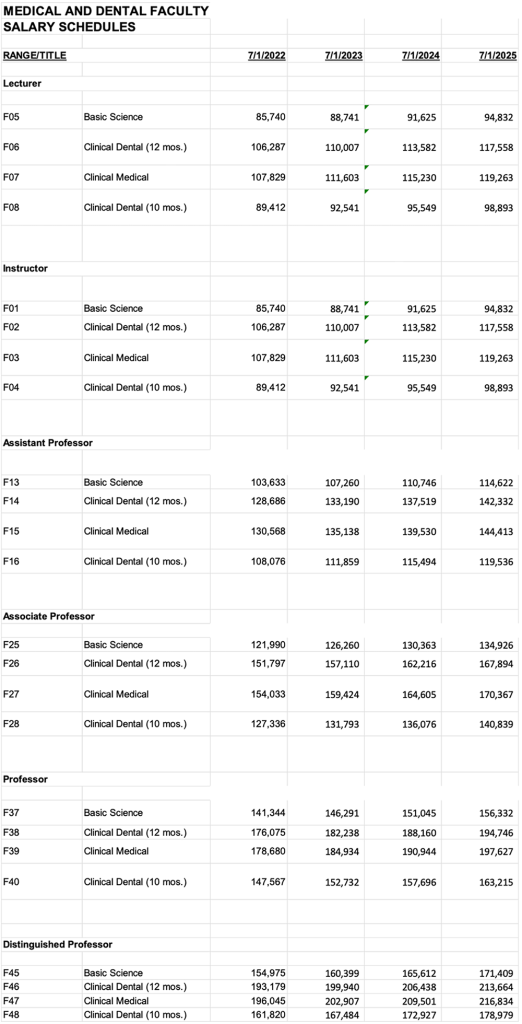
Appendix L – Public Health Faculty Salary Schedules
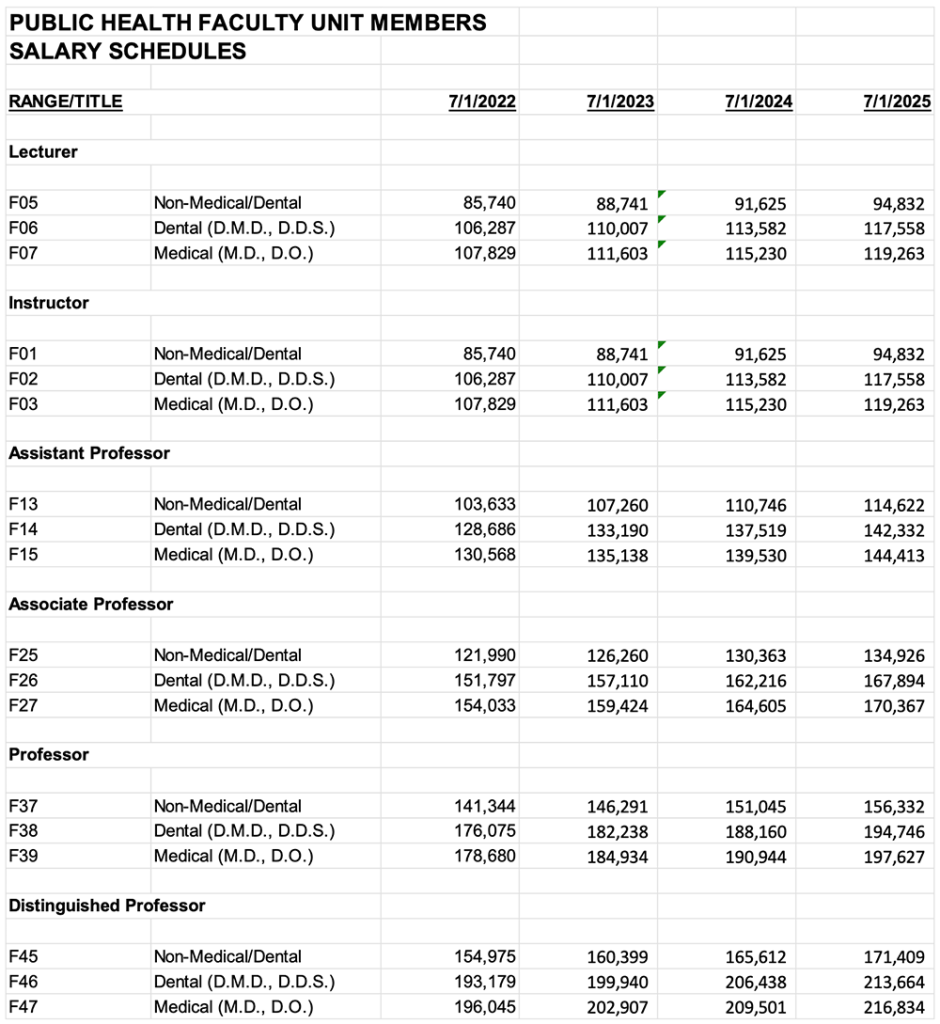
Appendix M – Nursing Faculty Salary Schedules
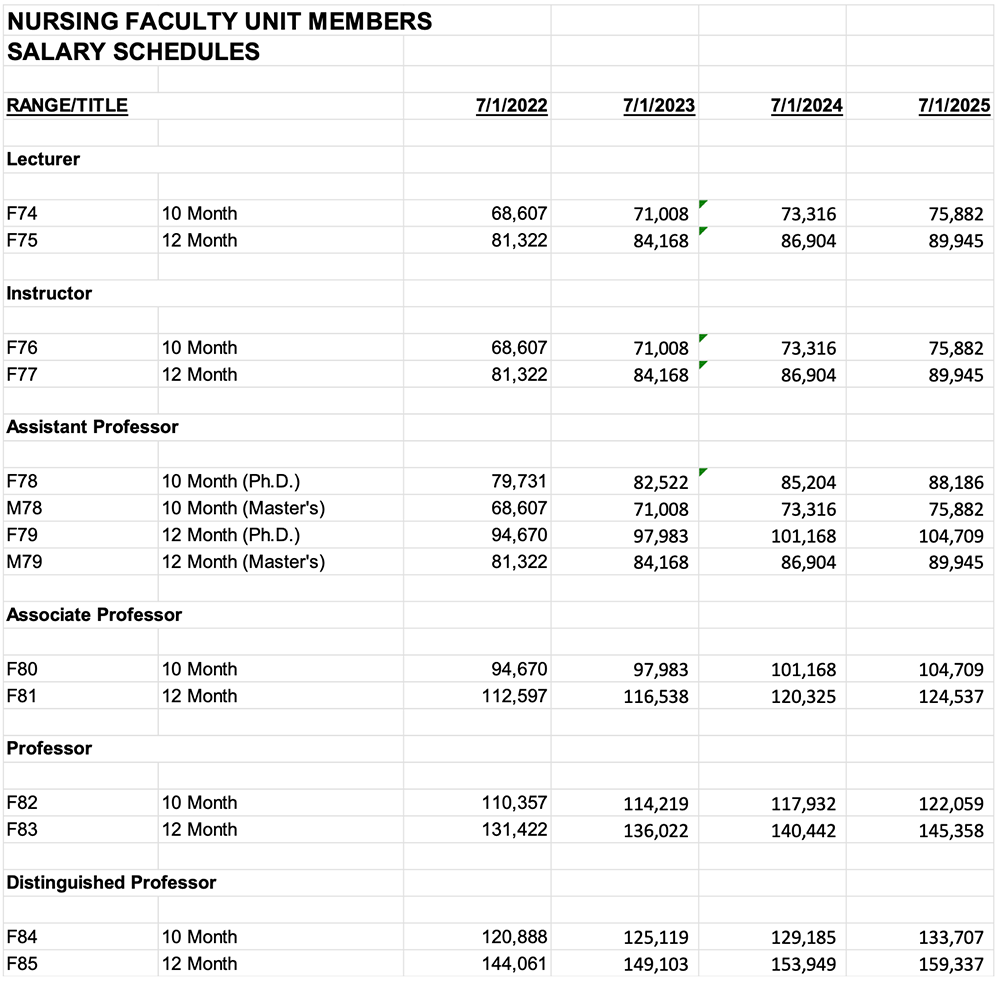
Appendix N – Librarian Unit Members Salary Schedules

Appendix O – SHP Faculty Salary Schedules
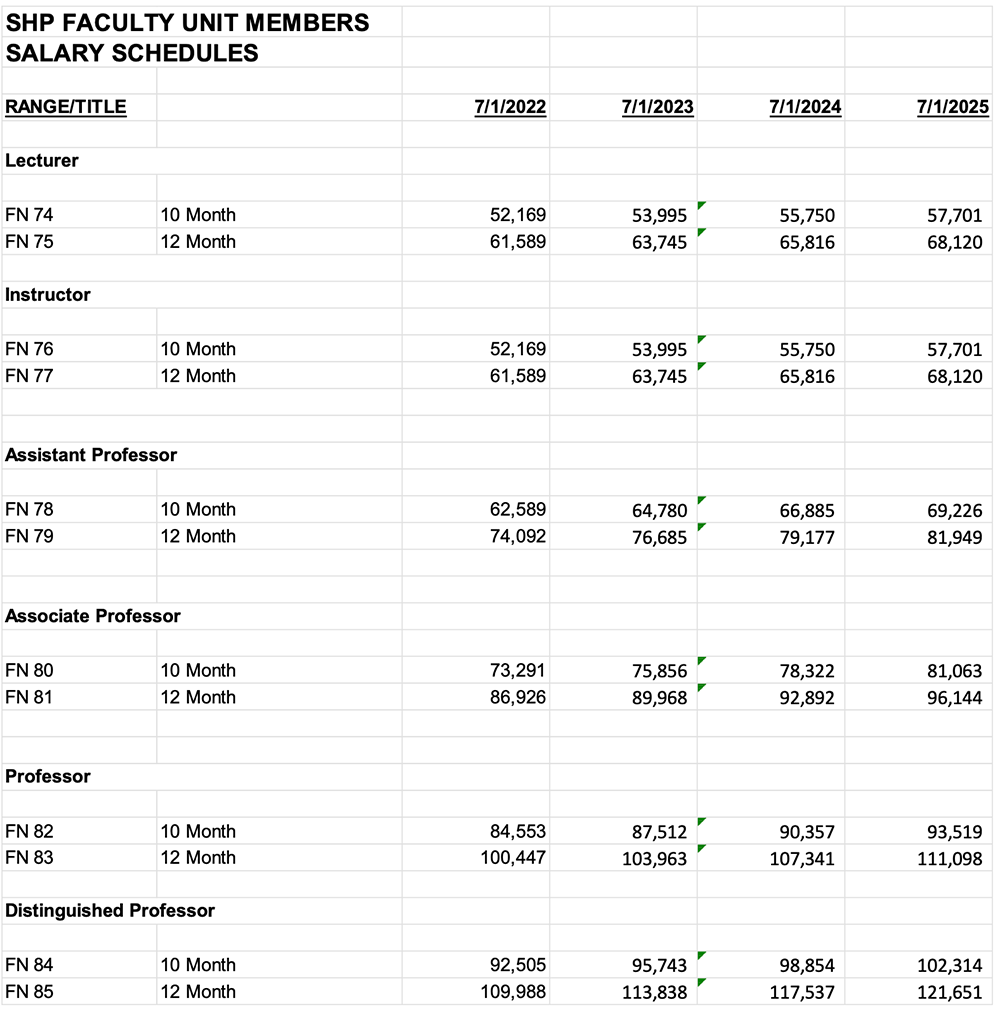
Appendix P – Outside Employment (BHSNJ Unit Members)
(Applies to Legacy BHSNJ Unit Members Only)
OUTSIDE EMPLOYMENT
The outside employment of unit members shall be governed by Rutgers policy 60.9.21 entitled “Outside Employment,” revised on October 10, 2013.
Appendix Q – Faculty Titles (BHSNJ Unit Members)
(Applies to Legacy BHSNJ Unit Members Only)
RBHS Instructor
RBHS Lecturer
Rank of Assistant Professor
Tenured/Tenure Track Titles
Assistant Professor
Non Tenure Track Titles
Assistant Professor, Teaching Track
Assistant Professor, Clinical Track
Assistant Professor, Professional Practice Track
Assistant Professor, Research Track
Rank of Associate Professor
Tenured/Tenure Track Titles
Associate Professor
Non Tenure Track Titles
Associate Professor, Teaching Track
Associate Professor, Clinical Track
Associate Professor, Professional Practice Track
Associate Professor, Research Track
Rank of Professor
Tenured/Tenure Track Titles
Professor
University Professor
Non Tenure Track Titles
Professor, Teaching Track
Professor, Clinical Track
Professor, Professional Practice Track
Professor, Research Track
Rank of Distinguished Professor
Tenured/Tenure Track Titles
Distinguished Professor
Non Tenure Track Titles
Distinguished Professor, Teaching Track
Distinguished Professor, Clinical Track
Distinguished Professor, Professional Practice Track
Distinguished Professor, Research Track
Appendix R – Crosswalk Between Provider Specialty and Benchmark Specialty
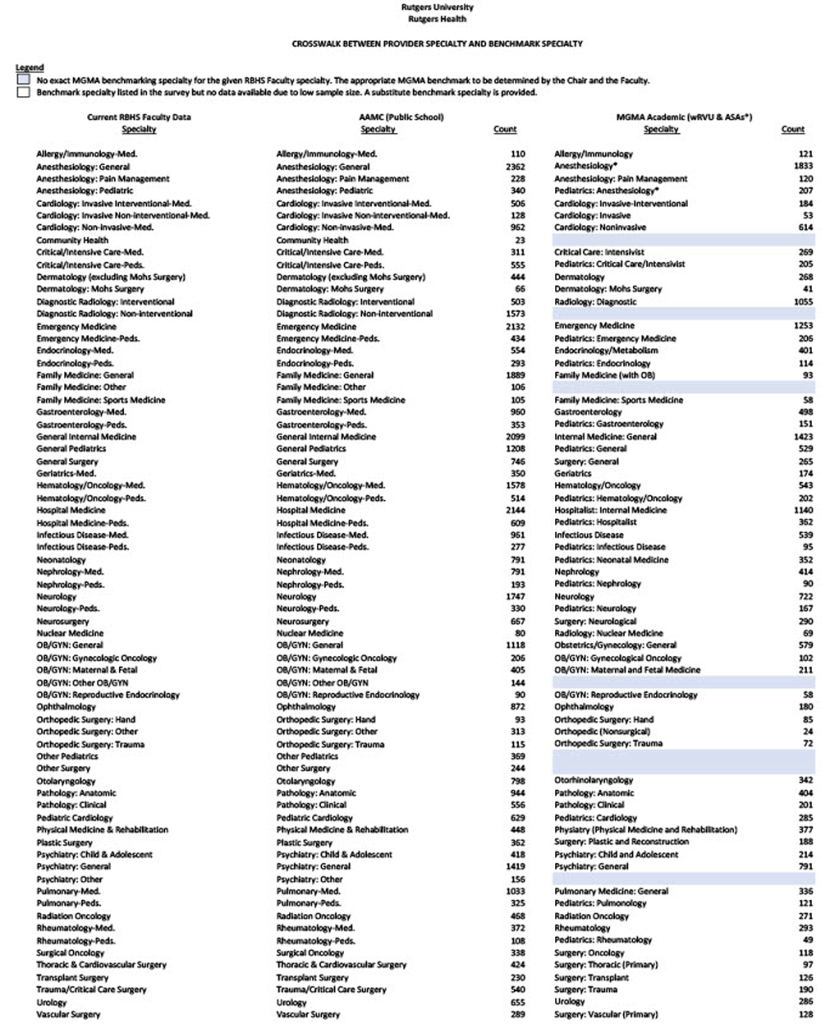
Appendix S – On Academic Freedom and Freedom of Speech
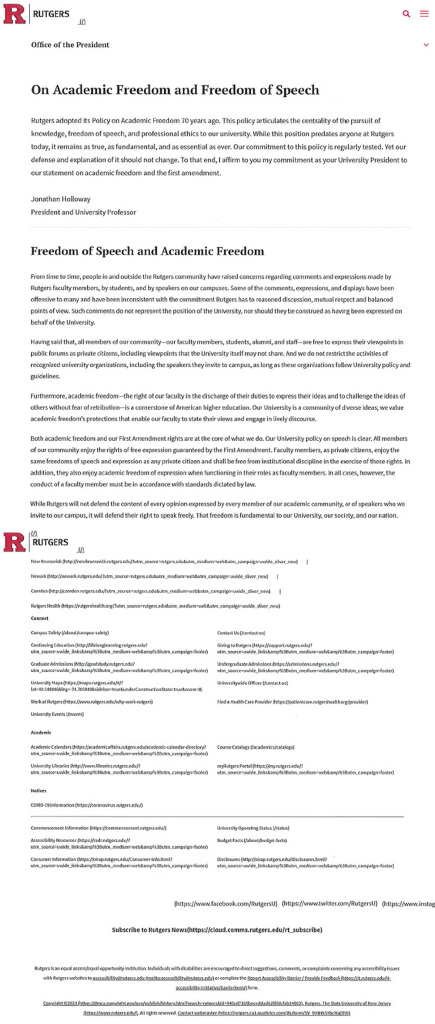
Side Letter Regarding Representation Fees
(Does Not Apply to Legacy BHSNJ Unit Members)
The AAUP-AFT agrees that if a court orders the return of representation fees deducted from the paychecks of non-members by the University and transmitted to the AAUP-AFT, the AAUP-AFT shall be solely responsible for the reimbursement of such fees.
The parties agree that Article VI – Representation Fees, as set forth in the parties’ 2014-2018 collective negotiations agreement is deleted in its entirety in the 2018-2022 agreement.
Side Letter on Caste Discrimination
(Applies to all Unit Members, including Legacy BHSNJ Unit Members)
WHEREAS, major public and private universities around the United States have included caste as a protected classification in their non-discrimination policies; and
WHEREAS, the Union has requested to add “caste” as a protected category to the non-discrimination article in the parties’ collective negotiations agreement;
THEREFORE, the Union and the University agree as follows:
1. The Union agrees to participate on a Task Force on the inclusion of caste as a protected category in the University’s anti-discrimination policies, based on the following description and mission of the Task Force:
Following the conclusion of negotiations, the University agrees to establish a Task Force to examine issues of caste discrimination impacting students and members of negotiations units and the inclusion of “caste” as a protected category in the University’s policies on prohibited discrimination and harassment and best practices to address caste discrimination. The task force will be co-chaired by the SVP for Equity, or designee, and a faculty member designated by the AAUP-AFT. In addition to faculty, staff, and student representation, the Task Force also will include representatives from University Human Resources and the University’s Office of the Senior Vice President and General Counsel. In addition to the co-chair designated by the AAUP-AFT, the Union may designate another faculty member to serve on the Task Force with respect to the impact of adding caste as a protected category to the employment-related policies on prohibited discrimination and harassment that apply to negotiations unit members. In the event that the University adds caste as a protected category to its anti-discrimination policies, caste shall also be added as a protected category to Article 4 of the AAUP-AFT collective negotiations agreement.
2. In its deliberations about whether to add caste as a protected category to the University’s anti-discrimination policies and collective negotiations agreements, the Task Force will consider other instances in which discrimination based on caste has been prohibited, including but not limited to, statutes, policies and collective bargaining agreements.
3. The Task Force shall issue a report, which shall be posted on the University’s website.
4. The University acknowledges that negotiations unit members who are alleged victims of caste discrimination related to their employment, currently may file a grievance under Article 9 alleging a violation of Article 4 under other existing protections, including, but not limited to ancestry, national origin, race, and gender. In addition, negotiations unit members who allege that they are victims of harassment based on caste may file a grievance alleging harassment under Section a.2 in Article 9.
Side Letter Regarding University Indemnification Policy
(Applies to all Unit Members, including Legacy BHSNJ Unit Members)
In deciding whether or not the University’s Indemnification Policy 50.3.3 covers a faculty member who uses social media and other virtual platforms (“virtual platforms”) to communicate, share, exchange and/or create information, ideas, research and scholarship (collectively “communications”), the University’s Senior Vice President and General Counsel will determine whether the faculty member’s communications on virtual platforms fall within the scope of the faculty member’s scholarship, research, service and/or pedagogical duties as a University employee.
Side Letter on Doctoral Fellowships
(Does Not Apply to Legacy BHSNJ Unit Members)
Within thirty (30) days following ratification of the parties’ collective negotiations agreement for the term July 1, 2022 to June 30, 2026, the University will establish a committee to (1) review issues associated with the sufficiency of stipend levels of the various University-funded doctoral fellowships; and (2) make recommendations to the Executive Vice President for Academic Affairs (“EVPAA”) concerning such issues by November 1, 2023. The committee will be chaired by one of the deans of the graduate schools, appointed by the EVPAA, and will include the other deans of the graduate schools, graduate program directors appointed by the EVPAA, doctoral students appointed by the deans of the graduate schools, and two representatives appointed by the AAUP-AFT.
Memorandum of Agreement Regarding Infosilem
(Does Not Apply to Legacy BHSNJ Unit Members)
Memorandum of Agreement between the AAUP-AFT and Rutgers University regarding Course Atlas/Infosilem83
Whereas, Rutgers University (the “University”) is using Course Atlas/Infosilem to schedule courses on all campuses; and
Therefore, the AAUP-AFT and the University agree as follows:
- The terms of this agreement apply toall campuses unless expressly stated otherwise.
- Prior to the development of a class schedule for any fall or spring semester, faculty shall have the opportunity to advise their Chairs of times when they are not available to teach as a result of scheduled University, School, and departmental obligations, including professional obligations relating to service, research and scholarship. If a faculty member has a scheduled University, School, departmental, or other professional obligation (as defined in paragraph #3) that is approved by the Chair, and is not changed by the Dean or head of unit, it shall be accounted for in the scheduling of courses. Where an academic program functions without a Chair, the program director may carry out the duties of the Chair as specified throughout this Memorandum of Agreement.
- University, School, departmental, and other professional obligations include, but are not limited to, regularly scheduled departmental meetings; regularly scheduled School meetings (e.g., meetings of committees identified in the School’s bylaws, Chair meetings, and undergraduate program directors meetings); regularly scheduled University-level meetings (e.g., meetings for active members of the New Brunswick Faculty Council, Promotion Review Committee, and University Senate); regularly scheduled research and scholarship obligations (e.g., regularly scheduled meetings with research partners/team;
,regularly scheduled, fixed research time outside the University; regularly scheduled clinical hours;andregularly scheduled participation as a fellow at research centers; regularly scheduled Departmental and/or School research seminars; and regularly scheduled Departmental and/or School teaching and research seminars. - Faculty who require a reasonable accommodation for a qualifying disability or as a result of a sincerely held religious belief or practice, in accordance with applicable law, shall submit such a request to the Rutgers Office of Employment Equity and comply with the reasonable accommodation process. If an accommodation for a qualifying disability or sincerely held religious belief or practice regarding course scheduling is approved, it shall be accommodated in the scheduling of courses.
- Faculty requiring a leave of absence for personal illness, pregnancy, post-pregnancy, disability, parenting, caregiving, family illness, or family leave shall seek such leave in accordance with Article 16 of the collective negotiations agreement between the AAUP-AFT and the University. If a leave of absence is approved, it shall be accommodated in the scheduling of courses.
- Department Chairs will provide faculty members with their schedules as far in advance as possible, and in accordance with standard departmental practice.
- If a faculty member has an objection to the faculty member’s schedule, the faculty member may raise that objection with the faculty member’s Chair. Chairs shall retain the ability to submit modifications to the schedule under the closed ranks process or to account for a leave of absence, religious or ADA accommodation or professional obligation that is approved after the schedule is created provided the Dean or head of unit does not disagree with the Chair’s request. Chairs shall have the authority to request time/day changes if a newly emergent professional obligation (as defined in paragraph 3) arises for the faculty member, provided the Dean or head of unit does not disagree with the Chair’s request. Chairs shall also have the authority to request time/day changes to accommodate the faculty member’s submitted time/day preferences, provided the Dean or head of unit does not disagree with the Chair’s request. The Chair’s requested schedule changes, as set forth in this paragraph shall be approved unless no room is available at the requested time/day and provided the Dean or head of unit does not disagree with the Chair’s request. If no room is available at the time/day requested, the Scheduling Office will negotiate with the Department Chair to find a satisfactory solution.
- The University shall provide the Union with notice of proposed changes to the guidelines for Rutgers course schedule change requests simultaneous with notification to the department or unit and upon request shall negotiate mandatorily negotiable proposed changes and shall meet and discuss non-negotiable proposed changes with the Union.
- If the faculty member still has an unresolved objection to the faculty member’s schedule following the discussion with the faculty member’s Chair, the faculty member may file an appeal with the Dean or head of unit of the faculty member’s school, who shall make the final determination regarding the faculty member’s course schedule. If the Dean or head of unit denies the appeal, they must inform the faculty member of the reasons in writing within eight (8) working days from receipt of the appeal. In cases where the unresolved objection to the faculty member’s schedule resulted from a decision of the Dean or head of unit, the appeal may be filed with the applicable Chancellor or Chancellor-Provost or designee who shall make the final determination regarding the schedule. If the applicable Chancellor or Chancellor-Provost or designee denies the appeal, they must inform the faculty member in writing within ten (10) calendar days from receipt of the appeal.
- The provisions of this MOA that are mandatorily negotiable may be grieved as Category One grievances under Article 9 of the parties’ collective negotiations agreement. Academic judgments made pursuant to this MOA, that are not mandatorily negotiable, are not grievable.
- This Agreement shall satisfy the obligations of the University and the AAUP-AFT pursuant to paragraph 3 of the Side Letter of Agreement between the AAUP-AFT and Rutgers University regarding Course Atlas/Infosilem.
- The AAUP-AFT represents that it has no pending unfair practice charges or grievances relating to the implementation of Course Atlas/Infosilem and that it will not file any unfair practice charges or grievances relating to the implementation of Course Atlas/Infosilem up to the date of signing of this agreement.
- This agreement is made without any waiver of the University’s rights to assert that the implementation and administration of a course scheduling system is not mandatorily negotiable. This agreement is made without any waiver of the AAUP-AFT’s rights to assert that the implementation and administration of a course scheduling system is mandatorily negotiable.
_____
83. Course Atlas may alternatively be referenced in this MOA as “Course Atlas/Infosilem.”
Memorandum of Agreement Regarding Dissertation Research
(Does Not Apply to Legacy BHSNJ Unit Members)
Rutgers, The State University (“University”) and the Rutgers Council of AAUP Chapters, American Association of University Professors-American Federation of Teachers, AFL-CIO (“AAUP-AFT”) agree as follows.
1. COVID-19 Dissertation Extension Funding (side letter agreement not to be included in the collective negotiations agreement)
A doctoral student may be eligible to apply for up to two additional semesters of stipend or other support to complete their dissertation research due to COVID-19 disruptions. By May 15, 2023, the University will form a COVID-19 Dissertation Extension Funding Committee, chaired by the Deans of the Graduate Schools (or designees) and also will include four members of the faculty serving as graduate program directors (one from each CLU), and four doctoral students (one from each CLU). The members will be nominated by the chancellors and appointed by the EVPAA. Alternates will be identified for cases where doctoral student applicants are enrolled in a committee member’s program.
Doctoral students who have reached the end of their University funding may apply for COVID-19 Dissertation Extension Funding provided they meet the following criteria:
- reached the end of their University funding at the end of the 2022-2023 academic year and do not have access to external funding.
- encountered direct disruption or delays in the completion of their research as a result of COVID-19 that was unable to be addressed through alternate means.
- received the support of their graduate program director for funding extension.
- remained in good academic standing and demonstrated steady progress toward degree completion prior to the pandemic.
Doctoral students may complete an application demonstrating the criteria with documentation for the committee’s review. The committee will review all applications and render a recommendation to the EVPAA (or designee), who will make the final decision.
Funding shall be through TAships, GAships or University-sponsored fellowships. Awards will be announced by June 30, 2023 in writing.
Grants will be administered by the Deans of the Graduate Schools. Recipients will be asked to complete a reimbursement form and attach receipts to receive the grant.
2. The terms of this Memorandum of Agreement are subject to ratification by the AAUP-AFT.
Memorandum of Agreement Regarding Recognition (BHSNJ Unit Members)
(Applies to Legacy BHSNJ Unit Members Only)
- In order to finalize the Recognition Article to be included in the parties’ 2018-202 collective negotiations agreement, the AAUP-BHSNJ (now the AAUP-AFT) agrees to withdraw its request to insert the term “clinical” in the first sentence of the Article.
- The University agrees that the AAUP-BHSNJ represents faculty members employed by the University, who, in addition to their other efforts, such as education, service and research, also treat patients in clinical settings.
- The University and the AAUP-BHSJ further agree that if a dispute arises with respect to the meaning, scope or application of the Recognition Article of the parties’ 2018-2022 collective negotiations agreement, neither the University nor the AAUP-BHSNJ shall introduce into evidence, or otherwise rely upon in any proceeding or before any tribunal: (a) any proposals exchanged between the parties during negotiations for the 2018-2022 agreement; (b) discussions, or minutes or notes reflecting discussions, regarding the Recognition Article either at or away from the negotiations table during negotiations for the 2018-2022 Agreement; or (c) any other communications, including email communications, regarding the Recognition Article that were exchanged during negotiations for the 2018-2022 Agreement.
Memorandum of Agreement Regarding Staff Librarians in the AAUP-BHSNJ
(Applies to Legacy BHSNJ Unit Members Only)
Agreement between Rutgers, The State University of New Jersey and the American Association of University Professors, Biomedical and Health Sciences of New Jersey (AAUP-BHSNJ) and Rutgers Council of AAUP Chapters, American Association of University Professors-American Federation of Teachers, AFL-CIO (AAUP-AFT) Regarding Staff Librarians in the AAUP-BHSNJ
Whereas, Rutgers, The State University of New Jersey (hereinafter “University”) and the Biomedical and Health Sciences of New Jersey, American Association of University Professors (hereinafter “AAUP-BHSNJ”) agreed to a side letter on September 21, 2015 to create a Subcommittee charged with continued negotiations for mandatorily negotiable open issues related to the AAUP-BHSNJ members of Rutgers University Libraries.
Whereas, on January 9, 2017, the Subcommittee agreed to revisions of Article IX (Fringe Benefits), Article X (Librarian Unit Members), and Article XXV (Tuition Remission/Reimbursement) of the collective negotiations agreement. Such agreements were incorporated into the Successor Agreement dated July 1, 2013 – June 30, 2018.
Whereas, on January 9, 2017, such Subcommittee also agreed to a side letter with regard to Librarian unit members which states in part “Librarian unit members will make a determination on or about June 30, 2017 as to whether they remain staff members or will become faculty members. If they choose to become faculty members, the University and the AAUP-BHSNJ will commence negotiations to address provisions other than salary.”
Whereas, the AAUP-BHSNJ, and the Rutgers Council of AAUP Chapters, American Association of University Professors-American Federation of Teachers, AFL-CIO (hereinafter “AAUP-AFT”), the University, and the staff Librarians represented by the AAUP-BHSNJ all agree that the staff Librarians who become faculty members will consent to the transfer from the AAUP-BHSNJ collective negotiations unit into the AAUP-AFT collective negotiations unit effective July 1, 2019, the same date in which he/she becomes a faculty member.
Therefore, the parties agree to the following:
Staff Librarians shall choose one of the two options outlined below. The Librarian will decide no later than 15 working days from the date this agreement is signed by all parties whether he or she wishes individually to remain a staff Librarian in the AAUP-BHSNJ or if he/she would transfer to a faculty position and therefore become a member in the AAUP-AFT, in accordance with the Recognition clause, Article Ill of the Rutgers-AAUP-AFT Agreement. If a Librarian does not exercise his/her decision by this date, the Librarian will remain staff and will continue to be represented by the AAUP-BHSNJ unit.
Option #1 – An AAUP-BHSNJ Librarian will remain staff and shall be entitled to all benefits afforded to him/her as staff consistent with the applicable provisions in the collective negotiations agreement dated July 1, 2013 – June 30, 2018 (“2013–2018 AAUP-BHSNJ agreement”) or its successor agreement.
Or
Option #2 – Effective July 1, 2019, an AAUP-BHSNJ staff Librarian shall transfer to a faculty position and therefore become a member in the AAUP-AFT collective negotiations unit.
A staff Librarian transferring to a faculty position will receive an initial three year, tenure-track faculty appointment for the period July 1, 2019 through June 30, 2022 (the tenure clock will begin effective July 1, 2019). The tenure-track titles are as follows:
Librarian III (rank equivalent – Assistant Professor)
Librarian II (rank equivalent – Associate Professor)No later than 30 working days from the date this agreement is signed by all parties, the Vice President for Information Services and University Librarian (“Vice President”) will constitute a committee consisting of at least three Unit Directors to consider the academic rank of each Librarian pursuant to the criteria for appointment, reappointment and promotion for the Librarian title series according to Academic/Reappointment Promotion Instructions for University Library Faculty. Prior to this date, each Librarian transferring to a faculty position will submit the following materials to the Vice President: current curriculum vitae and any other documents he/she wishes to be considered by the committee. The committee will review the material submitted and will make recommendations to the Vice President as to the appropriate academic rank of each Librarian. The final decision with respect to academic rank will rest with the Vice President and shall be final and binding and is not subject to the grievance procedure.- With regard to compensation, a staff Librarian transferring to a faculty position effective July 1, 2019 will be entitled to:
- Any compensation increases effective on or before June 30, 2019 as negotiated as part of the collective negotiations agreement between Rutgers and the AAUP-BHSNJ that will take effect July 1, 2018 (“7/1/18 AAUP-BHSNJ agreement”), provided he/she was a member of the AAUP-BHSNJ negotiation unit on the date designated by the agreement, continues to be a member of either the AAUP-AFT or AAUP-BHSNJ negotiation unit through the date of payment, and otherwise meets the eligibility requirements for those increases as described in the agreement. He/she will not be entitled to any compensation increases effective on or after July 1, 2019 that are provided for in the 7/1/18 AAUP-BHSNJ agreement.
- Any compensation increases that are effective on or after July 1, 2019 as negotiated as part of the collective negotiations agreement between Rutgers and the AAUP-AFT that will take effect July 1, 2018 (“7/1/18 AAUP-AFT agreement”), provided he/she was a member of either the AAUP-AFT or AAUP-BHSNJ bargaining units on the date(s) designated by the agreement, continues to be a member of the AAUP-AFT negotiation unit through the date of payment, and otherwise meets the eligibility requirements for those increases as described in the agreement. However, he/she will not be entitled to any compensation increases effective on or before June 30, 2019 that are provided for in the 7/1/18 AAUP-AFT agreement.
- A staff Librarian transferring to a faculty position understands that he or she is voluntarily relinquishing the rights, benefits, and privileges he or she has as per the AAUP-BHSNJ collective negotiations agreement. Instead, such Librarian will have all the same rights, benefits, and privileges concerning his/her terms and conditions of employment as any other Librarian faculty member of the AAUP-AFT unit.
- AAUP-BHSNJ understands and agrees that Librarians who elect to become faculty members will no longer be a part of the AAUP-BHSNJ collective negotiations unit. AAUP-AFT and the University understand and agree that these Librarians will become a part of the AAUP-AFT unit and AAUP-AFT shall become their exclusive representative.
- A Librarian interested in becoming a faculty member may review a copy of the criteria being used in making decisions for evaluating faculty for a rank with tenure before he/she makes a decision on whether to become faculty.
- A Librarian interested in becoming a faculty member may review a copy of the AAUP-AFT collective bargaining agreement before he/she makes a decision on whether to become faculty.
- Consistent with University policy, if successfully reappointed, faculty members will have a six-year probationary period, at the end of which they shall be evaluated for tenure. If such evaluation is not successful, the Librarian shall receive a one-year terminal appointment.
- Prior to July 1, 2019, Librarians will receive an appointment letter outlining the terms and conditions of their faculty appointment.
- Tenured and tenure-track Librarians will be evaluated for reappointment and promotion in accordance with the Academic Reappointment/Promotion Instructions for University Library Faculty in effect at that time.
- When evaluating tenure track Librarians for reappointment, promotion, and/or tenure, the various levels of review shall take into· consideration the Librarians’ accomplishments and service contributions to the institution that occurred prior to their becoming faculty members, in accordance with the applicable Academic Reappointment/Promotion Instructions for University Library Faculty in effect at the time of evaluation.
- Librarians on the tenure-track will be effectively mentored while on the tenure-track. This includes being assigned a mentor and having their work product periodically reviewed in relation to the criteria needed for tenure.
- Librarians newly hired or transferred into the negotiations unit on or after June 30, 2018 shall be considered faculty, and only afforded “Option 2” of this Agreement.
- The Rutgers Biomedical and Health Sciences Policies and Guidelines Governing Appointments, Promotions, and Professional Activities of the Faculty shall not apply to Librarians.
For the AAUP-BHSNJ – Dated 5/7/19
For AAUP-AFT – Dated 5/9/19
For Rutgers University – Dated 5/7/19
Side Letter of Agreement Concerning Restrictive Covenants
(Applies to Legacy BHSNJ Unit Members Only)
- During negotiations for the parties’ 2018–2022 collective negotiations agreement the University and the AAUP-BHSNJ (now the AAUP-AFT) exchanged proposals with respect to the application of restrictive covenants to negotiations unit members, but were unable to reach agreement.
- The parties recognize that there is a grievance pending arbitration regarding the application of restrictive covenants to negotiations unit members.
- The AAUP-BHSNJ acknowledges that the University denies the merits of the grievance.
- Following negotiations for the parties’ 2018-2022 collective negotiations agreement, the parties shall continue to meet regarding the application of restrictive covenants to negotiations unit members in an effort to reach agreement and resolve the pending arbitration.
- If the parties are unable to reach agreement on the application of restrictive covenants to negotiations unit member, AAUP-BHSNJ and the University shall retain all rights and defenses with respect to the pending grievance, which the AAUP-BHSNJ has sought to pursue in arbitration. In addition, the parties retain their respective positions concerning the negotiability of the application of restrictive covenants to negotiations unit members.
Side Letter of Agreement Concerning CO-2019-189 and the Use of Unmodified Titles
(Applies to Legacy BHSNJ Unit Members Only)
- The parties acknowledge that there is a pending unfair practice charge before PERC, Docket No. CO-2019-189.
- Nothing in the Policies and Guidelines Governing Appointments, Promotions and Professional Activities of Faculty (the “Guidelines”) or this Side Letter, agreed to by the AAUP-BHSNJ (now the AAUP-AFT) and the University during negotiations for the parties’ 2018-2022 collective negotiations agreement, waives the right of the AAUP-BHSNJ to pursue pending unfair practice charge CO-2019-189.
- The parties acknowledge that the University and various unions representing certain Rutgers employees, including AAUP-BHSNJ, have been meeting with respect to the Master Affiliation Agreement (MAA) between the University and RWJ Barnabas Health (RWJBH). During those meetings, the University and the representative Unions have exchanged proposals. Following the ratification of the 2018-2022 collective negotiations agreement between the University and the AAUP-BHSNJ, the University agrees to continue to meet and negotiate with the AAUP-BHSNJ with respect to mandatorily negotiable terms and conditions of employment relating to the impact of the implementation of the MAA. The parties understand and agree that neither party waives its position with respect to the classification of such negotiations.
Side Letter of Agreement Concerning Termination for Cause
(Applies to Legacy BHSNJ Unit Members Only)
- The AAUP-BHSNJ (now the AAUP-AFT) and the University have entered into a 2018-2022 collective negotiations agreement that includes a Termination for Cause article that requires the University to provide the AAUP-BHSNJ with certain information relative to the termination of a unit member.
- The parties agree that the Termination for Cause article does not limit the right of the AAUP-BHSNJ under the Employer-Employee Relations Act to request information in addition to the information provided by the University pursuant to the Termination for Cause article. Such requests, however, shall not serve to alter any of the timelines set forth in the Termination for Cause article.
Side Letter of Agreement Concerning Eligibility to Participate in Rutgers University Alternate Benefit Program and Trust
(Applies to Legacy BHSNJ Unit Members Only)
Effective January 1, 2018, employees in the AAUP-BHSNJ (now the AAUP-AFT) negotiations unit will be eligible to participate in the Rutgers University Alternate Benefit Program and Trust (“ABP Trust”). Those employees in the AAUP-BHSNJ currently participating in the former UMDNJ Benefits Assistance Program (“BAP”) will have the one-time option to choose, as of January 1, 2018, whether to continue participation in the BAP or to participate in the Alternate Benefit Program going forward from that date. The BAP will not be available to employees hired on or after January 1, 2018.
Side Letter of Agreement Concerning Professor Emeritus/a84
(Applies to Legacy BHSNJ Unit Members Only)
Professor Emeritus/a.: Professor Emeritus/a is a title restricted to persons who retire after having served in a full-time professorial capacity at this University ten years or more, or as a full professor at this University for at least five years, plus a sufficient number of years in a professorial capacity in another accredited university or college to make a total of at least ten years. The titles Associate Professor Emeritus/a or Assistant Professor Emeritus/a are not used, all persons entitled to the Emeritus/a designation being “promoted” to Professor Emeritus/a at the time of their retirement. Faculty designated Professor Emeritus will receive all benefits associated with that title.
_____
84. The Emeritus criteria as identified in this Side Letter apply to all unit members who retired after July 1, 2013.
Side Letter of Agreement Regarding Patient Care Supplements
(Applies to Legacy BHSNJ Unit Members Only)
The University agrees that in letters of appointment to faculty who will receive patient care supplements as part of their salaries, the amount of the patient care supplement will be specified along with information that such supplements are not subject to the across-the-board alary increases specified in Article VIII, Section 1 of the Agreement.
Memorandum of Agreement Regarding Faculty Transition to Retirement Program
(Applies to Legacy BHSNJ Unit Members Only)
Rutgers Faculty Represented by AAUP-BHSNJ Application for Faculty Transition to Retirement Program (FTTRP)
I. DESCRIPTION OF THE FACULTY TRANSITION TO RETIREMENT PROGRAM: This Faculty Transition To Retirement Program (“FTTRP”) is a faculty voluntary transition program. Faculty members who meet the eligibility criteria set forth below will have an opportunity to apply to participate in the FTTRP. Participating faculty members will relinquish their tenure by way of retirement in exchange for a term contract as set forth below.
II. FACULTY TRANSITION TO RETIREMENT PROGRAM ELIGIBILITY: The FTTRP is available only to faculty members who meet the following minimum requirements.
- Must be a full-time tenured faculty member at Rutgers Biomedical and Health Sciences (“Rutgers” or “University”).
- Must be a member of the Alternate Benefit Program (“ABP”).
- Must be at least 55 years of age on June 30 of the year in which the application is made.
- Must have at least 10 years of service at Rutgers on June 30 of the year in which the application is made. For purposes of this criterion, service for both full semesters of the academic year shall constitute one year of service.
III. FACULTY TRANSITION TO RETIREMENT PROGRAM APPLICATION AND ELECTION PERIOD: The annual FTTRP election period shall be the period between the date in the spring semester on which distribution to eligible faculty of FTTRP documents is made and the date on which completed applications are due in the dean’s office. Eligible faculty members wishing to participate in the FTTRP must file the Application and Election Form provided by the University during this period. Forms must be received by the faculty member’s dean on or before 4:30 PM on April 1 of the year in which the application is made.
IV. EFFECTIVE DATE OF TENURE RELINQUISHMENT: The effective date of tenure relinquishment shall be July 1 of the academic year following the faculty member’s application. Faculty members shall also separately submit promptly an Application for Retirement Allowance. The form should be submitted to University Human Resources Benefits Department whose telephone number is 848-932-3990. The form is available on the University Human Resources website (http://uhr.rutgers.edu).
V. TENURE RELINQUISHMENT AND RELEASE: The FTTRP Application and Election Form shall contain: 1) notice that the faculty member is officially retiring from the University effective July 1 of the academic year following the faculty member’s application, 2) an application for re-employment under the terms of this FTTRP, 3) an agreement that the faculty member relinquishes tenure effective on the effective date of the faculty member’s retirement, and 4) a general release.
VI. TERM OF RE-EMPLOYMENT CONTRACTS AT INCEPTION OF FTTRP: Eligible faculty members who apply for and are approved to participate in the FTTRP will announce their retirement and then enter into a re-employment contract of up to three years; provided, however, that there shall be no such re-employment contract with a term longer than one year that expires on or after [the date that is five years after the effective date of N.J.A.C. 17:7-8.11, as amended], and any such re-employment contract with a term longer than one year that purports to expire on or after [the date that is five years after the effective date of N.J.A.C. 17:7-8.11, as amended] shall be deemed to expire on [the date that is five years after the effective date of N.J.A.C. 17:7-8.11, as amended], and neither the faculty member nor the AAUP-BHSNJ shall have any right or recourse;
VII. TERM OF RE-EMPLOYMENT CONTRACTS ON AND AFTER [the date that is five years after the effective date of N.J.A.C. 17:7-8.11, as amended]: As of [the date that is five years after the effective date of N.J.A.C. 17:7-8.11, as amended], eligible faculty members who elect and are approved to participate in the FTTRP will announce their retirement and then enter into a re-employment contract of up to one year.
VIII. WORKLOAD AND COMPENSATION: The terms of re-employment will not exceed 50 percent of a full-time faculty load, as approved by Rutgers. Compensation shall be proportional with the re-employment employment assignment approved by Rutgers, not to exceed 50 percent of the faculty member’s final year’s academic base salary. As retirees, participating faculty have no claims of tenure or other rights and/or obligations of a tenured member of the faculty.
IX. EMPLOYMENT STATUS: Faculty participating in the FTTRP on or after May 1, 2023 shall be included and/or remain in the collective negotiations unit. Participating faculty members shall continue to be subject to the rules, regulations and standards applicable to faculty members. Suspension or termination of a participating faculty member’s employment pursuant to the applicable rules, regulations and standards shall have the same effect upon the faculty member’s compensation as applicable to other non-tenured faculty members. All re-employment contracts shall be reported to the AAUP-BHSNJ within 30 calendar days of execution.
X. Effective Date: July 13, 2015
Side Letter on Dues
(Applies to Legacy BHSNJ Unit Members Only)
The AAUP-AFT and the University agree to change the dues system for Legacy BHSNJ Unit Members to a percentage system as specified in the AAUP-AFT’s January 11, 2023 letter to the University no later than July 7, 2023.