
Update: CFUP doctors have won! Of the more than 150 CFUPs eligible to vote in an April election supervised by the National Labor Relations Board, an overwhelming majority voted “Union YES” to officially become part of their union—AAUP-BHSNJ, the biomedical faculty union—representing physician faculty at RWJMS/RWJUH and other RBHS facilities across New Jersey.
Now all physician faculty to work together to improve conditions for ourselves, our students, and our patients! If you’re a CFUP, we ask you to fill out this bargaining survey to help your elected union negotiators know what you, as union members, want to see improved about your working conditions.
You can still consult the FAQ below for answers to your questions.
CFUPs: Click here to sign a union card (if you haven’t already).
Learn about the benefits of joining the CFUP doctors’ union by clicking here.
Click here for a slide deck from a recent union town hall that also answers many of your questions.
See below for answers to your questions about the CFUP doctors’ union. Just click on any question to see the answer.
1. What is a “CFUP” or “90/10” physician faculty?
CFUP stands for Clinically Focused University Practitioner: a physician faculty member with 10% employment at Rutgers University and 90% employment at Robert Wood Johnson Barnabas Healthcare (RWJBH). Most CFUPs work at two local Rutgers units: the Robert Wood Johnson Medical School (RWJMS) and the Cancer Institute of New Jersey (CINJ).
The CFUP physician’s “dual-employee” status creates a lot of confusion, headaches, and workplace inequities for everyone (CFUPs themselves, non-CFUP academic medical colleagues, supervisors, administrative staff, etc).
The position was created during the COVID-19 pandemic for academic physicians to work at RWJMS and CINJ, but without the same union-negotiated rights, benefits, and protections as their 100% Rutgers-employed physician faculty colleagues in the exact same departments and clinics. Because they are technically only 10% Rutgers employees, CFUP physician faculty work right alongside union-represented physicians every day, but do not have the same benefits that are guaranteed by our union contract.
As a union devoted to improving working conditions for academic physicians and biomedical professionals, AAUP-BHSNJ unequivocally objects to the creation of tiers in the workforce.
To the best of our knowledge, there are around 170 CFUPs in academic medical departments (see below) at Rutgers—almost all MDs and DOs, with a few PhDs, according to hundreds of conversations physician organizers have had so far.
2. Which Rutgers departments at RWJMS and CINJ have CFUP physicians?
CFUP stands for Clinically Focused University Practitioner: a physician faculty member with 10% employment at Rutgers University and 90% employment at Robert Wood Johnson Barnabas Healthcare (RWJBH). Most CFUPs work at two local Rutgers units: the Robert Wood Johnson Medical School (RWJMS) and the Cancer Institute of New Jersey (CINJ).
These Rutgers departments at RWJMS/CINJ have CFUP physicians:
- Anesthesiology and Perioperative Medicine
- Cancer Institute of New Jersey
- Emergency Medicine
- Family Medicine and Community Health
- Medicine
- Neurology
- Neurosurgery
- OB/GYN
- Orthopaedic Surgery
- Otolaryngology – Head and Neck Surgery
- Pathology and Laboratory Medicine
- Pediatrics
- Psychiatry
- Radiation Oncology
- Surgery
These Rutgers divisions at RWJMS/CINJ have CFUP physicians:
- Medicine:
- Allergy, Immunology, and Infectious Disease
- Cardiology
- Endocrinology
- Gastroenterology and Hepatology
- General Internal Medicine
- Nephrology
- Rheumatology
- Pulmonary and Critical Care Medicine
- Family Medicine:
- Hospital Medicine
- Pediatrics:
- Cardiology
- Critical Care
- Emergency Medicine
- Endocrinology
- General Pediatrics
- Genetics
- Immunology, Allergy, & Infectious Disease
- Neonatology
- Neurology
- Pulmonary
- RU CARES (Center for Autism Research, Education & Services)
- Surgery:
- Acute Care Surgery
- Cardiac Surgery
- Colorectal Surgery
- General Surgery
- Pediatric Surgery
- Plastic Surgery
- Thoracic Surgery
- Urology
- Vascular Surgery
As you can see CFUP physicians cover a wide swath of the clinical academic work at Rutgers!
3. What are the main differences between CFUP physician faculty and 100% Rutgers-employed physician faculty?
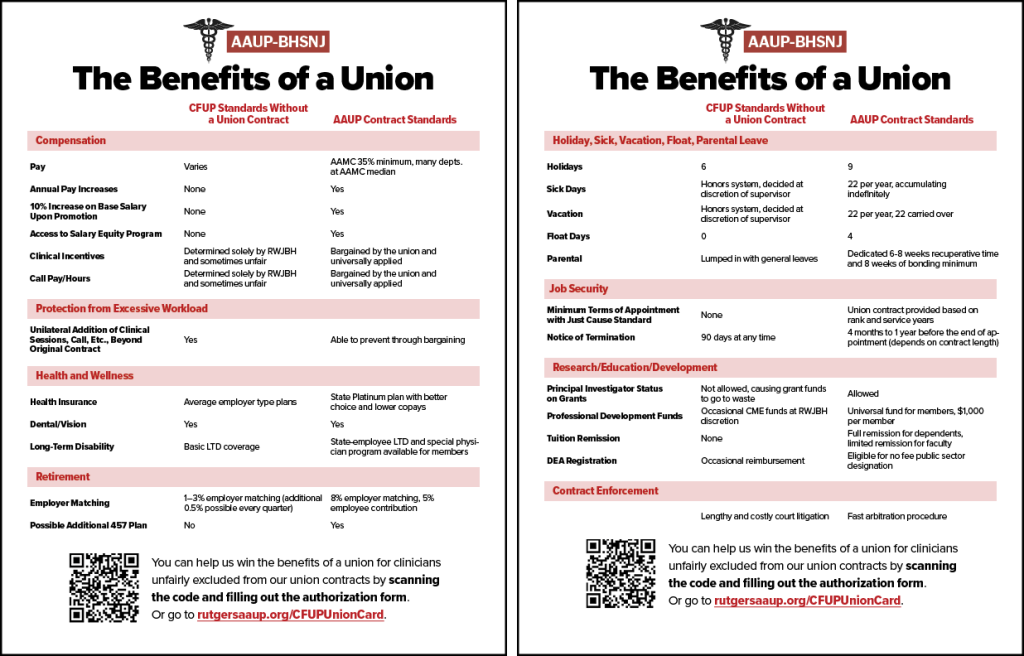
By coming together in our union, Rutgers physician faculty have won guaranteed annual raises, health care and retirement benefits, job security, workload protections, tuition remission, professional development, and other benefits. By joining the union, CFUPs can win these things, too!
Click here to see the flyer at full size
4. Why should CFUP physicians unionize? What is a labor union (or trade union)?
A union is a group of employees who democratically come together to use their strength in numbers to change what they want to change about their workplace.
They do so through collective bargaining with their employer, resulting in a legally binding union contract that improves pay, benefits, and working conditions. It’s as simple as that.
Physicians have a lot of labor market power to bargain for good wages, benefits, and working conditions on their own. However, there is greater strength in numbers and unity.
As with many instances of patient care, each individual doctor is not as effective as all the physicians working together. By organizing together in our union, AAUP-BHSNJ, physicians at Rutgers have been improving clinical working conditions for over half a century, in each and every medical department, division, and section and so wants every clinician at the hospital to similarly benefit now and going forward.
5. What is AAUP-BHSNJ?
The American Association of University Professors-Biomedical and Health Sciences of New Jersey is a labor union representing 1,650 biomedical faculty (and growing!) at the Rowan-Virtua School of Osteopathic Medicine and the following Schools at Rutgers University:
- Robert Wood Johnson Medical School (RWJMS)
- Cancer Institute of New Jersey (CINJ)
- New Jersey Medical School (NJMS)
- Rutgers School of Dental Medicine (RSDM)
- School of Public Health (SPH)
- University Behavioral Health Care (UBHC)
- School of Health Professions (SHP)
- School of Nursing (SON)
Our union is entirely made up of biomedical faculty members at Rutgers and Rowan.
Around 80% of the employees we represent are licensed health care professionals, including physicians, dentists, nurses, and physician assistants. The remaining 20% of members are scientists holding Ph.D.s.
Our union was first established in 1973 at the University of Medicine and Dentistry of New Jersey when the biomedical faculty democratically voted to unionize, forming AAUP-UMDNJ. When UMDNJ merged into Rutgers and Rowan Universities in 2013, we renamed ourselves AAUP-BHSNJ.
In 2023, we merged our union contract with Rutgers AAUP-AFT. This means that, at Rutgers, we bargain together with all the academic clinicians, teachers, and researchers across the Rutgers system: Camden, Newark, and New Brunswick. In total, our combined unions represent 10,000 academic workers across Rutgers.
6. Why are CFUPs unionizing now? Why aren’t CFUPs already part of AAUP-BHSNJ, the union for Rutgers physician faculty?
Physician faculty at RWJMS with 100% Rutgers appointments are already unionized and are part of AAUP-BHSNJ. In 2020, Rutgers and Barnabas created the “CFUP” position to weaken our union and carve certain newly hired physician faculty out of the benefits and protections of our union contract. In reality, of course, CFUPs do much the same work as 100% Rutgers physician faculty in terms of treating patients; teaching med students, residents, and fellows; conducting research; and participating in academic service at the department, school, and hospital level.
Rutgers and RWJBH seek to maximize profit, leaving physicians without a meaningful voice over key workplace issues and patient care. We need adequate resources to do our jobs well, and we need to have the same seat at the table that our 100% Rutgers physician colleagues already have.
In 2024, CFUP physician faculty across departments began the process of organizing to join the union. Now, CFUP and non-CFUP physician faculty are working together to win all CFUPs the same rights, benefits, and protections as the 100% Rutgers-employed physician faculty have.
Indeed, all of the other New Jersey public-sector university and college faculty (RWJMS, NJMS, the rest of Rutgers, Rowan, the NJ Institute of Technology, Montclair State University, Kean University, the County Colleges, etc.) are unionized.
When Rutgers/RWJBH hires physicians as CFUPs rather than Rutgers faculty, this divides our physician workforce. We see this as union-busting, which undermines our half-century of physician collective bargaining, leading to worse wages, benefits, and working conditions, as shown by the flyer in Question 4 above.
Under our 2022–26 Collective Negotiations Agreement, effective May 1, 2023, Rutgers was supposed to stop hiring medical faculty as “CFUPs” and instead hire new faculty as regular, unionized, 100% Rutgers faculty, with all of the benefits and protections of our union contract. However, the Rutgers administration has continued to hire at least some new faculty as “CFUPs.” We filed a union grievance to end this practice; click here to read the grievance. While this grievance is pending, CFUPs are coming together to join the union and secure equal voice and treatment at work!
7. What are the steps for CFUPs to unionize and win a contract? Where are we at in the process?
The purpose of joining together in a union is for CFUP physicians—like our 100% Rutgers colleagues—to have a meaningful, democratic voice in our workplaces.
- Physicians form a diverse organizing committee across departments and divisions to understand workplace issues and make a plan to form a union. DONE!
- A majority of all CFUPs sign union authorization cards indicating they want to unionize with AAUP-BHSNJ. DONE! (But if you’re a CFUP and haven’t signed yet, you still should! The more people who sign, the stronger our union!)
- CFUPs and 100% Rutgers RWJMS Faculty alike sign and send a letter to the Rutgers administration, calling for equal rights, benefits, and protections for CFUPs. DONE!
- Our union files a petition for a union election with the National Labor Relations Board (NLRB). DONE!
- The National Labor Relations Board (NLRB) schedules a union representation election! The NLRB will mail ballots to CFUPs on April 10; these ballots must be mailed back in time to be at the NLRB’s Newark office by end of business on April 28. If a majority of those who participate in the election vote “YES” to unionize with AAUP-BHSNJ, you win—and CFUPs will be part of the union!
- After winning a union election, an elected CFUP committee, supported by existing RWJMS faculty colleagues and union staff, will negotiate a contract with the Barnabas and Rutgers administrations. This could involve “converting” CFUPs to 100% Rutgers roles or negotiating an aligned union contract. Which alternative we pursue will be the decision of the CFUP negotiating committee. We will aim to extend all of the benefits, rights, and protections of the Rutgers union contract to CFUPs and to ensure that CFUPs keep any existing benefits we may have.
- YOU are the union: All CFUP union members will have the opportunity to vote on any conversion agreement/union contract.
8. What will happen to my benefits if we unionize?
The purpose of physicians coming together in our union is to secure our benefits in a union contract and to negotiate for improvements to pay, benefits, and working conditions.
Right now, without a union, CFUPs can lose our benefits at any time, because Barnabas management can simply choose to take these benefits away. They can—and have—even unilaterally lowered some of our colleagues’ pay! With a union, our pay and benefits are legally protected by a union contract. And through bargaining and organizing together, we can win more: better leave policies, fringe benefits, etc.
Negotiating a union contract is a participatory, democratic process. We will elect our CFUP colleagues to a bargaining committee; send out bargaining surveys and hold town halls to figure out what issues are most important to our colleagues; work together to draft contract proposals; and engage in collective action together to win a fair contract. When we reach a tentative agreement, we will all be able to vote on it—either accepting it or going back to the bargaining table. Working together, we will ensure that we negotiate a contract that lifts everybody up and ensures that RWJMS/RWJUH is a great place to work.
9. Will a union prevent me from talking with my supervisor to fix issues?
No. A union is both a shield (to protect physicians) and a sword (to fight for workplace improvements). A union is not a wall built to prevent the good parts of a workplace from functioning as they previously have. All of our union members work collaboratively with their supervisors, but if issues arise, then they work with union representatives to fix problems. Physicians are free to work through issues with their supervisors–but their supervisors are not free to violate our union contract.
10. Won’t a union take away my right to negotiate an individual contract? Won’t it lead to a “one size fits all” approach? Will I lose anything from joining AAUP-BHSNJ?
Not at all! Everyone represented by our union has union contractual minimum standards for their wages, benefits, and job security and also their own individual appointment letter/employment contract. You can ask any of your 100% Rutgers-employed physician colleagues for confirmation of this.
Our union contract—known as a “collective negotiations agreement”—sets a floor, not a ceiling. For instance, the union contract ensures that RWJMS clinical faculty are paid at least at the 35th percentile nationally. But many RWJMS clinical faculty earn substantially more than this! Collective bargaining is an addition to, not a substitute for, individual bargaining between a given physician and their employer.
Indeed, our in-house attorneys and other staff often help unit members with individual employment contracts—for example, with salary issues, pay equity adjustments, etc.
Across the Rutgers AAUP unions (both biomedical and academic), from July 1, 2023 to today, we have won union rights for 367 employees in the academic clinical, teaching, and research workforce. Not a single one of these employees has seen a reduction in their salary or benefits—instead, they have gained the union-won wage raises and benefits listed above in Question 3. And of course, we are also working together every day to negotiate and advocate for further gains—such as ensuring that all faculty are paid fairly for our productivity.
If the Barnabas or Rutgers managements try to say that you can’t finish your individual negotiations because “the union says no,” then please contact us right away, so we can step in and get this corrected. We are a union of, by, and for biomedical faculty—and we want to ensure that all clinical faculty get the best deal that we can and are treated fairly at work.
11. Will Rutgers/RWJBH retaliate against me for supporting a union? What will my chair, director, chief, dean, or supervisor think if I support our union?
Under both New Jersey and federal labor law, your employer or supervisor cannot interfere with you and your colleagues forming a union, retaliate against you, or coercively question you about you and your colleagues coming together in a union. Should a supervisor ask about our union, it is your right to reply, “I do not have to answer that question,” and we would strongly encourage you to let us know about any such conversation.
There have been a wide range of opinions among supervisors toward faculty unionizing at Rutgers/RWJBH, including faculty supervisors being strongly in favor, opposed, or completely neutral. In practice, many faculty physicians at Rutgers who are active in the union—including elected officers—have earned promotions, awards, generous merit raises, and maintain strong relationships with their supervisors.
Additionally, we have strength in numbers. Practically speaking, it would be quite difficult for the Rutgers/RWJBH administration to retaliate against hundreds of physicians who are doing crucial work for the university and hospital each and every day.
12. Don’t contract negotiations take a long time?
Currently, individual employment contract negotiations for some CFUP physicians have taken over 14 months. And with each CFUP negotiating on their own, there is no pressure on Barnabas to move quicker and get things done.
It is true that union contract negotiations can take a long time, but this isn’t because of employees and their unions’ unwillingness to sign a fair deal. We are eager to get CFUP physicians all of the rights, benefits, and protections of their peers, as soon as possible. And if management drags its feet, we can pressure Barnabas and Rutgers to come to the table and sign a fair contract by joining together as RWJMS faculty—and joining together with our colleagues across Rutgers.
13. Do CFUPs make more money than 100% Rutgers-employed physicians?
We would love to be able to answer this question, but RWJBH does not have any salary transparency, so it is impossible to say for certain.
Our unionized physicians make a wide range of salaries, across specialties, academic ranks, bonus structures, etc. Our clinician and physician salaries range between $200,000 and $1 million. The bottom line: our union campaign is about bringing salaries up, not forcing any down—and ensuring that all physicians receive raises that recognize the hard work that we do.
Under our Rutgers union contract, no one can be paid below benchmarks set by the American Association of Medical Colleges Faculty Salary Report for their given rank and specialization (for example, Assistant Professor of Surgery, Associate Professor of Pediatric Infectious Diseases, etc).
We also know from talking to over a hundred CFUPs and looking at dozens of individual employment contracts that CFUP physicians have not been receiving our 10% wage raises with rank promotions (e.g., from Assistant to Associate Professor) or annual wage raises to keep up with the always-rising cost of living. Instead of the annual raise wages that unionized Rutgers physicians receive under the union contract, some CFUPs have even received pay cuts with their successor individual employment contracts, with their only recourse being to leave and work somewhere else. With a union, you always have the power of your coworkers standing with you to prevent that from happening.
14. Who is eligible to join the union?
Any non-supervisory physician faculty can sign up for union membership and representation here (it only takes 30 seconds!). Supervisors are not eligible. This exemption exists because having supervisors in a union with people they have the power to fire would create a sharp power imbalance among union members.
15. Why do union members pay dues?
Winning a union and bargaining a union contract is a resource-intensive process entirely driven by the employees building the union.
Rutgers University has a $5.6 billion budget for Fiscal Year 2024–25, and RWJBH had revenue of $7.1 billion in 2023. The two central administrations are able to spend from this vast wealth to stonewall progress in winning union representation, so we need our own resources in order to change what we want to change. For that reason, AAUP-BHSNJ members pay dues at a rate of roughly $30 to $60 per pay period depending on income, which is affordable. This is the sole source of the finances for this organizing campaign.
Money from dues is used to pay for the things that make our work successful. Dues pay for lawyers to represent us, for our full-time union staffers’ salaries, for megaphones and signs at rallies, for food at social events and meetings, among other things. It is no exaggeration to say that without union dues, we never could have achieved any of the victories that we already have. On average, a unionized workforce makes 16% more in wages than a non-unionized workforce in the same occupation, according to the US Department of Labor’s Bureau of Labor Statistics. Here at Rutgers, by coming together in our union—and paying our dues—faculty have won strong annual raises, with minimum salaries pegged to AAMC benchmarks, 10% raises with promotions, professional development funds, paid parental leave, and more!
16. Can I join a union as a CFUP physician on a visa?
Yes, of course! Your right to join a union is federally protected under American labor law (and under New Jersey labor law) on the same terms as your US citizen or permanent resident colleagues.
17. What is the difference between a union and professional association or faculty senate?
A union engages in collective bargaining with an employer, resulting in a legally binding union contract that improves pay, benefits, and working conditions while professional associations, medical societies, faculty senates, and other organizations engage in non-binding advocacy work.
We frequently work with professional associations, as they are an addition to, rather than substitute for, union representation.
18. Will a union force me to go on strike?
No. Job actions, up to and including strikes, are decided democratically by the union membership votes—you decide collectively with your coworkers if (or when) you will take collective action at work. A strike is a tactic of last resort and requires a lot of preparation to happen and to succeed. In our 51 years of existence as a union, AAUP-BHSNJ has only had one strike authorization vote (with 95% voting in favor of authorization in March 2023) and one strike, lasting five days, from April 10–14, 2023. We did not strike patient-facing duties, but rather refused to perform teaching and administrative/service work.
The net result of the strike was a minimum pay increase of at least 14% across four years; longer employment contract appointments; increases in parental leave; paid time off for less-than-full-time faculty; tenure protections on parity terms with legacy Rutgers (rather than legacy UMDNJ) faculty; a new for addressing salary inequities; and minimum take-home pay pegged to the American Association of Medical Colleges (AAMC) annual salary benchmarks, which yielded significant pay increases for many faculty.